Leading Cuban dissidents see Trump as best shot at change, but want a bigger role
The Trump administration’s pressure campaign on Cuba is probably the best chance for collapsing the country’s repressive, communist regime, high-profile Cuban political activists and survivors of the regime’s prisons told The Hill. But more effort needs to be given to including the Cuban opposition and democratic movement, they added. José Daniel Ferrer, a leading Cuban…
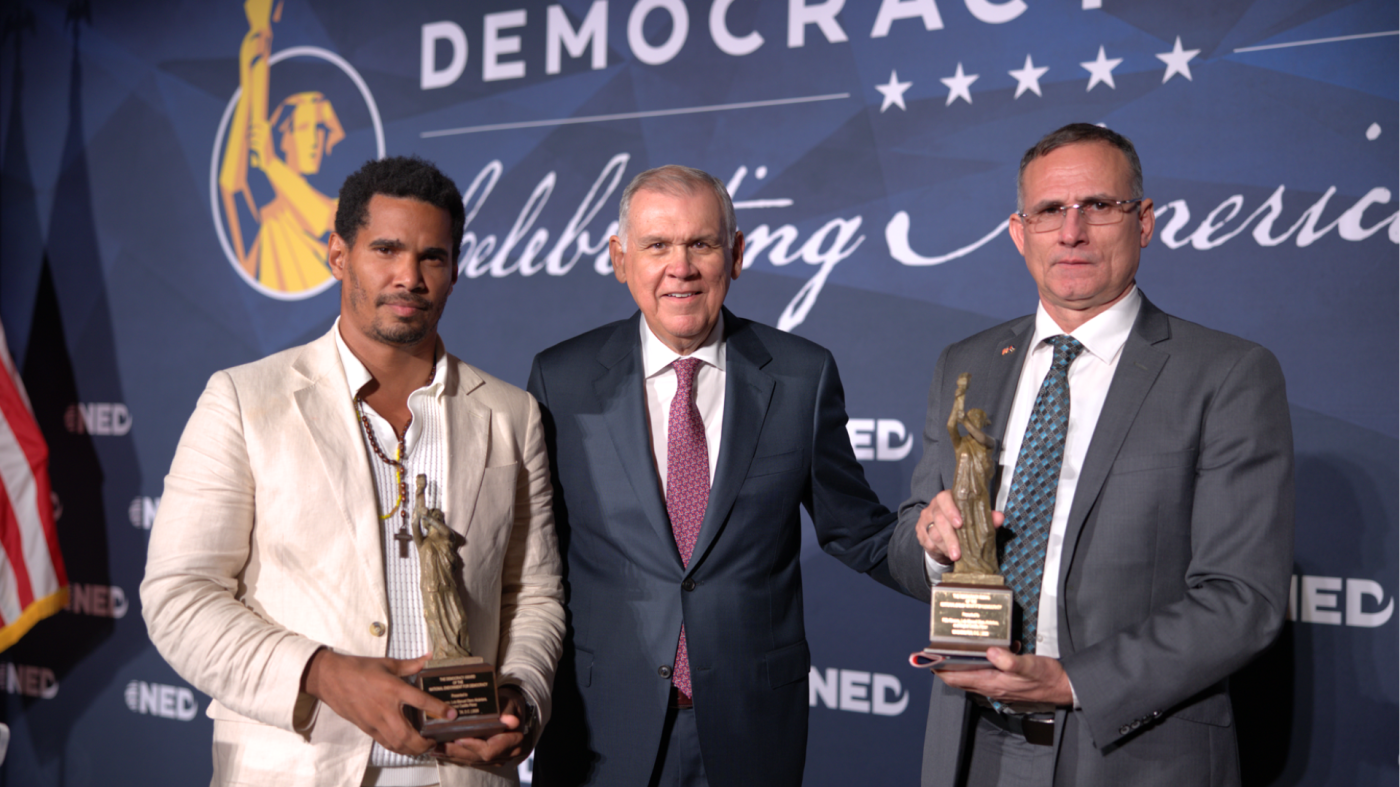
The Trump administration’s pressure campaign on Cuba is probably the best chance for collapsing the country’s repressive, communist regime, high-profile Cuban political activists and survivors of the regime’s prisons told The Hill.
But more effort needs to be given to including the Cuban opposition and democratic movement, they added.
José Daniel Ferrer, a leading Cuban political activist exiled in Miami, and Luis Manuel Otero Alcántara, released in July after five years in a Cuban prison after direct intervention from the U.S., spoke to The Hill last week ahead of their acceptance of the freedom of speech award from the National Endowment for Democracy (NED), a pro-democracy organization funded by Congress.
“This is perhaps the best chance that something will occur,” Ferrer, who was also released from prison in Cuba in October 2025 after demands from the U.S., said of the Trump administration’s pressure campaign.
He said the unprecedented efforts were buoyed by the high discontent among the Cuban people, organizing more than 1,000 spontaneous protests throughout the summer, rivaling the 2021 protest movement that triggered a brutal crackdown, including Ferrer’s arrest.
Alcántara, a prominent political artist, was also a victim of that crackdown. He was arrested in July of that year as a leader in the San Isidro Movement, a group of artists, journalists and activists demanding the right to freedom of speech, inspiring a mass protest movement under the slogan “patria y vida,” or “country and life,” a play on the communist revolutionary slogan “country or death.”
The Cuban government released Alcántara on July 18 under U.S. pressure but also forced him into exile — separating him from his family, friends and political community.
Alcántara said he is still recovering from his time in prison and getting used to the reality of life in exile, describing it as a clash of two sides of the Straits of Florida.
“I am still processing. It’s a difficult process, but I have to do it. Especially because we have to continue working and pushing to achieve freedom in Cuba,” he said.
The regime did not release Maykel “Osorbo” Castillo Pérez, another San Isidro Movement leader and musician, despite U.S. demands . Félix Navarro, a close political partner of Ferrer’s, is also still in jail.
Both men were honored with the NED award, and Alcántara spoke on behalf of his “brother” Pérez, growing visibly emotional.
“I want this award to serve as a monument; it should be engraved on the conscience of everyone here, of injustice being done to him,” he said.
“Today, there are decisions being made about Cuba, and in my opinion, the Cuban opposition, the Democratic movement, the independent artistic movement, is not being fully taken into account,” he told the crowd at Mount Vernon.
“This award will serve as a reminder that that sacrifice needs to be taken into account.”
President Trump said he believes he will have the “honor” of taking over Cuba , signaling his desire for a Venezuela-like relationship with the island that preserves the regime but with a leader compliant to U.S. demands.
Cubans are not necessarily against a U.S.-style intervention similar to the events of Jan. 3, when the American military descended on Caracas to snatch authoritarian President Nicolás Maduro and bring him to New York on an indictment of drug charges, according to Ferrer.
“People wish change so much that, after Jan. 3, many were wishing for something similar to what happened in Venezuela to happen as well in Cuba,” he said.
But negotiations over a possible exit of Cuban President Miguel Díaz-Canel have reportedly stalled. And even if the Trump administration succeeded in changing Cuba’s leadership, its record in Venezuela so far has included empowering Maduro’s vice president, Delcy Rodríguez, to lead the country and prioritizing U.S. control over the country’s oil fields.
Trump has boxed out María Corina Machado, whose party won the last Venezuelan presidential election, and instead hand-picked leaders among the democratic opposition to negotiate with the regime.
Prioritizing economic deals over democratic reforms appeared to be the initial U.S. strategy in Cuba, as well.
The Miami Herald reported Thursday that the U.S. sought control over Cuba’s energy infrastructure to allow American investment to rebuild it and benefit from the import and distribution of gasoline, while also demanding Díaz-Canel flee the island.
It’s not clear whom Trump wants to take power, although the administration has cultivated ties with Raúl Castro’s grandson Col. Raúl Guillermo Rodríguez Castro. But the Herald reported that such talks collapsed and the administration has since ratcheted up its sanctions pressure — announcing new measures about every few weeks since May.
The Cuban government is looking to counteract those measures by imposing economic reforms to open the island up to foreign investment, USA Today reported .
Ferrer and Alcántara both called for the U.S. to internationalize its sanctions campaign on Cuba — bringing in partners from Europe, Latin America, Asia and even the African continent to truly isolate the regime and force change.
“This all stems from a deep understanding that the Cuban regime, without pressure, will not make concessions,” Ferrer said. “They need to be pressured; they need to understand that their behavior will not be tolerated, that there will be consequences.”
“We need their solidarity,” Alcántara said about the international community, citing the regime’s human rights abuses.
There are more than 1,300 political prisoners in Cuba, according to a recent report from Prisoners Defenders . The Trump administration imposed an effective fuel blockade on Cuba in January, exacerbating an already dire humanitarian situation. The population of about 8 million are facing shortages of food, water, electricity and fuel.
“Cuba is a DICTATORSHIP, with all capital letters,” Alcántara said. “It is the epitome of violations of human rights.”
Ferrer and Alcántara represent the diverse range of Cuba’s political opposition across generation, race and profession. Ferrer is a conventional, suit-wearing, Hispanic politician. Alcántara is the Afro-Cuban, casual and stylish artist. Alcántara said the NED award recognizes the importance of both their styles of political engagement.
Both men reflected on their long ties to the NED, where grants from the organization aided and sustained their political campaigning and organizing efforts.
“This award is a symbol of the unity across generations, across race and across geographic distances in Cuba in favor of democracy,” Alcántara said.
“And the different types of ways to do politics, and to engage in politics.”
Topics in this story
Gathered from external sources. Rights to this text belong to whoever originally published it.