The Mandarin in Macaulay's exam hall
Rahul Sagar’s recent column in an English daily , marking Thomas Babington Macaulay's 226th birth anniversary, makes a persuasive case that the open
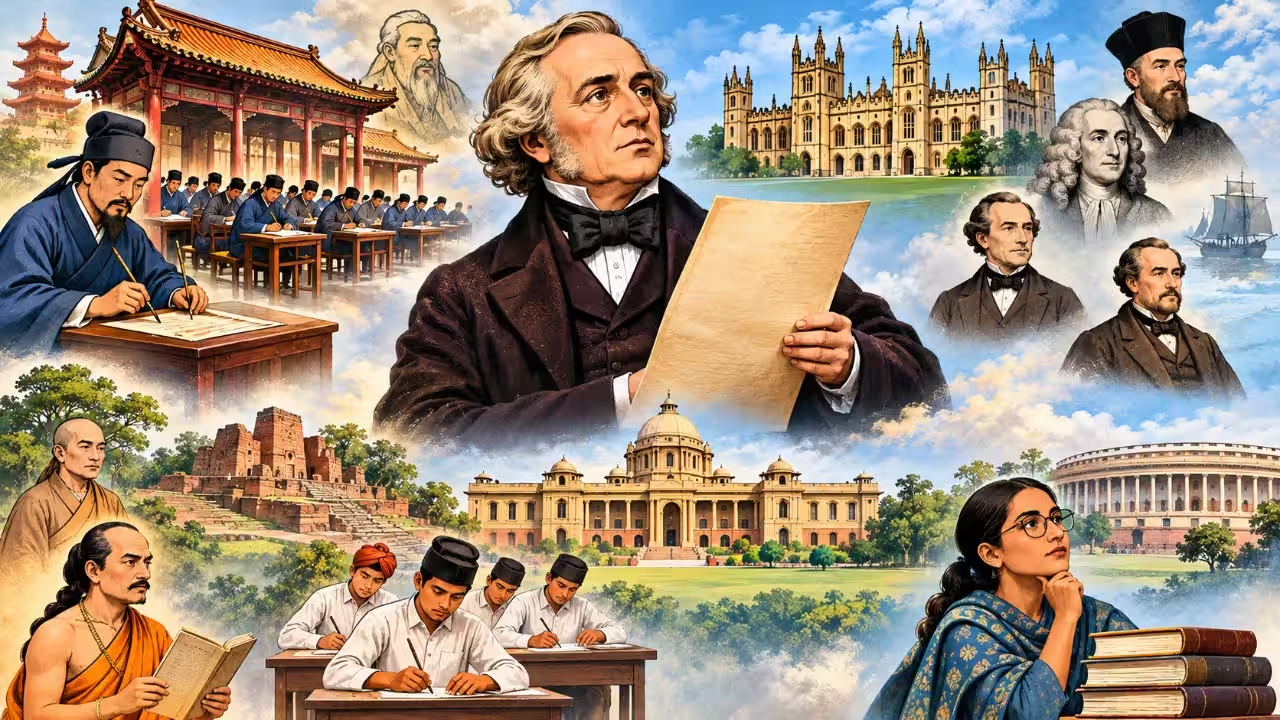
Rahul Sagar’s recent column in an English daily , marking Thomas Babington Macaulay's 226th birth anniversary, makes a persuasive case that the open competitive examination, not the much-maligned 1835 Minute on Education, was Macaulay's most consequential legacy in India. His story runs from Lord Grenville's 1813 proposal, through the failings of Haileybury, to the Charter Act of 1853 and the first open competition for the Indian Civil Service in 1855. In this telling, Macaulay's model was Oxford and Cambridge.What the story leaves out is the oldest and best-documented precedent: China.By the time Macaulay rose in Parliament in 1833, the Chinese imperial examination had been selecting officials for more than twelve centuries. Instituted under the Sui dynasty around 605 CE and expanded under the Tang and Song, the keju system tested candidates on the Confucian classics, ranked them, and sent the successful into the bureaucracy. It was the world's first durable answer to the very problem Macaulay faced: how to staff a vast administration with men chosen for learning rather than connections. It lasted until 1905.This was no obscure precedent. From the early seventeenth century, Jesuit accounts, beginning with Matteo Ricci's journals, described China's examination halls to European readers. Enlightenment writers, Voltaire foremost among them, held up the Chinese mandarinate as a rebuke to Europe's hereditary privilege. By the nineteenth century, the Britons who knew China best were explicit. Thomas Taylor Meadows, an interpreter in the British consular service in China, urged in his Desultory Notes on the Government and People of China (1847) that Britain adopt competitive examinations on the Chinese pattern.The route the idea took matters for India. In a classic 1943 study in the Harvard Journal of Asiatic Studies, the historian Teng Ssu-yu argued that East India Company men familiar with China carried the examination idea into the Company's reforms, so that competition was tried in India before Britain adopted it at home through the Northcote-Trevelyan Report of 1854. That report's co-author, Charles Trevelyan, was a veteran of the Company's Indian service and Macaulay's own brother-in-law. Opponents in Britain knew where the idea came from; critics derided competitive examination as a "Chinese" innovation, unfit for English gentlemen.None of this diminishes Macaulay's role as an advocate. But it changes the story. The examination that produced the "competition-wallah" was not simply a gift that liberal Britain bestowed on India. It was an Asian institution that reached Britain through its Asian empire, and was then administered to Indians as if it were a European discovery.India, too, had traditions of testing learning, though in different forms. The seventh-century Chinese pilgrim Xuanzang reported that at Nalanda, learned gatekeepers questioned would-be students on arrival, and most were turned away. Shastrartha, the formal public debate, was for centuries the arena in which scholarly reputations were won and lost before royal courts. Kautilya's Arthashastra prescribed secret tests, upadha, to assess ministers' integrity before appointment. These were not civil service examinations in the Chinese sense, but they show that the principle that authority should rest on demonstrated ability was hardly foreign to the subcontinent.There is an irony here. Sagar's own scholarship, most recently The Birth of Indian Liberalism, argues convincingly that Indian liberalism was not merely borrowed from Britain but was an indigenous project with its own ambitions. The same corrective applies to the civil service. To credit merit-based selection to Oxbridge and Macaulay alone is to repeat the derivative narrative Sagar has worked so hard to dismantle elsewhere.Why does this matter now? Every year, hundreds of thousands of young Indians sit the UPSC civil services examination. The debates Sagar notes, over cramming, unequal access, and whether examinations select for wisdom or memory, were rehearsed in China for a thousand years before Britain encountered them. Chinese critics complained that the "eight-legged essay" rewarded formula over thought, and reformers repeatedly tried to balance literary polish with practical statecraft. India's examination system would be better understood, and perhaps better reformed, if we recognized it as heir to an Asian tradition and not only to a Victorian one.Macaulay deserves credit for championing competition. But the idea of merit he championed was older, and more Asian, than either his admirers or his critics usually admit. Remembering that is not a rejection of the liberal inheritance; it is a fuller account of it.Disclaimer: Views expressed above are the author's own.
Topics in this story
Gathered from external sources. Rights to this text belong to whoever originally published it.