Quote of the Day by Confucius: "By three methods we may learn wisdom, first, by reflection, which is noblest; second, by imitation, which is...."
More than 2,500 years after his death, Confucius’ ideas continue to shape the way millions of people think about education, family, leadership, morali.
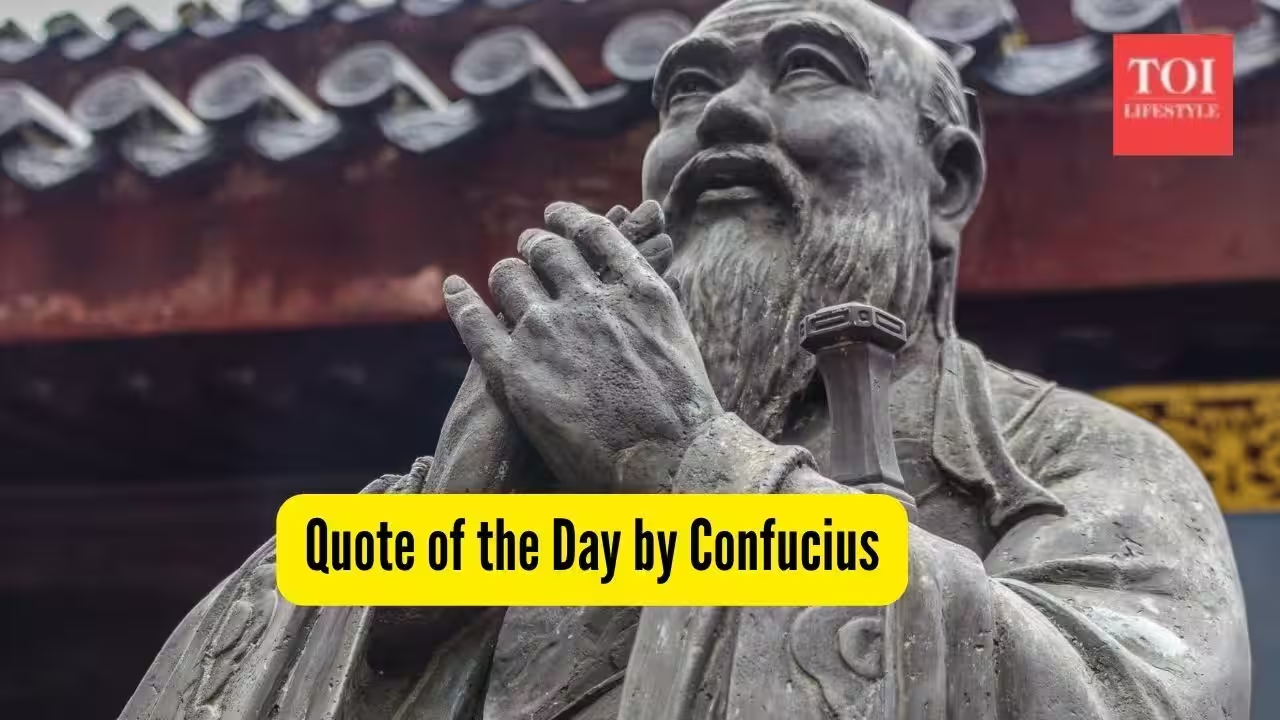
More than 2,500 years after his death, Confucius’ ideas continue to shape the way millions of people think about education, family, leadership, morality and human relationships. Confucius was born in ancient China at a time of political instability and social upheaval. He did not base his philosophy on sweeping theories about the universe. Rather, he was concerned with something much closer to the quotidian, of how human beings should act, how they should treat one another and construct a just society.Chinese Kong Fuzi, or “Master Kong” Confucius was born c. 551 BCE in the state of Lu (now Shandong province, China). Although his family was of the lesser nobility, his early life was troubled by financial difficulties. Confucius’ father died when he was young and Confucius had to work at many different jobs before becoming a teacher. Confucius believed that everyone who wanted to learn should be able to learn, at a time when education was largely reserved for the aristocracy. He taught students regardless of their social background and was said to be a demanding but influential teacher. In his approach to education he did not simply learn facts. He wanted his students to think, to question, to reflect and to grow in character. To Confucius, knowledge without moral character was incomplete.A teacher who changed the definition of wisdomConfucius lived in the Spring and Autumn period, when China was divided into competing states and traditional political and social structures were breaking down. He believed that many of society’s problems stemmed from a lack of morality and responsibility. His answer was not a revolution. It was self-betterment. A stable society begins with individuals knowing their responsibilities to other people, he said. A good ruler should lead by virtue, not by fear. Parents take care of their children, children respect their parents, friends are trustworthy and people act with honesty and consideration.One of the most important ideas he developed was ren, usually translated as “humaneness”, or “benevolence”, or compassion for fellow human beings. Another was li, a generic term for proper conduct, rites, manners and social duties. In these ideas he expressed his belief that a good society is built through everyday behaviour.Confucius also emphasised learning enormously. He did not think wisdom automatically came with age. The individual had to actively seek it out, review mistakes and be willing to get better. This made the teacher-student relationship the center of his philosophy. The right person wasn’t someone who thought they knew everything already, it was someone who was curious and willing to learn.His entry into politicsConfucius did not wish to remain simply a teacher. He also hoped to improve government with his ideas. Eventually he accepted administrative and political posts in the state of Lu, and became involved in efforts to restore order and good government. But rivalries and political differences thwarted his influence. Traditional accounts tell that he then went from state to state, trying to convince rulers to take a more ethical approach to leadership. His political career was not a success story of sweeping reforms as he had hoped. His political failure, in the end, did not diminish his influence.He returned to teaching and continued to study and pass on the traditions of ancient China. His teachings were preserved by his students, and later compiled into the Analects, a collection of conversations, observations and sayings attributed to Confucius and his disciples.Confucius died c. 479 BCE, but his intellectual journey was not over.The philosophy that lasted 2,500 yearsEventually, Confucianism became one of the major intellectual traditions in East Asia. Its influence spread across China, later to Korea, Japan and Vietnam. For centuries, Confucian ideas dominated Chinese education, government, and social life. His emphasis on scholarship and learning had a similar effect on the civil service examination systems that helped decide who could enter the government.Quote of the DayOne of the sayings attributed to Confucius offers a remarkably simple way of understanding how people become wiser: ‘There are three methods for acquiring wisdom: First, by reflection, which is the noblest; second, by imitation, which is the easiest; and third, by experience, which is the bitterest."The first method is that of reflection. Confucius thought that reflection was the highest form of learning, for it involves the stopping to think. We can learn not only from what happens to us but by examining our actions, decisions and beliefs. Thought creates an event to comprehend. A person can make a mistake, for instance, but the mistake in itself doesn’t create wisdom. And they ask me, why did I do that? And that's wisdom. What was I to do? What does this say about myself?This profound consideration of life is what makes reflection “the noblest” path. The second method is the easiest, according to Confucius, and that is imitation. Humans learn in a natural way through watching others. Children learn how to behave by watching their parents. A teacher teaches a student. Young professionals learn from senior colleagues. Sometimes we get better just by finding people we admire and trying to be like them.Imitation can therefore save us making all the mistakes ourselves. If we see someone being patient, brave, disciplined or kind we can learn from their example, without having to find out for ourselves through hard experience. But there’s a limit to imitation: we need to choose our models carefully. To copy blindly is not to be wise. The real value is in seeing admirable behaviour, understanding why it works, and then making it part of our own character.The third way is experience, and Confucius calls this the “bitterest”. This is probably the most recognisable form of learning . We often discover life lessons only after we’ve lived them. Failure can teach you resilience. “Loss can teach us gratitude.” Disappointment can show us who truly has our back. A wrong choice can show us things that no book could have explained better. Experience is a hard teacher because she gives the test first, the lesson afterward.But those lessons can also be all-consuming. So the three methods are in progression. We can learn from our own thoughts, we can learn from the wisdom of others, or we can wait for experience to teach us, sometimes painfully. The deeper message is that wisdom isn’t just a product of growing older. It is derived from listening.One may get older, but not likely wiser if they keep making the same mistake over and over again without learning from it. Another person can learn from looking at someone else’s choices and never make the same mistake.Looking for trusted parenting advice? Follow TOI Parenting Circle on Instagram for expert guidance, relatable stories, and practical tips delivered every day.
Topics in this story
Gathered from external sources. Rights to this text belong to whoever originally published it.