The picture that defines MAGA's midterms loss: A Republican mocked Indian kids watching football. Then Texas turned blue
A viral photograph of Indian students celebrating a football victory becomes the symbol of the Republican Party's unexpected midterm loss in Texas. Explore the political ramifications and racial tensions exposed by Bo French's controversial comments.
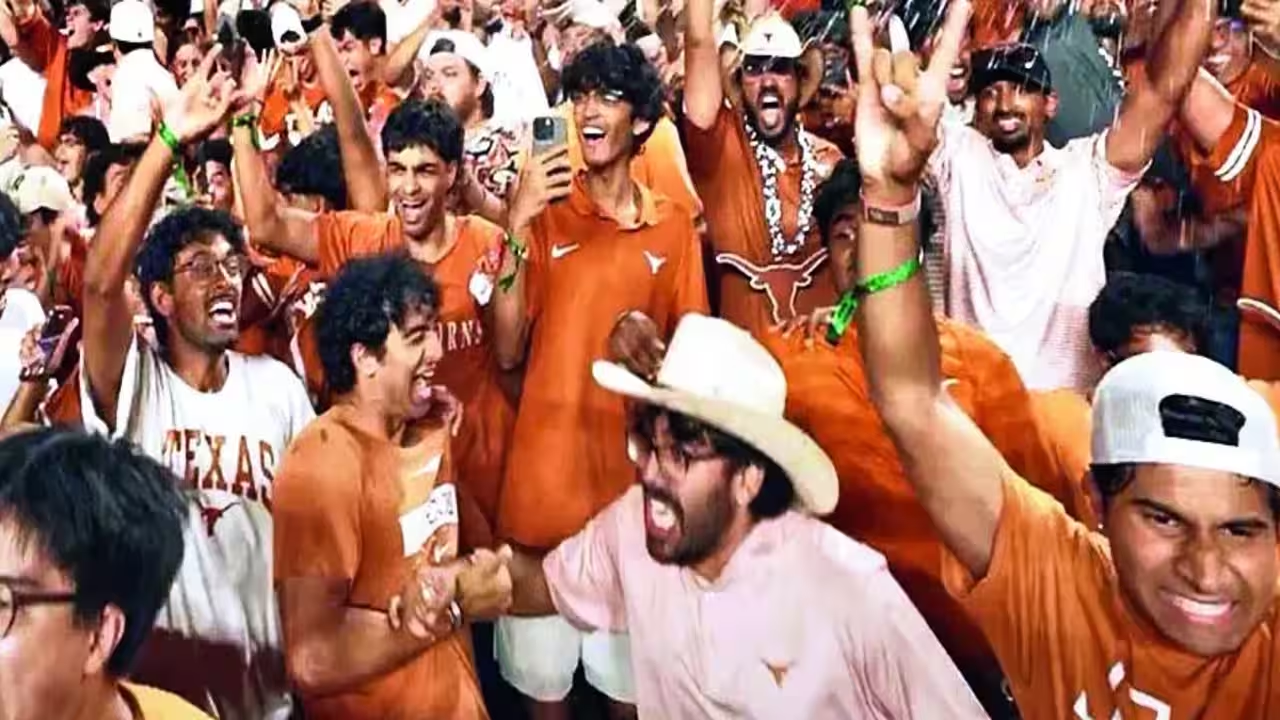
A picture, they say, is worth a thousand words. A bright starry night immediately makes one think of a talented artist who cut off his own ear. A man reaching out to God immediately makes one think of the Sistine Chapel and, with it, the role Christianity has played in being the edifice of modern Western civilisation. And now a bunch of Indian students celebrating a college football win will forever be etched as the definitive picture of MAGA’s midterm loss.But let’s start from scratch. Many years ago, a Conservative politician in the UK named Norman Tebbit came up with the Tebbit Test to test an immigrant’s loyalty: If an immigrant’s home country played England in a cricket match, did the immigrant back England or his home country?Recently, a Texan politician named Bo French, no wonder Butch Coolidge said in Pulp Fiction: “I'm an American, honey. Our names don't mean s***”, gave the most asinine reinterpretation of the Tebbit Test, which shall henceforth be known as the French Test.Posting a picture of Texas students celebrating a famous football win, French wrote: “I heard UT graduation this year looked like this. I didn’t believe it. The problem is now obviously far worse than anyone imagined.”The photograph came from the University of Texas Longhorns' extraordinary 24-23 comeback victory over Ohio State on September 12. The students were wearing burnt orange, making the famous Hook 'em Horns gesture and celebrating an American football victory. Yet French, the Republican candidate for Texas Railroad Commissioner, saw something considerably more sinister: evidence that Americans were being displaced by foreigners. Among those photographed was Dhairya Gupta, a naturalised American citizenThe photograph quickly travelled through the MAGA ecosystem, attracting the usual comments about Bollywood, cricket and the demographic transformation of America. Nick Fuentes, the far-right commentator and leader of the Groyper movement, declared it “the most evocative image in recent memory of white replacement”. He devoted part of his programme to what he called the "Indian takeover of Texas".French's remarks even managed to provoke an increasingly rare phenomenon in American politics: bipartisan outrage. Republican Senator John Cornyn condemned the comments, while former George W Bush strategist Karl Rove announced his support for French's Democratic opponent, Jon Rosenthal. Several Republican lawmakers demanded an apology. French refused, dismissing his critics as insufficiently conservative.And then the controversy became financially consequential.According to the Texas Tribune, Rosenthal, previously an obscure Democratic candidate, raised approximately $488,000 during the July-September reporting period, much of it following French's viral remarks. Contributions arrived from every American state except North Dakota. French subsequently raised $748,000 in the next reporting period, indicating that the controversy energised donors on both sides.Incidentally, the Texas Railroad Commission regulates oil and gas, not railways, which is almost as misleading as French's understanding of American citizenship. Perhaps he should have spent more time studying oil wells and less time studying the complexions of college students.Then came November 3.French lost to Rosenthal, who became the first Democrat elected to the commission in decades. But the larger shock was unfolding across Texas. Gina Hinojosa defeated Greg Abbott to become the state's first Democratic governor since Ann Richards. James Talarico defeated Ken Paxton to win a US Senate seat. Democrats captured several other statewide offices, ending a Republican electoral dominance that had appeared unassailable since 1994.It would be tempting to construct a neat political morality tale in which Republicans insulted Indians and consequently lost Texas. Reality, particularly electoral reality, is rarely so accommodating. The results establish no such cause-and-effect relationship. But the photograph offers a remarkable window into the identity politics, demographic anxieties and political contradictions that had been building across the Lone Star State.To understand those contradictions, one needs to travel north from Austin to Frisco, a prosperous Dallas suburb where nearly one in five residents is Indian.For years, Indian immigrants helped transform Frisco into a thriving centre of technology, medicine and business. But in 2026, its City Council meetings also became a forum for complaints about an alleged Indian takeover. Speakers attacked H-1B visas, demographic change and the growing Indian population. At one demonstration, an Indian flag was torn apart while protesters shouted abuse against India.Among those listening was Burt Thakur, an Indian-born US Navy veteran, Trump supporter and Republican councillor. Thakur had served in the American military, acquired citizenship, embraced conservative politics and won an American election. Yet he found himself confronting people questioning whether Indians belonged in his city.Even a video of Indian-American Boy Scouts reciting the Pledge of Allegiance attracted racist abuse. Thakur wondered how children performing one of America's most recognisable patriotic rituals could simultaneously be accused of failing to assimilate.The hostility extended beyond immigration. In Sugar Land, conservative activist Jesse Hughes threatened to tear down a 90-foot Hanuman statue on private temple property if his political side prevailed. The Coalition of Hindus of North America (CoHNA) condemned the threat as religious bigotry.Nor were disputes involving Hindu identity confined to MAGA or America. In France, BAPS became embroiled in controversy over the exclusion of female Eiffel Tower employees during a religious delegation's visit. A subsequent investigation found that women had indeed been moved, but that the organisation had not explicitly requested their exclusion. The incidents were different, but each fed wider arguments over the place of Hindu religious practices in Western public life.And these incidents unfolded against a measurable increase in online hostility.A September report by the Center for the Study of Organized Hate (CSOH) found that the monthly volume of anti-South Asian hate posts on X had increased 240% between January 2024 and June 2026. Researchers identified more than half a million such posts between January 2025 and June 2026 alone. Nearly 45% involved narratives portraying South Asians as invaders, job thieves or demographic threats, often invoking H-1B visas and immigration.The findings covered South Asians broadly, rather than Indians exclusively, and measured online discourse rather than the prevalence of racist attitudes among American voters. Nevertheless, they provide important context for how a photograph of students celebrating a sporting victory could become material for an argument about racial replacement.There is something particularly curious about this hostility because Indian-Americans have, by conventional measures, done remarkably well in America.According to the Pew Research Center, the median annual income of Indian-headed households stood at $151,200 in 2023, compared with $105,600 for Asian-headed households overall. The Migration Policy Institute found that 82% of Indian immigrant adults aged 25 and above held at least a bachelor's degree in 2024. Indian-origin executives lead companies such as Microsoft and Google, while the community has become increasingly visible in medicine, academia, entrepreneurship and American politics.There are more than five million people of Indian origin in the country. Yet economic success and elite representation have not necessarily translated into a collective political voice or immunity from prejudice.For years, Indian-Americans were celebrated as a model minority, people whose educational and professional accomplishments appeared to validate the American Dream. But that success has increasingly become a source of resentment in some online circles, where Indian professionals are accused of nepotism, visa fraud or stealing American jobs, often without evidence.Of course, legitimate questions exist about the H-1B programme, labour-market competition and corporate immigration practices. But questioning immigration policy is different from deciding that American citizens are foreigners because of their appearance.The political contradiction becomes even more striking when one remembers what Republicans were doing just two years earlier.In 2024, the Collin County Republican Party had put up Trump-Vance campaign signs in Hindi, Telugu, Gujarati and Tamil to woo Indian-American voters. Sreekanth Reddy, who helped organise the outreach, subsequently found himself confronting anti-Indian rhetoric within the political movement he supported.And the outreach had not been entirely unsuccessful.Donald Trump had made notable gains among Indian-Americans in 2024, particularly younger men, as part of his broader effort to expand the Republican coalition.According to the Carnegie Endowment's Indian American Attitudes Survey, Trump's support rose from 22% in 2020 to 30% in 2024. Among Indian-American men aged 18 to 39, it reached 40%.The appeal was hardly inexplicable. Many Indian-Americans are entrepreneurs, professionals and business owners who favour lower taxation, economic opportunity and, in some cases, socially conservative policies. Others had grown increasingly uncomfortable with Democratic identity politics.But two years into Trump's second presidency, there were signs that these Republican gains had evaporated.The Carnegie Endowment's October 2026 survey, released just before the midterms, found that 62% of Indian-American citizens intended to vote Democratic in congressional elections, compared with only 19% supporting Republicans. Among younger Indian-American men, Republican congressional voting intentions stood at 23%, compared with the 40% who had supported Trump in 2024.An important qualification: the surveys compared presidential preferences with congressional voting intentions, not the behaviour of the same individuals. In fact, Carnegie found that much of the Republican decline among younger Indian-American men was already visible in January 2026, months before French posted the photograph. The controversy cannot explain a political shift that had substantially preceded it.Another Carnegie finding was particularly revealing. Among Indian-Americans intending to vote Democratic, 35% said their primary motivation was opposition to Republicans rather than support for Democrats.Indian-Americans might not particularly love Democrats, whose identity politics and treatment of Hindu concerns can also alienate sections of the community. But that dissatisfaction does not automatically make them Republicans.And there is another complication. A 2026 survey by Asian Texans for Justice found that 40% of Asian Texans identified as Republicans, compared with 31% as Democrats. That survey covered Asian Texans broadly, not just Indian-Americans. It suggests that the state's political alignments cannot simply be inferred from national Indian-American polling.Nor can we establish that Indian-Americans swung the Texas election. While community organisers reported increased early voting in neighbourhoods with substantial Indian populations in Collin County, higher turnout does not establish which candidates those voters supported.The statewide Democratic victory had much larger explanations. Hinojosa campaigned on affordability, public education and dissatisfaction with Republican leadership. Talarico benefited from broader discontent over prices, the Iran war and national politics. The Republican defeat involved Hispanic voters, younger Americans and other constituencies far beyond the Indian-American community.None of this diminishes the photograph's significance. It simply means the photograph is better understood as a symbol of an extraordinary political moment than as proof of what caused it.For Republicans, the contradiction was stark. A party that had worked to win over Indian-Americans was simultaneously confronting a strain of political activism that questioned whether those same people belonged in America. Several Republicans condemned French, while others defended him. Some Indian-American Republicans continued to challenge the hostility without abandoning their party.The image itself even provoked an uncomfortable debate within the University of Texas. Emails obtained by the Texas Tribune revealed that students and alumni had urged university leaders to condemn French more explicitly. One Indian-American student, who had lived in California their entire life, wanted the university president to look into a camera and tell them they belonged in Texas.That may be the most revealing detail of the entire controversy. For all the talk of immigration, foreign workers and demographic replacement, the students in the photograph were not trying to make a political statement. They were celebrating a football victory at their university.Then, less than two months later, the politician who made them a national controversy lost his election, along with a succession of Republican candidates across Texas.One election cannot establish whether a state has permanently changed its political character. Nor can a single photograph explain an electoral reversal involving millions of voters.But photographs do not always become historical symbols because they explain everything. Sometimes they endure because they capture a contradiction more clearly than a thousand arguments ever could.Bo French looked at the photograph and believed he could see what was wrong with Texas.The election did not prove him responsible for what happened next.It did, however, produce an answer he probably wasn't expecting.You use AI every day. Now get your AI Quotient. Take the AIQ test.
Topics in this story
Gathered from external sources. Rights to this text belong to whoever originally published it.