Archaeologists discover at least 9,000-year-old underwater sites in Australia with stone tools
Archaeologists have discovered two submerged sites off Murujuga in Western Australia, where stone tools offer clues to how Indigenous people used the
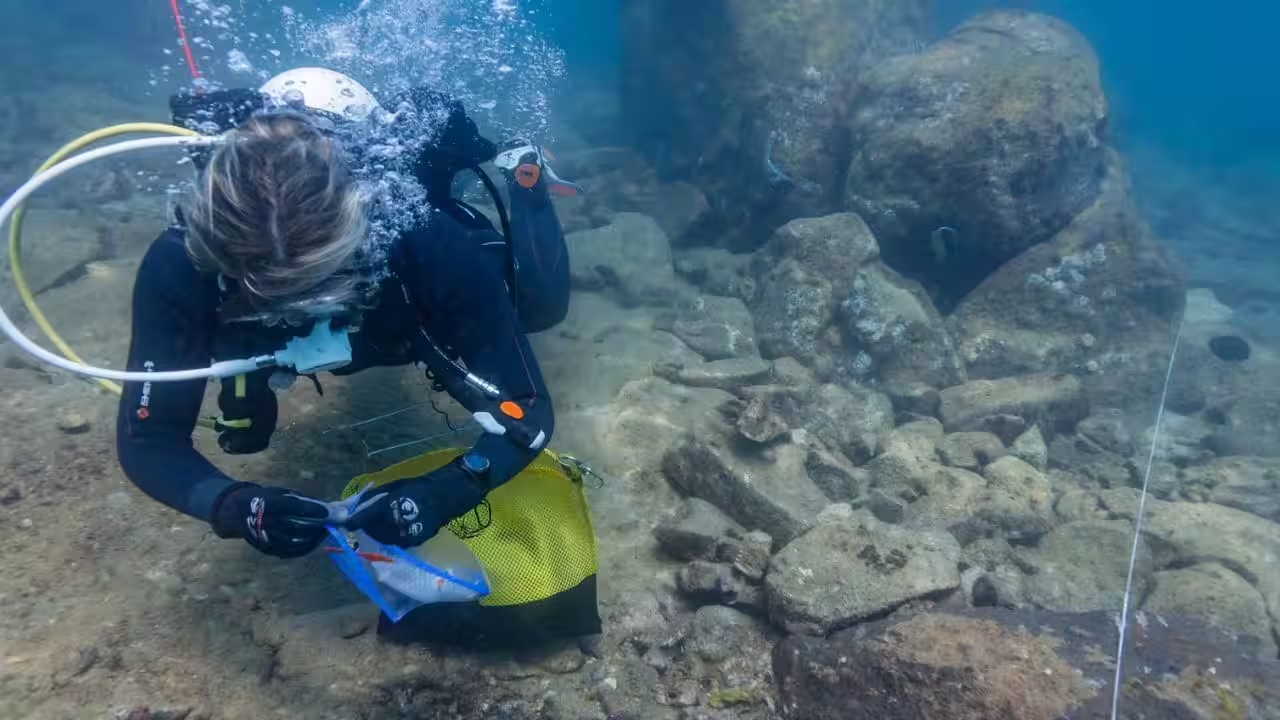
Archaeologists have discovered two submerged sites off Murujuga in Western Australia, where stone tools offer clues to how Indigenous people used the landscape before rising sea levels covered it. Located 11 to 15 metres underwater, the sites contain stone artefacts made from local rock and materials sourced from more than 20 kilometres away.According to research published in Quaternary Science Reviews titled “Underwater archaeological discoveries demonstrate raw material selection and transport of stone artefacts: new evidence from the submerged cultural landscape of Murujuga, Western Australia,” the discoveries include a submerged freshwater spring and a rocky outcrop beside an ancient river channel. Researchers examined the artefacts and used portable X-ray fluorescence analysis to identify their geological origins.Two underwater archaeological sites reveal ancient human activityThe research examines two previously unidentified underwater archaeological sites in Murujuga Sea Country, part of Western Australia’s Dampier Archipelago. The first, WH2, lies in Flying Foam Passage, about 400 metres offshore from the present-day shoreline. It is associated with a submerged freshwater spring and is close to the previously identified WH1 site.The second site, the Maitland River Hummock (MRH), lies between Enderby and Eaglehawk Islands, about 1.3 kilometres from the nearest present-day landmass. It occupies a rocky outcrop beside the submerged channel of the palaeo-Maitland River. Both sites lie 11 to 15 metres below sea level and were submerged at least 9,000 years ago as sea levels rose.How did archaeologists identify stone tools beneath the waters of MurujugaArchaeologists, geoscientists and Murujuga Aboriginal Corporation Rangers trained in scientific diving worked together to investigate the sites. The team first used high-resolution sonar surveys to map the seabed and identify promising geological features before searching underwater. At WH2, divers collected 158 rock specimens, nine of which were confirmed as stone artefacts.At the Maitland River Hummock (MRH), they recovered 12 artefacts from exposed bedrock and marine sands covering the rocky surface. The WH2 finds included three complete flakes, five broken flakes and one core. The MRH collection comprised six broken flakes, three complete flakes, two cores and one object that may have served as either a core or a tool. Both sites yielded relatively large stone artefacts, including pieces showing signs of retouching.What do the rock types reveal about ancient movement and exchangeResearchers used portable X-ray fluorescence analysis to investigate the geological origins of the artefacts. At WH2, 56% of the analysed pieces were made from locally available granophyric rock, while 44% consisted of volcaniclastic sedimentary rock associated with sources approximately 23 kilometres away on or near Rosemary Island. At MRH, 75% of the analysed artefacts belonged to the andesite, basalt or dolerite group, while the remaining 25% were made from granophyre.Both materials were available relatively close to the site. The findings indicate that people visiting the submerged spring used stone from a wider geographical area, whereas the MRH assemblage relied on nearby sources. However, the researchers could not determine whether distant materials were obtained through individual movement or exchange between groups.Why are the submerged sites important for understanding ancient human activityThe researchers interpret the Maitland River Hummock as a likely stone quarry, where people could obtain suitable rock for making tools near an ancient river. Its large cores and artefacts made from locally available materials support this interpretation.The WH1 and WH2 freshwater spring sites appear to have served a different purpose. Their artefacts include materials transported from distant sources, suggesting that people visiting these locations brought stone tools or raw materials with them.The researchers note that freshwater springs may have been important gathering places, although the reasons for the movement of materials cannot be established from the geochemical evidence alone. The discoveries also demonstrate that stone artefacts can survive underwater for thousands of years, supporting further investigation of submerged Indigenous cultural landscapes.You use AI every day. Now get your AI Quotient. Take the AIQ test.
Topics in this story
Gathered from external sources. Rights to this text belong to whoever originally published it.