After San Francisco's 1906 disaster, engineers blasted a 4,233-foot tunnel beneath the city; the hidden conduit still runs near Lands End
When the earthquake of 18 April 1906 struck San Francisco, the four-day fire that followed destroyed about 28,000 buildings and killed at least 3,000
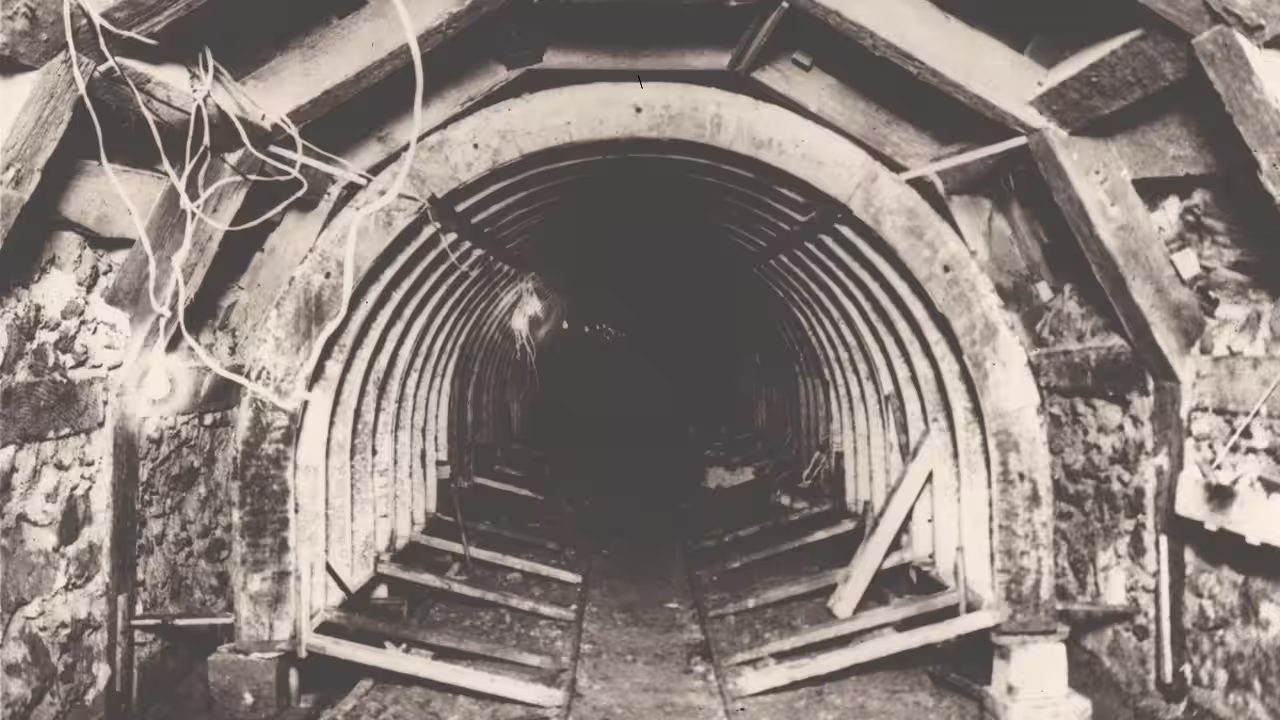
When the earthquake of 18 April 1906 struck San Francisco, the four-day fire that followed destroyed about 28,000 buildings and killed at least 3,000 people. The disaster prompted an overhaul of the city's water supply and wastewater collection. Among the results was the Mile Rock Tunnel, a 4,233 ft sewer and stormwater drain beneath the streets near Sutro Heights. Specified in 1914 by city engineer Michael Maurice O'Shaughnessy, it required workers to blast through more than 900 ft of solid rock and used compressed air to place concrete, a first successful application in San Francisco for the city. It went into operation by September 1915.Why was San Francisco’s 4,233-foot tunnel builtAccording to the American Society of Civil Engineers, Nemo cites Carl E. Grunsky, a former city engineer, who said that city officials and committees had pointed to the need for a comprehensive sewer system with increasing frequency before the earthquake. The city appointed a board of civil engineers in September 1892 to develop a cohesive system. Grunsky recorded that sewers at the time emptied into San Francisco Bay wherever they reached the water. He described one spot, where sewage ebbed and flowed with no rain to dilute it during half the year, as a "filthy nuisance beggaring description".Nemo reports that funding was limited, so the improvements Grunsky and his colleagues envisaged arrived in stages. Only in May 1908 did residents approve a $4 million sewer bond to pay for a larger number of changes, some of which would eventually cover the Mile Rock Tunnel. In 1912, Mayor "Sunny Jim" Rolph appointed Michael Maurice O'Shaughnessy as city engineer. O'Shaughnessy submitted his specifications for the tunnel to the Board of Public Works, which approved them in January 1914. The contract went to builder Edward Malley the following month for $193,314, but it fell apart after newspapers reported that Malley had not known the city would require indemnity insurance. By early 1915 the contract was held by R.C. Storrie and Co., run by the Scotsmen R.C. Storrie and Robert Muir.How was the 4,233-foot tunnel blasted through solid rockNemo, drawing on Mary L. Maniery's 1995 Historic American Engineering Record (HAER) report, explains that crews worked at both ends of the tunnel, digging towards each other. They had to cut through more than 900 ft of solid rock, using drilling and dynamite. The southern team worked through blue shale, creating eight to 11 holes with hand drills before each round of dynamite. In the north, where workers met blue sandstone before reaching blue shale, 17 to 21 holes from column-mounted piston drills were needed before each blast. A side-dump car on a narrow-gauge track, pulled by mules, carried the muck out. In stretches without rock, about 2,600 ft, timber cribbing provided support.Miners and shovelers worked two eight-hour shifts at either end, and the third shift each day was for concreting. Western Engineering (January 1915) reported an "average of 10 ft per day" at each end. According to Maniery's HAER report, the tunnel was the first successful application in San Francisco of pneumatic mixing and placing of concrete using compressed air. A compressor at the south end supplied the air, and materials were fed into a mixer at the tunnel adit. The mixed concrete flowed from a 6 in. pipe into a 6 in. rubber hose, and the teams communicated by a system of bells. Maniery wrote that an average of 32 batches per hour were placed even when the distance from the mixer to the discharge point was as great as 2,000 ft.When did the 4,233-foot tunnel near Lands End openNemo reports that the final section, roughly 30% of the total length, required cut-and-cover construction through sand. A dragline excavator and a turntable derrick rig excavated a trench the width of the street above. Groundwater kept flooding the trench, so a layer of gravel was laid at the bottom and the water was directed to two sumps through a 10 in. underdrain. According to the HAER report, this removed 1.25 million gallons of water every day. On 26 August 1915, an inspection party that included Rolph, O'Shaughnessy and Muir drove a car into the tunnel. The tunnel went into operation by September 1915. By 2 March 1916, according to a letter from O'Shaughnessy to the Board of Public Works, only the filling of a shaft and some pavement restoration remained, and these were finished by early June.Nemo states that O'Shaughnessy singled out Mile Rock in his 1922 summary of city construction in The Military Engineer, when the city had spent a total of $9 million on its new sewer system. A weir wall built in the mid-1990s means the tunnel now serves only as an emergency overflow. Tidal sand has reduced its cross-section, and by the time the weir was added, the tunnel was only about 3 ft tall within about 110 ft of the exit. Nemo concludes that the tunnel was innovative in its use of pneumatics for concrete placement, and that it was the first in the city built with both rock boring and open-cut timber cribbing.You use AI every day. Now get your AI Quotient. Take the AIQ test.
Topics in this story
Gathered from external sources. Rights to this text belong to whoever originally published it.