In 2007, Con Edison unveiled a $300 million Bronx substation disguised to read like a rowhouse street; it houses two substations delivering 900MW, and a $47.3 million capacity upgrade is now approved
When Con Edison unveiled its East 179th Street substation in the Bronx in 2007, it did not look like a typical industrial power facility.
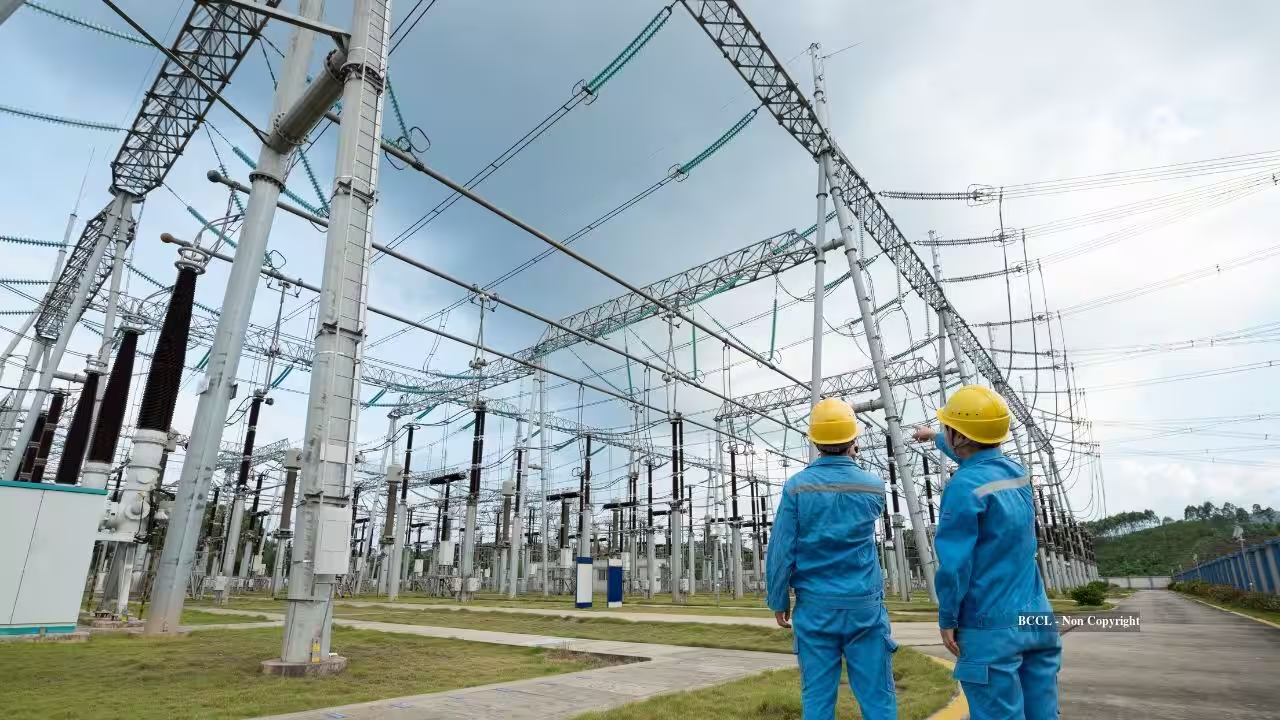
When Con Edison unveiled its East 179th Street substation in the Bronx in 2007, it did not look like a typical industrial power facility. The $300 million project was designed to resemble a row of Bronx rowhouses, with a brick facade and a street-level appearance intended to blend into the surrounding neighbourhood. Con Edison said the facility housed two substations capable of delivering 900 megawatts, enough electricity for about 900,000 homes.Nearly two decades later, the substation remains central to the Bronx’s power supply. A New York Public Service Commission order issued in June 2025 approved a $47.3 million urgent upgrade at the facility, including a fifth 138/13 kV transformer and a new 138 kV feeder from the East 179th Street substation. Read more details about it here, as per the report:A substation designed to fit the BronxThe East 179th Street project was unveiled in June 2007 as part of Con Edison’s effort to strengthen New York City’s electric delivery system ahead of rising summer demand. The company described it as a $300 million investment that combined two substations into one facility.What made the project unusual was its design. Rather than presenting residents with a large, plain industrial structure, Con Edison built the substation to read like a rowhouse street, using a brick facade that reflected the character of the surrounding Bronx neighbourhood.The design choice reflected a practical reality of urban infrastructure. Substations need to be close to the communities they serve, but they can also be visually intrusive. By making the facility resemble familiar residential architecture, Con Edison sought to reduce its visual impact while still delivering a major increase in electrical capacity.How much power it deliversThe facility contains two substations with a combined capacity of 900 megawatts. Con Edison said that amount could power approximately 900,000 homes, based on its estimate that one megawatt can supply about 1,000 homes. At the time of the unveiling, Con Edison was investing $1.4 billion across its electric delivery system to meet forecasted peak demand of 13,575 megawatts. The company projected a peak load of 11,780 megawatts for New York City and 1,795 megawatts for Westchester County.The Bronx substation was part of a wider programme that included $739 million for distribution upgrades, $489 million for substation-related projects, and $137 million for transmission improvements. Con Edison said it expected to spend $7.5 billion over the following five years to maintain reliability and support economic growth.Why an upgrade is needed nowThe 2025 upgrade is tied to New York’s transition toward building electrification and electric vehicles. The Public Service Commission created an urgent upgrade process to identify projects that must begin before the completion of its broader long-term grid planning process.Con Edison identified 14 potential electric vehicle charging hotspots across its service area, suggested the report. After further analysis, it concluded that four locations required urgent near-term investment, including Zerega Avenue and Hunts Point in the Bronx, as well as East New York and Steinway in Queens.The company found that these areas already had significant electric vehicle charging activity, ranging from early customer interest to projects under construction or in operation. It also projected future demand from electric vehicles and electrified buildings, which would place additional pressure on local grid capacity.The $47.3 million Bronx upgradeThe approved Bronx project includes the installation of a fifth 138/13 kV transformer at the Parkchester No. 1 substation. It will be supplied by a new 138 kV feeder running from the East 179th Street substation.The project was approved as part of a broader set of 29 urgent upgrades across New York State. The Public Service Commission authorised development and cost recovery for projects that met its criteria for need, urgency, certainty, and cost-effectiveness.The $47.3 million investment is intended to mitigate risks associated with projected load growth at Zerega Avenue and Hunts Point. By adding transformer capacity and a new feeder, Con Edison aims to support electrification while maintaining reliable service for existing customers.Part of a larger grid planCon Edison’s nine proposed urgent projects had an estimated capital cost of $854.9 million and were expected to add 485 megawatts of incremental system capacity. Those projects included four primary feeder projects, three area substation and sub-transmission projects, and two distribution system programmes.The Bronx upgrade is therefore not an isolated repair. It is part of a wider effort to prepare New York’s grid for increased demand from electric vehicles, heat pumps, and other electrified building systems.The Public Service Commission said the approved projects would help enable building electrification and electric vehicle charging while supporting the state’s efforts to reduce greenhouse gas emissions. It also found that the projects would not disproportionately burden disadvantaged communities.Why the rowhouse design still mattersThe East 179th Street substation shows that essential infrastructure does not have to look hostile to its neighbourhood. Its rowhouse-inspired design allowed a high-capacity facility to sit within an urban community while reducing the visual impact of heavy electrical equipment.That approach is increasingly relevant as cities invest in grid upgrades to support electrification. New transformers, feeders, and substations will be needed, but residents are more likely to accept such projects when they are designed with local context in mind.The Bronx facility began as a response to rising electricity demand in 2007. Nearly 20 years later, it is being upgraded again, showing how power infrastructure must continually evolve as homes, vehicles, and industries use more electricity.You use AI every day. Now get your AI Quotient. Take the AIQ test.
Topics in this story
- Con Edison Bronx substation upgrade
- East 179th Street substation
- Bronx electrical infrastructure
- sustainable urban infrastructure
- urban substation design
- electrical vehicle charging infrastructure
- power supply for homes
- renewable energy solutions Bronx
- energy capacity upgrades Bronx
- New York Public Service Commission
Gathered from external sources. Rights to this text belong to whoever originally published it.