From about 1950 to 1964, a Washington janitor spent nights in a rented garage assembling a 180-piece throne from foil, cardboard, old furniture and light bulbs; it now fills a Smithsonian gallery
Discover the story of James Hampton, a Washington janitor who created an extraordinary 180-piece religious installation from discarded materials, now featured in the Smithsonian American Art Museum.
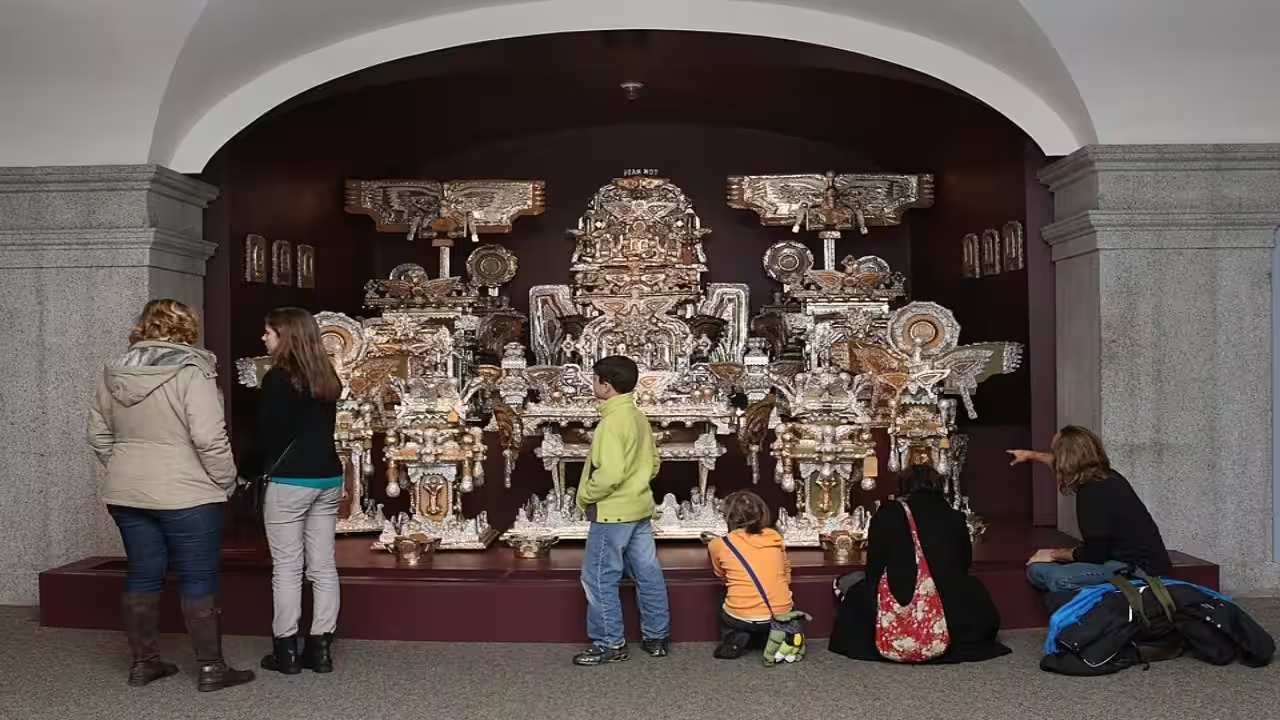
For about 14 years, James Hampton worked in a rented carriage house in Washington, D.C., assembling a religious installation out of discarded objects and inexpensive materials. The self-taught artist built around 180 separate components for The Throne of the Third Heaven of the Nations’ Millennium General Assembly, a work he based on religious visions and his faith in Christ’s return.Hampton worked on the project while working as a janitor for the General Services Administration. Rather than using conventional sculptural materials, he transformed old furniture, cardboard, plastic, jelly jars and discarded light bulbs to create a highly ordered installation. Gold and silver foil, purple paper and other reflective materials covered many of the surfaces, giving the objects a bright appearance despite their humble origins. The Smithsonian American Art Museum now holds the work, which is listed as a mixed-media sculpture and assemblage dating from about 1950 to 1964.A religious vision realised from discarded objects The installation is centred on a throne surrounded by rows of crowns, altars, lecterns, tablets and other objects. Hampton arranged the components in parallel rows across two levels, to create a pronounced symmetry, with the central throne acting as the focal point, while the two sides consist of biblical references. The museum identified the left side with the Old Testament and Moses, while the right side alluded to the New Testament and Jesus. Hampton's use of the term “third heaven” came from scripture describing the “heaven of heavens” as being the realm of God.At the centre is the phrase “FEAR NOT”, taken from the book of Revelation, while other components are marked with biblical references and inscriptions and Hampton’s own handwritten labels for individual sections, according to the Smithsonian American Art Museum. His religious ideas extended beyond the objects into a notebook called “The Book of the 7 Dispensation” which is written largely in an invented or asemic script that remains difficult to interpret, according to the Smithsonian American Art Museum.Hampton referred to himself as “ST JAMES”, and much akin to the Bible, its pages are organised in numbered chapters, according to Smithsonian Magazine. The museum presentation also includes a chalkboard showing sketches or working plans, offering a glimpse into how Hampton developed his ideas. Beyond its biblical imagery, the museum describes the work as a combination of Christianity with African-American spiritual practices rife with themes of deliverance and freedom.From a hidden garage to the Smithsonian Hampton did not live to see his work exhibited at the museum and died from cancer in 1964, leaving the installation unfinished. After his death, his landlord, Myer Wertlieb, went to the rented garage to collect overdue rent and discovered the enormous collection of work assembled there. Wertlieb initially struggled to find someone willing to take the work until the installation eventually came to the attention of sculptor Ed Kelly, who contacted an art collector. This set off a chain of contacts that brought it to Harry Lowe, then an exhibitions and design official at the National Collection of Fine Arts.Lowe later recalled to the Washington Post entering the garage as being “like opening Tut’s tomb”. He paid Hampton’s outstanding rent and arranged for the entire assembly to be acquired by the museum, and a selection from its central section was first exhibited in 1971. Since then, the work has become one of the most recognised examples of American visionary art, and its significance also prompted the continuation of conservation work. Museum staff have catalogued, cleaned, examined, photographed, scanned and restored its individual components, allowing the installation to be studied piece by piece.You use AI every day. Now get your AI Quotient. Take the AIQ test.
Topics in this story
Gathered from external sources. Rights to this text belong to whoever originally published it.