In 2006, the Navy sank the 888-foot carrier USS Oriskany 24 miles off Pensacola, Florida, creating what was then the world’s largest intentionally sunk artificial reef, now attracting divers and marine life
Discover how the USS Oriskany, once a powerful Navy aircraft carrier, created the world's largest artificial reef off Pensacola, Florida, supporting diverse marine life and boosting the local economy.
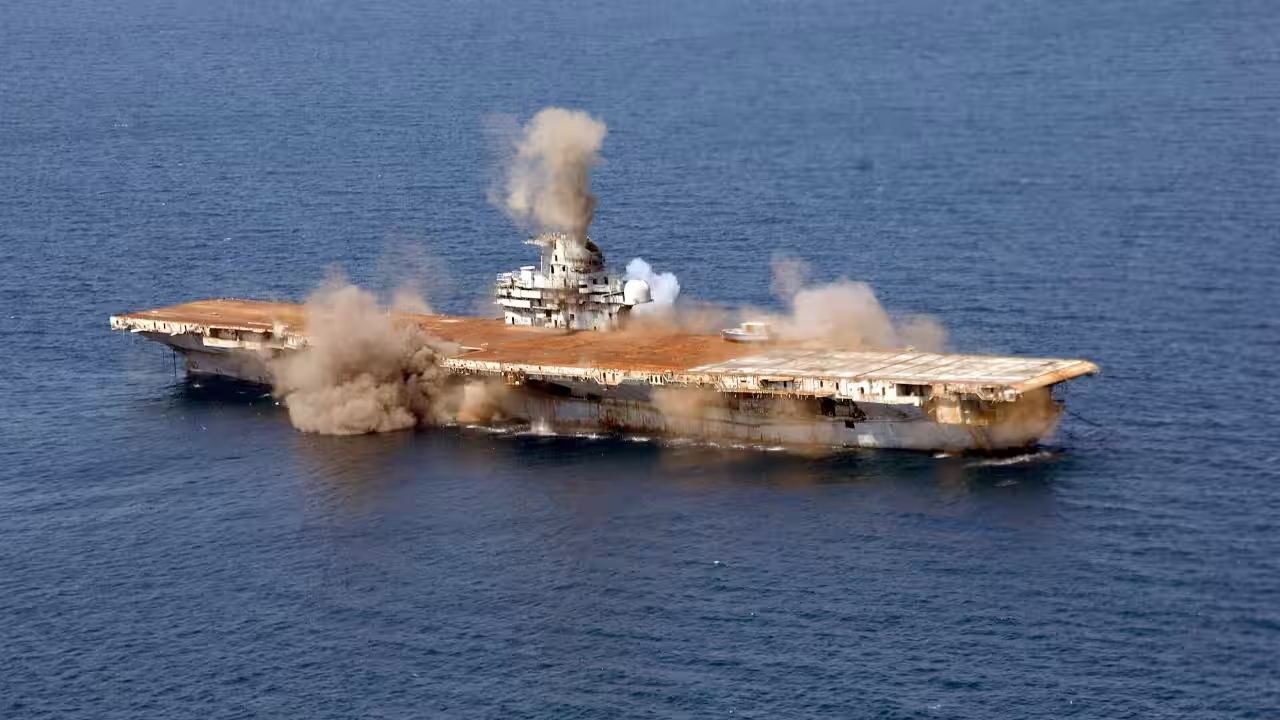
Off the Florida Panhandle, in the Gulf of Mexico southeast of Pensacola Pass, the hull of a former US Navy aircraft carrier rests on the seafloor. The ship is the USS Oriskany, nicknamed the “Mighty O” by its crew members. The Navy, the state of Florida, and Escambia County cooperated to sink the ship at this site. Pensacola already had artificial reefs, but the authorities wanted another dive destination, so they chose a ship.USS Oriskany’s service from launch in 1945 to decommissioning in 1976The Naval History and Heritage Command’s Dictionary of American Naval Fighting Ships entry for USS Oriskany confirms that the carrier was launched on October 13, 1945, but not commissioned until September 25, 1950, after construction was suspended following World War II, and that she served during both the Korean and Vietnam Wars. WPMI, an NBC affiliate, reported that she was one of the ships used by President Kennedy during the 1962 Cuban Missile Crisis.H-Gram 011 from the Naval History and Heritage Command records that Senator John McCain flew 22 strike missions over North Vietnam from the Oriskany before a surface-to-air missile shot him down on October 26, 1967, during his 23rd mission. She was decommissioned in 1976 and was scheduled to be scrapped before being chosen for reefing, Guinness World Records states.Preparing and sinking the 888-foot carrier on May 17, 2006The Navy NewsStand release reported that the 888-foot carrier sank on May 17, 2006, in about 212 feet of water roughly 24 miles from Pensacola. She had been towed to the site at two knots starting on May 15. The release called her the biggest ship intentionally sunk as an artificial reef. Atlas Obscura reports that the Navy spent more than three years and an estimated $20 million preparing the retired carrier to become an artificial reef. The Navy planned to position the ship in an upright orientation with its bow towards the south. Scuba Diving magazine, republishing the Navy’s press release, also described it as the Environmental Protection Agency’s first risk-based approval for disposing of polychlorinated biphenyls (PCBs).On the day, there were blasts of the controlled charges that put holes in her hull. WPMI reported that more than 500 pounds of plastic explosives were used, and boat owners watching from one mile away saw flashes and smoke as the stern went under. Guinness World Records puts the time to reach the seabed at 37 minutes. National Interest adds that the Navy led the operation, with help from the Florida Fish and Wildlife Conservation Commission, the Coast Guard, the Pensacola Police Department, and Escambia County agencies.Economic estimates from a 2004 Florida State University study and a Scuba Diving magazine figure for the OriskanyA 2004 Florida State University study, which the Navy release cites, estimated that artificial reefs may provide Escambia County economic benefits of about $92 million per year, a figure that covers all of the county’s artificial reefs and not only the Oriskany. Scuba Diving magazine published a separate estimate for the Oriskany alone, at about $9 million a year.Marine life on the reef and the limits of what scientists knowColonization was rapid, and Atlas Obscura reports that a diver found the vessel covered with baby crabs just a week after the sinking. Sea urchins have developed on the sides of the ship now. The reef has come into use as an area popular with divers owing to rich sea life. This reef has been confirmed by Guinness World Records to be inhabited by sea creatures seldom found in the northern part of the Gulf. The reef is popular with divers, and Guinness World Records reports that it is home to sea creatures seldom found in the northern Gulf. Atlas Obscura puts the deck of the ship’s island at 80 feet of depth.These are early observations, and the reef’s wider ecological effects are still being studied. The NOAA RESTORE Science Program says Gulf reef fish assemblages are poorly understood, and its Gulf-wide survey aims to build a comprehensive database of reef fish and their habitats. Atlas Obscura likewise describes the Oriskany’s overall environmental impact as unsettled. The project, known as G-FISHER, brings together habitat mapping, water-quality information and three reef-fish surveys to build what NOAA calls the most comprehensive Gulf database on fish abundance, size and community composition. The project runs on a $13.44 million award through August 2029, and the team says it will merge historical and new Gulf-wide data, including time-series samples spanning 1992 to 2024. These records cover the Gulf as a whole and begin well before the Oriskany was sunk in 2006, so they are not a record of the reef itself.You use AI every day. Now get your AI Quotient. Take the AIQ test.
Topics in this story
Gathered from external sources. Rights to this text belong to whoever originally published it.