Machado finally made it back to Venezuela. Her challenge now is to pressure Rodríguez without upsetting the US
María Corina Machado’s return to Venezuela not only challenges Washington’s vision for the country’s transition, it also puts pressure on acting President Delcy Rodríguez by heightening tensions within her ruling party, which until this Sunday appeared to be weathering the aftershocks of Nicolás Maduro’s capture without major upheaval.
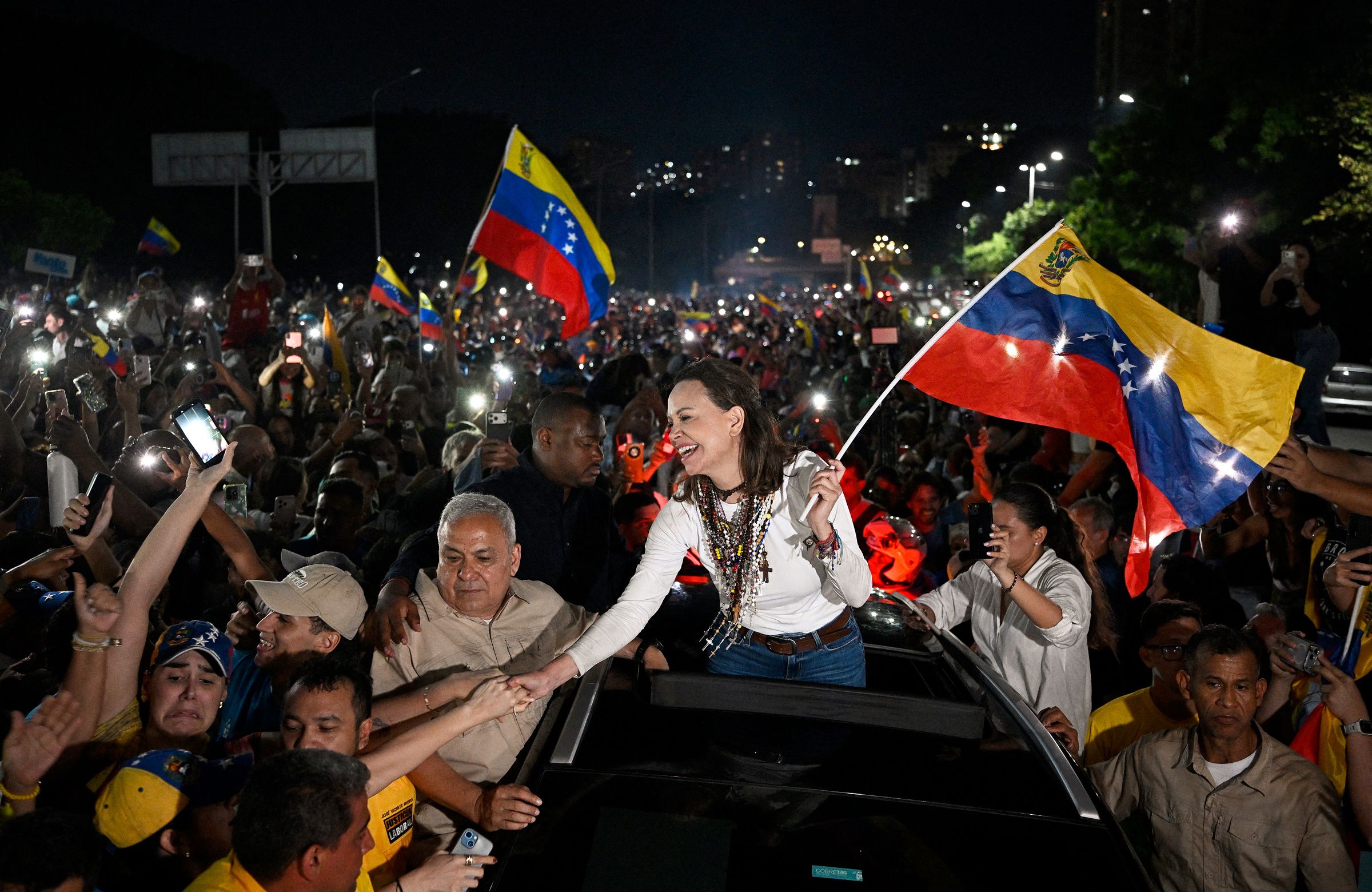
María Corina Machado’s return to Venezuela not only challenges Washington’s vision for the country’s transition, it also puts pressure on acting President Delcy Rodríguez by heightening tensions within her ruling party, which until this Sunday appeared to be weathering the aftershocks of Nicolás Maduro’s capture without major upheaval. The opposition leader’s presence on the ground disrupts the relative calm which many have come to call the South American country’s “new political moment” following the US military operation that seized Maduro on January 3. In exchange for remaining in power, the Washington-backed Venezuelan government amended some laws, released dozens of political prisoners, allowed some exiles to return, and gave a company that partnered with the Pentagon privileged access to the South American country’s vast oil reserves. Machado’s unexpected appearance at the Santa Rosa church in Barquisimeto on Sunday, in west-central Venezuela, will also test the Rodríguez-US relationship, which appears to be much stronger than the connection the opposition leader currently has with the Donald Trump administration. “The relationship with Washington is strained but not broken. We are aware that the United States is our main strategic ally,” a source close to Machado told CNN. Machado must now push ahead with her political goals while balancing the delicate relationship with the US. Clash of interests Washington’s interest in designing an institutional framework for Venezuela without the upheaval that Machado’s presence and her demand for change cause within Chavismo — the socialist political movement named after former President Hugo Chávez — was already clashing with her need to establish herself in the country to regain political momentum, which had begun to fade after a period of just over two years, part of which she spent living underground in exile. The conflict between the interests of Washington and Machado became even more evident after the double earthquake on June 24. After that, Machado stepped up pressure to return to Venezuela, something the United States had advised against for security reasons. She tried several times, unsuccessfully, to return from Panama, where she had lived in recent weeks. She was never able to do so “because of the regime’s blockade,” Pedro Urruchurtu, director of international relations for the Vente Venezuela party, said in a statement published Sunday. US Secretary of State Marco Rubio said Monday that any “impediments” to her return “had nothing to do with us.” He said that the only time he “personally” had discouraged her from returning to Venezuela was “right after the earthquake” because “the only thing we were focused on from a logistical standpoint was getting as many planes with relief aid as possible into the country.” She finally succeeded four months after the tragedy without Washington’s expressed approval. “We felt that it was not the time to ask, but to act. We preferred to act independently so as not to bother anyone,” a source close to Machado told CNN. “And, apparently, the United States did not object. We assume they must have found out beforehand because they know everything,” the source added. President Trump told CNN that he was unaware of Machado’s return but hoped she was well. Rubio said on September 1 that Washington had concerns about her possible return but that she did not need the United States’ approval. Rubio then said Sunday on X that “the conditions allowing for the safe return” of Machado were “the direct result of the US-backed reconciliation talks, which have already secured the release of hundreds of political prisoners and the return of hundreds of Venezuelan opposition figures.” “The United States expects the freedoms of all sectors of Venezuelan politics to continue to be respected, and we expect all political actors to support these talks,” Rubio added. With this, Washington appears to be setting the ground rules for Venezuela’s transition. It does not oppose Machado’s return, but it does expect that the pressure the Venezuelan leader will exert on Chavismo when she resumes her political activities will not jeopardize the negotiations between delegations from the Rodríguez government and a sector of the opposition, which will eventually culminate in presidential elections, as the acting president herself has acknowledged. Rodríguez on Monday declined to say whether Machado would be involved in the reconciliation talks but said she hopes the ongoing dialogue will offer a space for all “voices of good” to be heard. Without naming Machado, she also said she hopes that “those who have harmed Venezuela, those who called for sanctions and external aggression, feel some remorse and regret.” The Venezuelan government has in the past criticized Machado for urging the US to take action against the Maduro regime, including sanctions. Asked about whether Rodríguez can be trusted on a democratic transition, given some of her rhetoric around “external aggression,” Rubio said, “we ultimately judge it not by rhetoric but by action.” “If at the end of the day we have a new TSJ (Supreme Justice Tribunal), a new CNE (Electoral Council), a new election, and a new, you know, system of government, that’s what we want,” he said. The challenges ahead Machado’s team is aware that she is returning to a different country. There have been no major changes in the local economy, still weighed down by the loss of three-quarters of GDP and now seeking to recover from the effects of the double earthquake. “She has to get a feel for the streets again and see what the next steps are, thinking them through very carefully so as not to make a mistake. She understands that,” a source close to her inner circle said about Machado’s need to make direct contact with supporters in Venezuela after being in exile. The Vente Venezuela team, Machado’s political movement, has been preparing the ground for its leader’s arrival. Several of its senior figures, including two of the leaders who were confined to the Argentine Embassy compound in Caracas for more than a year, have returned to Venezuela to take part in rallies and events with party members, who are slowly beginning to resume their activities after the harsh repression that followed the disputed results of the July 28, 2024, presidential election. The opposition leader’s international relations team said in a statement that Machado is returning “to help build and promote a broad and pluralistic national agreement that will make it possible to develop a shared vision for the country.” “This agreement,” the statement adds, “must transcend political differences, foster understanding and reconciliation, and lay the foundations for a common future grounded in democracy, respect for human rights, peaceful coexistence, and prosperity.” For now, it is unclear whether Machado’s team is seeking to promote any agreement with the opposition delegation taking part in the US-sponsored dialogue. “That alliance would have to be built with her because it does not currently exist,” said a person familiar with the talks with the government. “But if we can establish coordination across the different fronts, it could provide major support for what is being discussed at the negotiating table,” the person acknowledged. Machado is not part of the negotiations being promoted by the United States, but she has said that she will not obstruct its efforts and will judge them by their results. Her arrival in Venezuela will energize a public that seemed resigned to waiting for the outcome of the US-backed talks, but she must be careful not to antagonize the country that, despite their differences, remains the key ally of her political project.
Topics in this story
Gathered from external sources. Rights to this text belong to whoever originally published it.