In 2025, South Korea approved a two-year test near Osong Station for solar panels placed along railway tracks, with nationwide expansion possible if the panels withstand rail conditions
In a groundbreaking move, South Korea has approved a two-year pilot project utilizing removable solar panels along railway tracks near Osong Station, potentially revolutionizing renewable energy generation in the rail sector. This initiative could pave the way for nationwide expansion if successful.
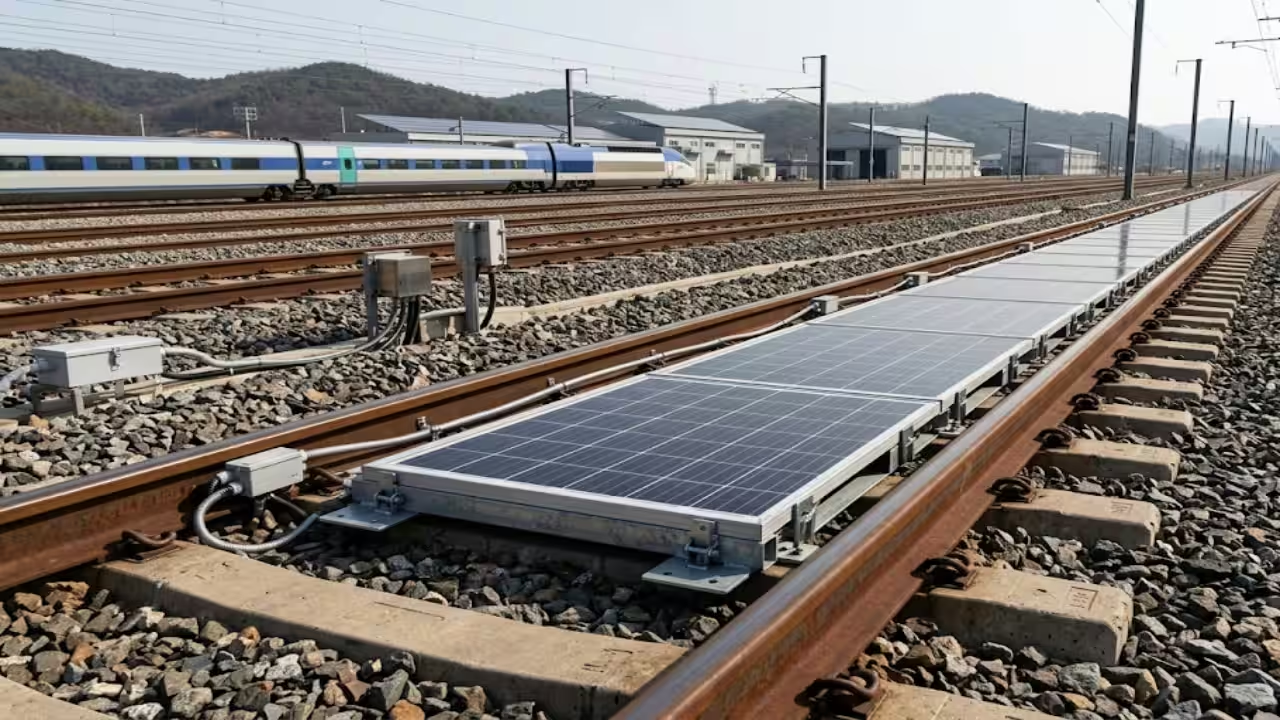
Railways were built to move people and goods, but engineers are now asking whether the tracks themselves can do more. The space between the rails is long, flat, already cleared and part of the railway property. A Swiss startup called Sun-Ways has spent several years working out how to fill that space with removable solar panels without getting in the way of trains.In September 2025, South Korea's Korea Railway Solar Power Generation Project received government approval to install solar panels near Osong Station in North Chungcheong Province. According to Swissinfo's reporting, the pilot will run for two years, with nationwide expansion possible if it performs well.Where is the pilot project located?Details on the Korean site are scant. Swissinfo said it was near Osong Station, and the Irish Times said the two-year pilot was approved for the Korea Railroad Research Institute’s test track, which makes sense as the institute has a railroad test track at Osong. The project is being conducted by the Korean Rail Solar Power Generation Project Company, whose chief executive, Taebon Park, told Swissinfo in 2025 that he opted for Sun-Ways because the technology is suitable for railroad maintenance and operations. Park attended the Swiss inauguration and was particularly interested in how the panels connect electrically and how they move on and off the track.It helps to be clear on what the panels are and aren’t. They are not on the poles along the line. In the Sun-Ways design, they sit on the sleepers between the rails and are held in place by pistons pushing on the steel, as the Irish Times put it. Sun-Ways estimates that Switzerland's roughly 5,320 kilometres of railway network, excluding tunnels and poorly lit sections, could generate up to 1 billion kilowatt-hours of solar electricity annually. That is equivalent to approximately 188 megawatt-hours per kilometre per year and represents the company's estimate for suitable routes.Lessons in SwitzerlandKorea is participating in a study that has been underway in Switzerland for more than a year. Sun-Ways launched the pilot on April 24, 2025, installing 48 removable solar panels across a 100-meter stretch of an active passenger railway line in Buttes, in the canton of Neuchâtel, Switzerland. The installation consists of 48 panels, each rated at 380 watts, giving a total peak output of around 18 kilowatts. France's SNCF Group is working with Sun-Ways to assess how the removable solar panels affect railway maintenance and operations. Its teams are examining panel installation and removal, glare, track inspections, maintenance impacts, electricity output and dirt buildup. According to SNCF's official project page, the pilot will run until April 2028. A trial in Korea will demonstrate how the system can cope with local climate and operating conditions. No performance data from the Korean site have been made public at the time of writing; thus, the results from Osong remain to be seen.Can South Korea’s rail network afford it?A separate modelling study examined the potential for generating solar power on suitable railway corridors in South Korea. The researchers estimated the system's potential electricity output and assessed its financial viability, but they did not measure the performance of the Osong pilot itself.The South Korean modelling study identified 28.4 kilometres of suitable railway corridor, with an estimated solar capacity of 8.51 megawatts and annual electricity generation of 9.95 gigawatt-hours. That works out to approximately 350 megawatt-hours per kilometre annually. The estimate is higher than Sun-Ways' projection of roughly 188 megawatt-hours per kilometre, but the two figures rely on different system configurations and installed-capacity assumptions. They should not be treated as directly equivalent measurements. The study's figures describe a modelled system, not electricity production measured at the Osong pilot.The modelling study estimated a 68% probability of payback within 12 years when the proposed system received a 40% capital subsidy, compared with roughly one-third without the subsidy. These figures represent a modelled financial scenario, not a requirement that removable panels remain on the same stretch of railway for 12 years. The overall investment case depends on factors such as installation and removal costs, maintenance, electricity generation and the assumptions used in the model.Meanwhile, Sun-Ways says it is transitioning from pilot to commercial rollout. The Greater Geneva Bern area, a Swiss business development agency, said in August 2026 that the firm has signed its first commercial partner in Italy, has a technological partnership with SNCF and has obtained South Korean permission. China, Singapore and Indonesia are also interested.South Korea approves a pilot for solar panels between railway rails near Osong Station, using Swiss technology already running on a live line in Switzerland. Nobody yet knows how the Korean panels will perform, but the Swiss results, the modelling study showing real potential and a tough payback, and the shortage of land for solar farms help explain why the idea is spreading. If the Osong pilot performs well, it could support a wider rollout across the country’s rail network.You use AI every day. Now get your AI Quotient. Take the AIQ test.
Topics in this story
Gathered from external sources. Rights to this text belong to whoever originally published it.