In 1979, artist Kit Williams buried a jewelled golden hare as a puzzle in his book Masquerade; after being found in 1982 and sold in 1988, it fetched £82,550 at Sotheby’s in 2025
Discover the fascinating tale of Kit Williams' golden hare, a buried treasure from the 1979 puzzle book 'Masquerade', unearthed in 1982 and sold for £82,550 at Sotheby’s in 2025.
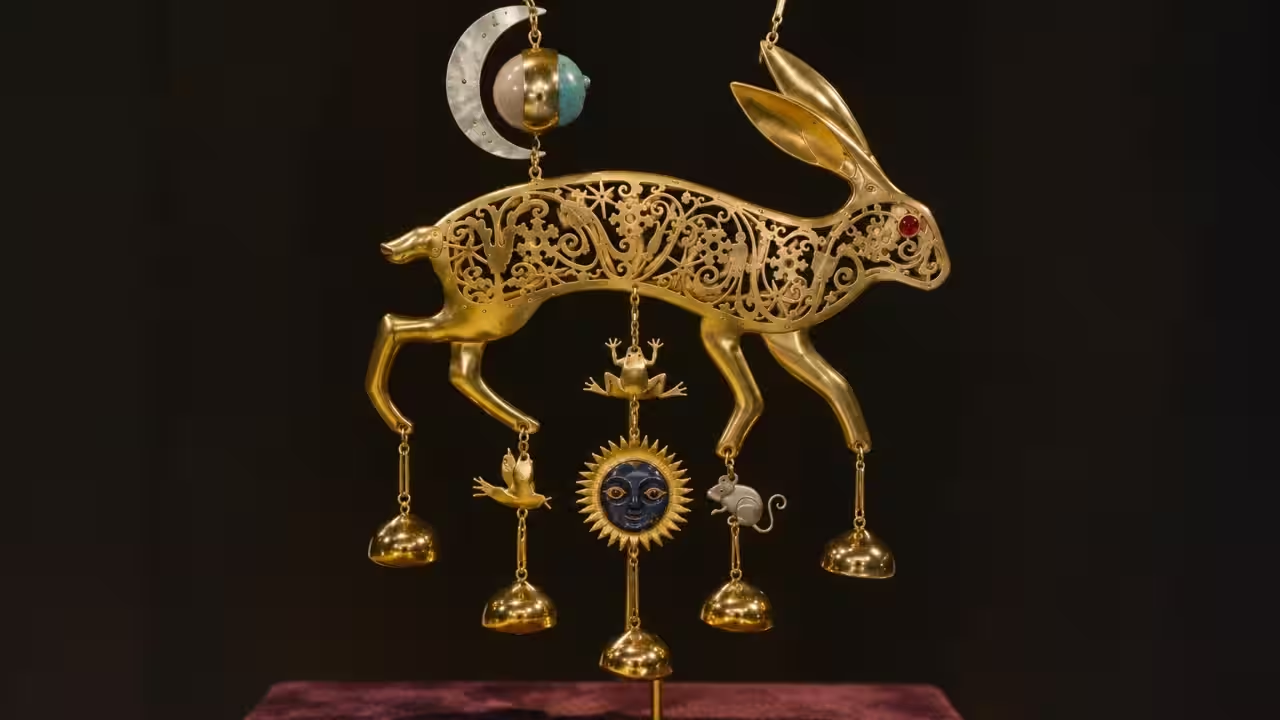
British artist Kit Williams, in August 1979, buried an 18-carat gold hare decorated with precious stones somewhere in the English countryside. The location of the hare was not revealed through a map or a conventional treasure hunt; instead, it was revealed through a series of intricate riddles that were hidden inside his illustrated children’s book Masquerade. Readers had to examine paintings, verses, numbers and other visual details to get to the correct location of the buried hare. The book became an international publishing sensation after its release. Eventually, the gold hare was unearthed in Ampthill Park, Bedfordshire, in February 1982. More than four decades after the hunt had begun, the jewel returned to Sotheby’s London, where it sold for £82,550 on November 28, 2025.How a children’s picture book became an international treasure huntThe idea behind Masquerade developed from Williams’ interest in making readers follow the illustrations more closely. According to Sotheby’s auction catalogue, publisher Tom Maschler had approached Kit Williams in 1976 about illustrating children’s books. Initially, Williams declined. However, Maschler’s suggestion that he could create something different from the traditional children’s book stayed with him. Instead of just illustrating a story, Williams wanted his readers to analyse his artwork repeatedly and discover the minute details that might otherwise go unnoticed. This eventually became the foundation of Masquerade. The book’s illustrations and accompanying verses contained clues that led to a real object hidden somewhere in Britain.Jonathan Cape published the book in 1979, with the plot of the story focusing on a hare named Jack, who was entrusted by the Moon with a precious jewel to deliver to the Sun. During his journey, the hare lost the jewel. This fictional narrative gave the framework for the real-life treasure hunt in which Williams had created an elaborate golden hare and concealed it in the English countryside. Sotheby's noted that the illustrations consisted of 16 original oil paintings, accompanied by verses and approximately 4,000 words of text. Furthermore, the central puzzle required interpretation of different elements together rather than relying on a single obvious hint.Williams had designed and handcrafted the 18-carat gold hare. He reportedly used techniques like piercing, hammering and riveting for the hare’s decorative chain. The auction house’s description mentions that its body consists of pierced foliate scrollwork, stars and five flower-shaped motifs set with cabochon turquoise. Furthermore, it carries a ruby eye and suspends five small bells which include representations of a mouse, frog and bird. Meanwhile, the necklace includes a crescent moon decorated with mother-of-pearl and a sun mask with citrine eyes. The artist reportedly invested a month in making the jewel, which was valued at approximately £5,000 at the time of burial. The object’s hallmark identifies Williams as the maker, thus making it a distinctive piece of jewellery as well as a centrepiece of a treasure hunt.On the night of August 7, 1979, Williams buried the hare in the presence of television presenter and author Bamber Gascoigne, who acted as his sole witness. The jewel was placed inside a terracotta container which was engraved with a message that identified it as the keeper of the Masquerade treasure. The container was sealed with wax for an additional layer of protection against people attempting to locate the object using metal detectors. Following this, Williams published the book in the same month and began the treasure hunt. The records from the auction house suggest that the first edition of the book sold out within two days. Reports claim that nearly two million treasure seekers from countries like America, Australia, South Africa and Japan attempted to interpret its clues.The discovery in 1982 that did not end the mysteryThe hunt continued for around two and a half years before the golden hare was finally discovered in 1982. The discovery was initially attributed to a man using the name Ken Thomas, though it was later revealed that his real name was Dugald Thompson. According to a report published by The Washington Post on March 15, 1982, Thompson had spent around 18 months following clues from the book but admitted that he had not solved its central riddle. His account involved walking his dog in the park, where the animal led him towards a stone which carried an inscription from Psalm 104. The nearby monument commemorating Catherine of Aragon, the first wife of Henry VIII, helped him connect the location with clues in the book. After several days of digging, he uncovered the terracotta container holding the jewel.This discovery did not establish that Thompson had correctly followed the instructions and solved the puzzle as Williams had originally intended. Mike Barker and John Rousseau, two physics teachers from Manchester, had worked out the book’s master riddle without any outside help. Through their solution, the teachers identified the location, but they had not physically recovered the treasure before Thompson found it. Therefore, the treasure hunt’s apparent conclusion left questions in the wake about whether the person who has been officially credited with discovering the prize had actually deciphered the puzzle.The controversy became more serious in December 1988, when a Sunday Times’ investigation examined Thompson’s identity and his connections to people associated with Williams. A later piece by The Washington Post in 1989 described how Thompson had obtained information about the approximate location through his business associate John Guard, who had a relationship with Williams’ former girlfriend Veronica Robertson. Williams himself expressed disappointment, saying that the revelations tarnished the achievement of his book and the efforts put in by the people who had genuinely tried to solve its mystery.From a £31,900 sale in 1988 to £82,550 sale in 2025The hare entered the auction market in December 1988, when Sotheby’s sold it for £31,900 to an anonymous overseas buyer. The object reportedly remained with the same family for years, largely away from public view. Its whereabouts became known again in 2009, when the BBC documentary The Man Behind the Masquerade brought together Williams and the jewel once again. The owners agreed to lend it for public exhibitions later on.On November 28, 2025, the hare returned to the auction house as part of its Fine Jewels Sale. The auction house had placed an estimate of £15,000 to £20,000 on the piece. Competitive bidding, however, pushed the final price to £82,550, with the jewellery acquired by a UK-based private collector.You use AI every day. Now get your AI Quotient. Take the AIQ test.
Topics in this story
Gathered from external sources. Rights to this text belong to whoever originally published it.