Meet Nikhitha Swaminathan and Aanya Jindal, the Texas students who designed a new way to control heat in data centres and spacecraft
For two freshmen at Allen ISD’s Lowery Freshman Center in Texas, a science competition project has moved well beyond the school classroom.
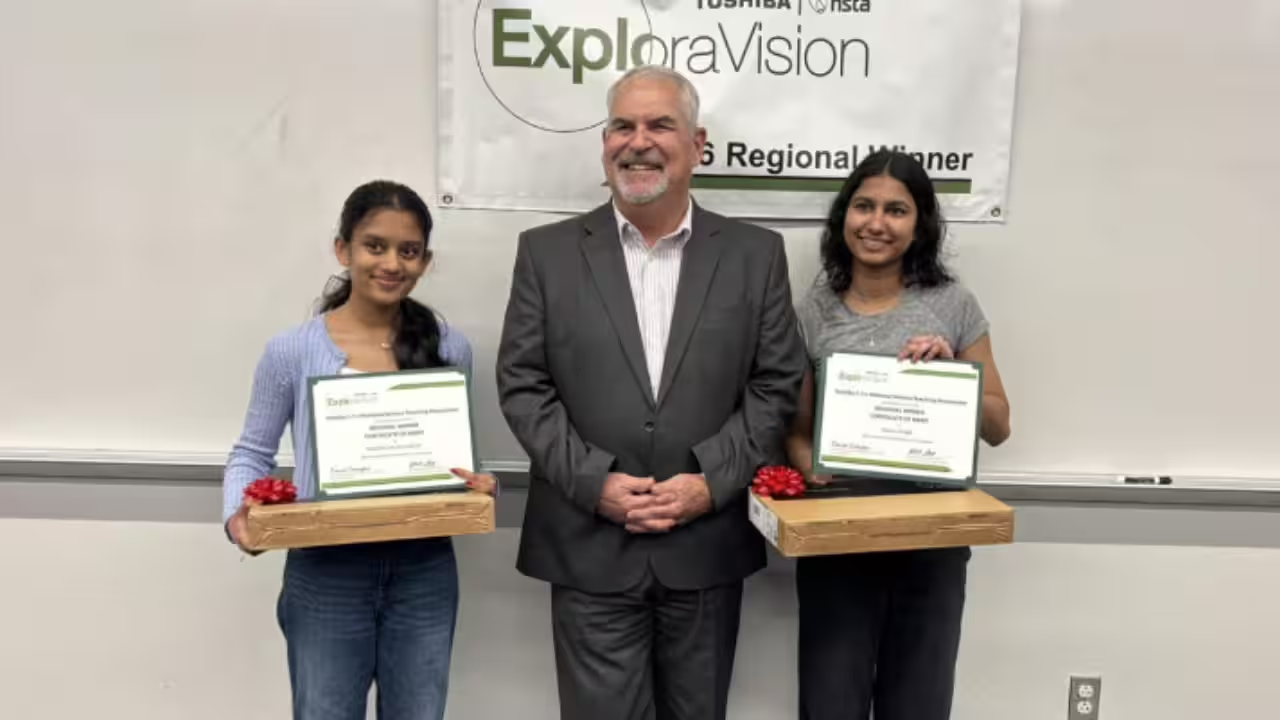
For two freshmen at Allen ISD’s Lowery Freshman Center in Texas, a science competition project has moved well beyond the school classroom. According to the Toshiba STEM Education Instagram post, Nikhitha Swaminathan and Aanya Jindal have been named national winners of the Toshiba/NSTA ExploraVision competition after developing an idea for controlling heat without relying on conventional active cooling systems. Their project, called “Micro-Gap Thermal Diode for Passive Heat Control”, looks at how heat could be managed in electronics, data centres and spacecraft. The pair had already secured regional recognition before advancing to the national stage. Their latest result places them among the student teams recognised by the long-running K–12 science competition.Texas students turned a future-focused idea into a national winning projectSwaminathan and Jindal’s achievement was built over several stages of the ExploraVision competition. Before being announced as national winners, the two students had been recognised as regional winners, an earlier milestone that was marked at Lowery Freshman Center.The school celebration brought together Toshiba’s John Ausmus with Principal Jill Stafford and House Principal Moriah Ahlfinger. By then, the students’ project had already progressed through the competition’s selection process. The national result now completes that run with the pair taking first place in the Grade 7-9 division.ExploraVision has been running for 34 years and is organised by Toshiba in partnership with the National Science Teaching Association (NSTA). Rather than asking students simply to demonstrate an existing scientific principle, the competition asks them to consider where current technologies could lead over a period of at least a decade.Students develop a future-focused approach to managing heat flowTheir entry focuses on a problem that appears across several areas of technology: how to move and manage heat efficiently. The project’s proposed micro-gap thermal diode is intended as a passive method of heat control, meaning the concept is designed around managing heat flow without depending on the same kind of active systems normally used to regulate temperature.The students identified potential applications in electronic equipment, data centres and spacecraft. These environments can all face demanding thermal conditions, although the practical requirements differ from one setting to another.In a data centre, for example, controlling heat is closely tied to the operation of computing equipment. Spacecraft present a different set of constraints, with thermal management forming part of the wider engineering challenge of operating equipment beyond Earth.The students’ proposal is therefore less about a single device for one industry and more about a possible approach to handling heat across several types of technology.How ExploraVision shaped the ideaExploraVision asks students to begin with technologies that exist now and then project how those technologies could develop to address practical problems in the future. The competition is open to K–12 students, with teams researching a technology and presenting a vision for what it could become at least 10 years ahead. That framework gives students room to work with technologies that are still conceptual. Swaminathan and Jindal used that opportunity to centre their project on thermal control, taking a subject that is often part of engineering systems and turning it into the focus of their proposed innovation.Their national win came in the competition’s Grade 7-9 category, placing the two Allen ISD students at the top of their division.Recognition comes with a $10,000 awardAccording to Allen ISD, the national first-place result also carries a financial award. Each member of the winning team will receive a $10,000 US Series EE Savings Bond at maturity. Swaminathan and Jindal are also due to attend an awards ceremony in Washington, D.C., in June. The event will give the students an opportunity to present their project and receive recognition alongside other national winners.For the Allen ISD students, the Washington ceremony follows a progression that began with their regional award and continued through the national judging process.Students’ future heat-control idea earns a place on the national stageThe subject of their entry sits at the intersection of several engineering fields. Heat is an unavoidable part of electronic systems, and managing it becomes increasingly important as equipment operates under demanding conditions. The same broad issue appears in spacecraft, where systems have to function within tightly controlled thermal environments.Swaminathan and Jindal approached that challenge through the idea of a micro-gap thermal diode for passive heat control. The project does not represent a commercial product already being deployed in data centres or spacecraft. It is a future technology concept developed for the ExploraVision competition.For Nikhitha Swaminathan and Aanya Jindal, that exercise has resulted in a national first-place award and an invitation to present their work in Washington. Their project began as a school science entry, but its focus reaches into the same thermal-management questions faced by engineers working with computing systems, electronics and spacecraft.You use AI every day. Now get your AI Quotient. Take the AIQ test.
Topics in this story
Gathered from external sources. Rights to this text belong to whoever originally published it.