Student grievances, cost-of-living crisis, political discontent: Why are protests turning violent in France
France’s student-led protests over teacher shortages, overcrowded classrooms and deteriorating school facilities have widened into a nationwide movement
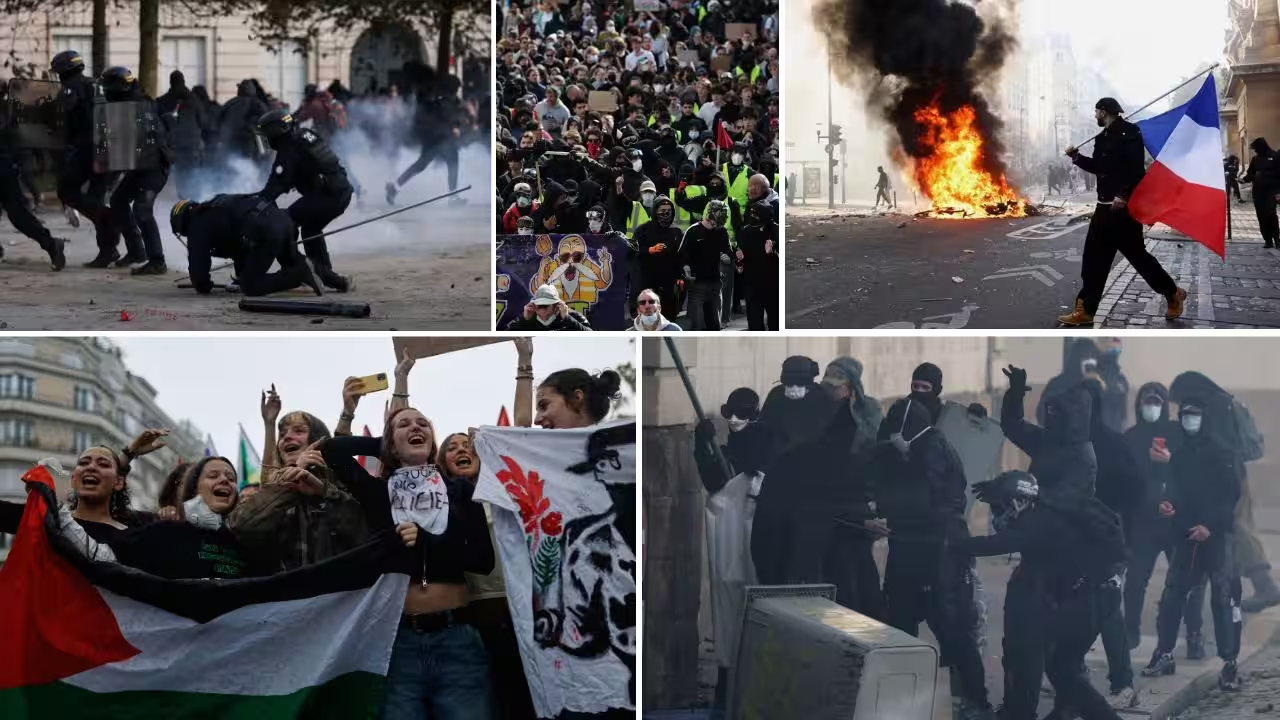
France’s student-led protests over teacher shortages, overcrowded classrooms and deteriorating school facilities have widened into a nationwide movement fuelled by economic anxiety, anger over police conduct and growing political discontent ahead of the 2027 presidential election. The demonstrations, which began in the Paris suburb of Créteil in mid-September, have drawn in trade unions, parents and activists associated with the Yellow Vest movement, with some protests escalating into clashes, arson and looting.On Saturday, looters targeted luxury boutiques, an Apple Store, supermarkets and other businesses across several French cities as demonstrations against the cost of living intensified. The unrest spread across Paris, Marseille, Lille and Nice, with reports of vandalism, fires and confrontations with police. Prime Minister Sébastien Lecornu said the weekend's clashes had resulted in more than 1,200 arrests and 150 injured police officers, while President Emmanuel Macron vowed to prosecute those involved in violence and looting.The protests have evolved from demands for better educational resources into a broader expression of frustration over inequality, purchasing power, public spending and a political establishment struggling to address competing demands. The approaching presidential election has added another dimension, with political parties seeking to influence the movement and position themselves ahead of the 2027 vote.Also read - Watch: Historic French town hall burnt, tear gas fired as 5,50,00 protest in FranceHow the protests beganThe unrest began on last month in September, when students at Lycée Saint-Exupéry in Créteil, an underprivileged suburb of Paris, protested against a shortage of substitute teachers, overcrowded classrooms and inadequate school facilities. Students and teachers raised concerns about deteriorating educational standards and classrooms that had become difficult to use following summer heatwaves.The movement spread through social media, with students blocking school entrances and piling rubbish bins outside campuses to prevent access. Demonstrations soon reached cities including Lille, Bordeaux, Marseille, Lyon, Nantes and Rennes. What began as a localised dispute over school conditions developed into a wider campaign against inequalities in education and the government's handling of public services.The grievances reflect a broader concern that students in under-resourced public schools face disadvantages compared with those attending better-funded institutions. In France, access to elite higher education and the career opportunities associated with it remains a central route to social mobility. Protesters argue that unequal school conditions undermine the country's stated commitment to equality.The mobilisation gained momentum as public-sector workers prepared to strike against government budget proposals. By late September, the student movement was intersecting with opposition to spending cuts and plans to rein in public finances, creating a wider platform for dissatisfaction with the government.From school blockades to street violenceThe first major escalation came as student demonstrations coincided with public-sector strikes in late September. The Union Syndicale Lycéenne called for national action, while students at hundreds of schools blocked entrances using bins and barriers. Although many demonstrations remained peaceful, confrontations were reported at several locations, with police deploying tear gas and protesters throwing objects and setting rubbish bins on fire.By September 30, the education ministry said around 400 schools had experienced protests or disruptions. More than 440 people were detained, most of them minors, according to officials. The unrest continued into October, with fires reported at schools and clashes spreading to additional cities.The response by law enforcement became a major source of anger. On October 5, a 15-year-old boy lost his hand after a police grenade exploded during a protest in Lens, northern France. The incident intensified criticism of the authorities' handling of demonstrations and sharpened concerns about the use of force against young protesters.The scale of mobilisation grew further on October 6, when high school students were joined by university students, teachers, parents and trade unionists. Estimates of participation ranged from 256,000, according to the government, to 450,000, according to unions. While many marches began peacefully, violence broke out in several cities, including Paris, Lyon and Rennes.The government subsequently promised to recruit 3,000 substitute teachers and review school hours. Student unions rejected the proposed measures as insufficient, and further strikes and demonstrations followed. By October 13, cars had been set ablaze and riot police had used water cannon and tear gas in Paris and Nantes.Why the cost-of-living crisis mattersThe student movement has expanded amid growing anxiety over household finances and purchasing power. France's cost-of-living pressures have added to dissatisfaction with the government, particularly as fuel prices have risen since the start of the US-Iran war earlier this year. The economic strain has helped bring the student protests closer to the concerns of workers and other groups already critical of government policy.The Yellow Vest movement, which emerged in 2018 and 2019 in opposition to fuel taxes and wider economic grievances, has again become part of the protest landscape. Its earlier demonstrations reflected resentment among people who felt that economic decisions made in Paris placed a disproportionate burden on households outside the country's wealthier circles.Trade unions have also opposed the government's proposed budget savings and public-sector pay restraint. France has been trying to rein in its public deficit while dealing with a mounting debt burden. The draft 2027 budget includes a proposed €54 billion savings drive, which has become a focal point for opposition among public-sector workers and others concerned about the future of public services.This has created a difficult balancing act for the government. Authorities are under pressure to control public spending, while students, teachers and unions are demanding more resources for schools, better working conditions and measures to protect purchasing power. The convergence of these demands has helped turn a school-focused movement into a broader protest against economic and political priorities.Inequality and anger over educationThe protests have also exposed longstanding concerns about inequality in France's education system. Students have complained about teacher shortages, overcrowded classrooms and deteriorating facilities, arguing that poor conditions disproportionately affect disadvantaged communities.The movement's origins in Créteil, a working-class suburb outside Paris, have reinforced concerns about unequal access to educational opportunities. Students from underfunded public schools may find themselves at a disadvantage compared with peers who attend better-resourced institutions and have greater access to academic support.These concerns extend beyond school infrastructure. Protesters have raised questions about whether France's promise of equality is reflected in the opportunities available to young people from different social and economic backgrounds. The concentration of political power, elite education and economic opportunity in Paris has also contributed to resentment among communities that feel neglected.The protests have drawn support from parents who believe demonstrations are necessary to force the government to address educational inequality. Three students told the BBC: “France likes to speak of égalité, but the reality is the poor here are prejudiced against, while the rich benefit”.The demonstrations have also revived memories of the May 1968 student movement, which grew into a major general strike after workers joined the protests. The latest mobilisation has similarly expanded beyond campuses, although its immediate demands and the circumstances surrounding it are different.How protests turned into urban riotsThe movement underwent a major transformation on October 17, when student groups, labour unions and Yellow Vest activists converged during nationwide demonstrations. The protests, which drew more than 550,000 participants according to figures cited in the supplied material, were accompanied by widespread violence and looting in several cities.In Paris, looters broke into shops near République Square, throwing skincare products and mobile phones into crowds. A nearby bar, La Barrique, was ablaze, while the monument at the square was covered in graffiti and paving stones were ripped up. Youths also broke into a supermarket and threw bottles and cans at police officers.In Marseille, protesters vandalised dozens of shops, including luxury brand Hermès and businesses selling jewellery, clothing, cosmetics, household appliances and bread. Firefighters responded to a blaze at a shoe shop. In Lille, an Apple Store was targeted, while shops, sportswear outlets and a motorcycle dealership were looted in Nice.Other reports described attacks on public buildings and state symbols, including a fire that severely damaged Limoges town hall and an attack on Marseille City Hall. A tourism office in Lyon was also reported to have been set ablaze. The incidents marked a shift from school blockades and marches to widespread attacks on businesses and public property.The violence has complicated the movement's demands for educational reform and economic relief. While many demonstrators have focused on school conditions, public spending and inequality, looting and arson have prompted a tougher response from authorities and given political leaders grounds to condemn the unrest.Political battle ahead of 2027 electionThe protests have unfolded as France prepares for its 2027 presidential election, with political parties seeking to position themselves around public anger. Prime Minister Sébastien Lecornu has accused the radical-left La France Insoumise (LFI) party of exploiting the student movement for electoral gain.“Members of [Mélenchon's] France Insoumise (LFI) are instrumentalising the high school movement for their electoral advantage,” Lecornu said on Wednesday, accusing the party of encouraging protests while condemning violence.LFI leader Jean-Luc Mélenchon has attracted support from demonstrators who back proposals including a wealth tax, improved education and lowering the voting age to 16. The party's position has placed it at the centre of the political debate over how the government should respond to the unrest and the demands behind it.The election has also intensified wider political competition. Marine Le Pen's National Rally and Mélenchon's LFI have drawn support from voters disillusioned with the political establishment, albeit from opposing ends of the political spectrum. The protests have created another challenge for the government as parties seek to translate economic anxiety and dissatisfaction with public services into electoral support.The political divisions reflect a wider crisis of confidence in the country's institutions. France's fragmented parliament and difficulties in building stable governing coalitions have complicated efforts to agree on spending priorities and economic reforms. The approaching election has increased pressure on political leaders to respond to public anger while avoiding commitments that could worsen the country's financial position.Government faces pressure to restore orderThe French government has condemned the violence while acknowledging the need to address the grievances behind the protests. Prime Minister Sébastien Lecornu faces pressure to tackle teacher shortages, poor school infrastructure and public service dissatisfaction as his government tries to rein in spending and manage the country's mounting debt.President Emmanuel Macron vowed action against those involved in vandalism and looting, saying: "those who carried out vandalism, attacked administrative offices or businesses, or carried out looting -- even in our town halls, will be prosecuted and punished".The government faces the twin challenge of restoring law and order while addressing demands for better education, relief from rising living costs and greater equality. While injuries to police personnel and damage to shops and public buildings have intensified calls for a crackdown, the injury to a teenage protester has fuelled criticism of the police response. With France set to hold presidential elections in 2027, the government's handling of the protests could influence the political debate in the months ahead.You use AI every day. Now get your AI Quotient. Take the AIQ test.
Topics in this story
Gathered from external sources. Rights to this text belong to whoever originally published it.