London designer turns waste mussel shells and local Thames sand into glass; wins £10,000 Design Museum prize
London designer Lulu Harrison has won the 2025 Ralph Saltzman Prize from the Design Museum for Thames Glass, a project that turns locally sourced and
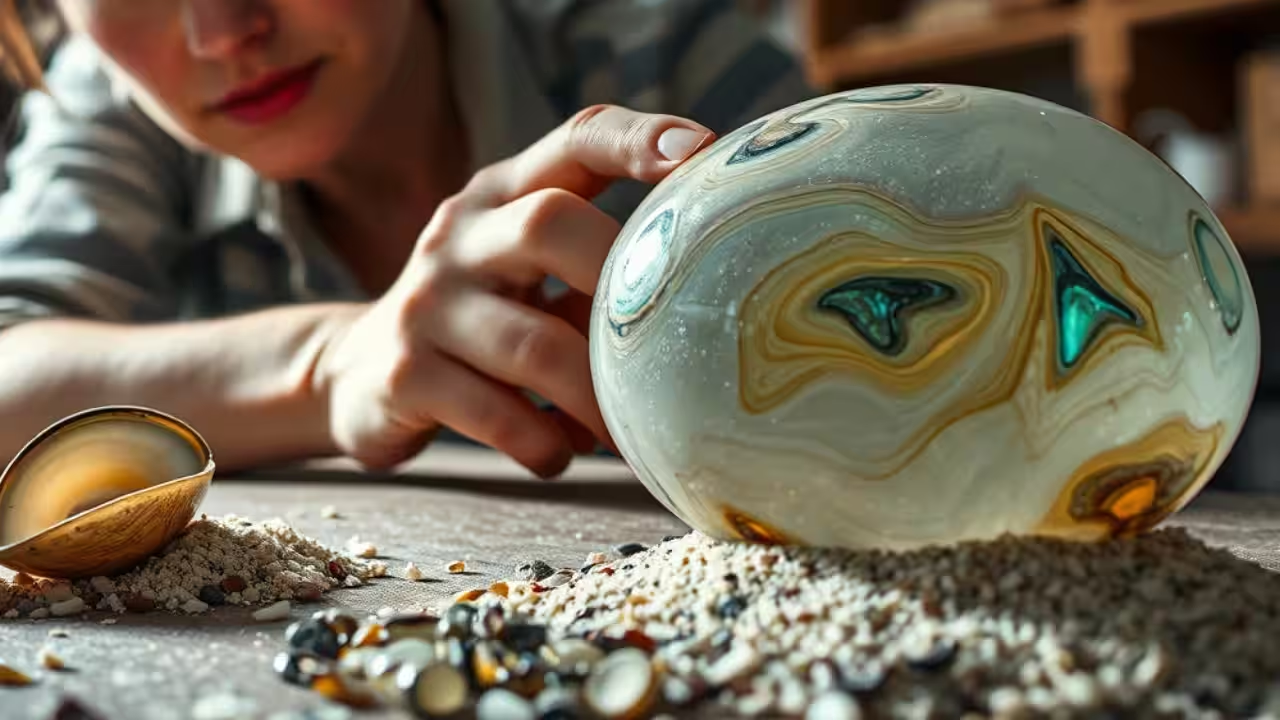
London designer Lulu Harrison has won the 2025 Ralph Saltzman Prize from the Design Museum for Thames Glass, a project that turns locally sourced and waste materials into glass. Harrison's recipes use materials including sand from around the River Thames, wood ash and waste quagga mussel shells supplied by Thames Water. The Design Museum describes Harrison as a geo-alchemist glass artist whose project explores the possibility of creating geo-specific glass from abundant and waste materials associated with a particular place. Harrison was selected as the fourth recipient of the annual prize by a jury comprising industrial designer Konstantin Grcic, material designer Seetal Solanki, artist and designer Stephen Burks and design journalist and author Michelle Ogundehin, alongside Lisa Saltzman. The judges praised Harrison's research and her approach to mapping the raw materials used in the glass and communicating that process to audiences. She received a £10,000 bursary to continue developing her work.Quagga mussel shells became one of the key ingredientsA central component of Thames Glass is the shell of the quagga mussel, an invasive non-native species that can cause blockages in Thames Water's transfer tunnels and has to be removed. Harrison says her collaboration with Thames Water gave her access to the waste shells, which would otherwise require disposal. She combines ground-up mussel shells with local sand and waste wood ash to create different glass recipes. Her own project description says the work began with experiments using local and waste materials sourced in and around the Thames, including waste shells from water companies and wood ash or bracken from surrounding forests. The resulting glass has been used to create objects including carafes, tumblers and other vessels, with the material's natural impurities contributing to its distinctive appearance. Harrison developed the project while studying for an MA in Material Futures at Central Saint Martins and has worked with glassblowers, glass chemists and glass archaeologists during its development.Thames Glass grew from a collaboration with Thames WaterThe project developed through Harrison's work with Thames Water while she was studying at Central Saint Martins. Harrison has said that the collaboration helped her find a use for the tonnes of quagga mussel shells being removed because the animals were blocking water infrastructure. Her early work produced prototypes of a Thames Glass carafe and tumbler, while later experiments explored other forms and applications. Central Saint Martins documented the project in 2022, describing Harrison's use of local sands, waste shells and wood ash and her collaboration with Thames Water. Harrison has also worked with Here Design, glassblowers and other specialists to develop the material and its applications. Rather than presenting Thames Glass as a replacement for conventional glass, Harrison describes the project as an exploration of alternative glassmaking recipes based on materials associated with a particular geographical area.The material has also been tested as architectural claddingHarrison later worked with London architecture studio Bureau de Change to investigate whether Thames Glass could be used on buildings. The collaboration produced a series of cast glass façade tiles made using the material, with patterns inspired by London's architectural history, including designs found on 19th-century terracotta chimney pots. The tiles were presented as part of Beautility: How Fusing Beauty and Function Can Change the World, an exhibition curated by Here Design during London Craft Week. Bureau de Change says the project explored whether Thames Glass could be used as an alternative material for building cladding, while Harrison's own project page describes the tiles as an exploration of future applications for the material. The collaboration therefore moved Thames Glass beyond vessels and into architectural experimentation, although the work remains a design and material research project rather than an established commercial building product.The prize will support Harrison's next stage of researchThe Ralph Saltzman Prize gives Harrison £10,000 to continue developing Thames Glass and provides an opportunity to display the project at the Design Museum. The museum describes the prize as an annual award for emerging product designers whose practices explore new directions in design, including technical innovation, sustainability and cultural re-evaluation. Harrison's 2025 project was displayed at the museum from June 24 to August 25, 2025. In describing the award, Harrison said her practice is driven by research, process, collaboration, experimentation and hands-on making, connecting craft and science while exploring more localised possibilities for glassmaking. Thames Glass is still fundamentally an experimental material project, but its use of waste quagga mussel shells, local sand and waste ash demonstrates how materials removed from one system can become ingredients in another.You use AI every day. Now get your AI Quotient. Take the AIQ test.
Topics in this story
Gathered from external sources. Rights to this text belong to whoever originally published it.