In 1983, Atari dumped truckloads of unsold video games in a New Mexico landfill; when the site was excavated in 2014, about 1,300 cartridges were recovered, with some later selling for hundreds or thousands of dollars
US News: In a shocking revelation, Atari buried truckloads of video game cartridges, including the infamous E.T. game, in a New Mexico landfill in 1983. In 2014, over 1,300 cartridges were excavated, with some fetching thousands of dollars at auction, changing the narrative of video game history forever.
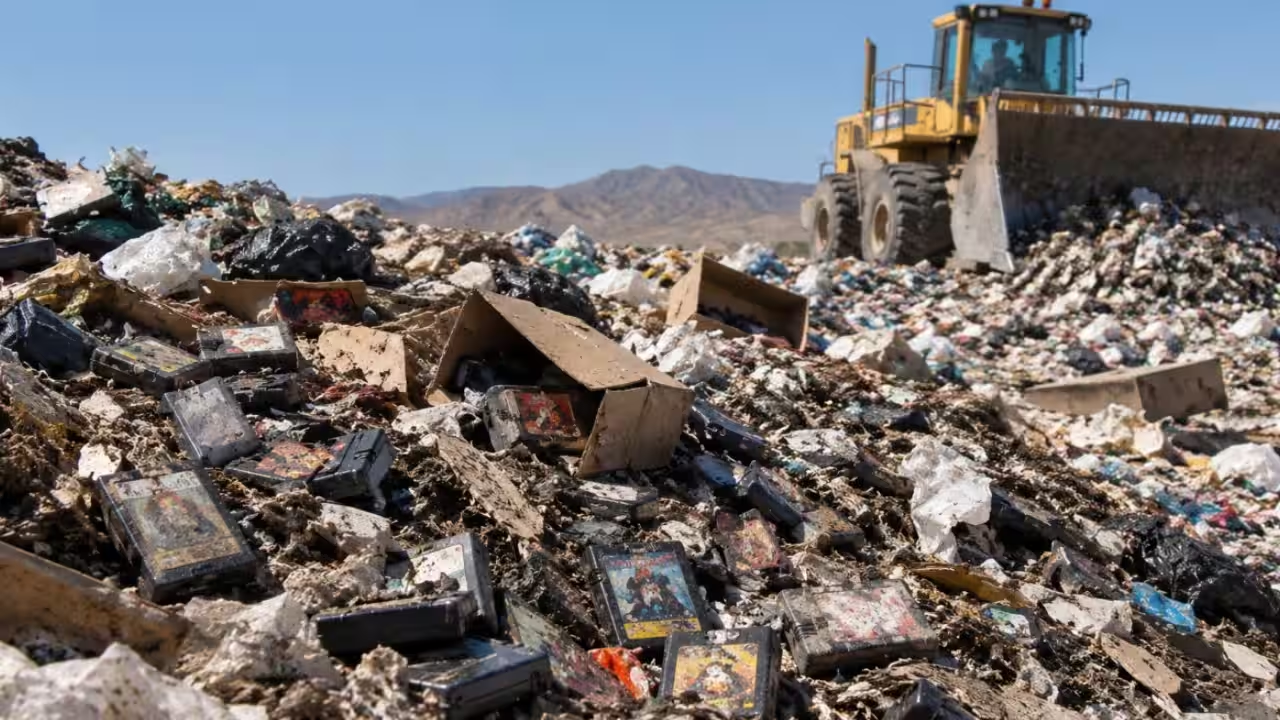
At a landfill in Alamogordo, New Mexico, in September 1983, Atari disposed of truckloads of video-game cartridges and computer equipment. Among the material were cartridges for E.T. the Extra-Terrestrial, the Atari 2600 game that was closely associated with the company’s troubles. More than 30 years later, an excavation at the landfill recovered about 1,300 cartridges, turning a decades-old industry story into tangible evidence. Subsequently, some of the recovered games were auctioned online for hundreds of dollars, whereas E.T. cartridges were sold for more than $1,500.A contemporary report published on September 28, 1983, suggested that the company dumped 14 truckloads of video-game and computer equipment at the landfill in New Mexico. The material allegedly came from Atari’s El Paso, Texas, operation. An Atari spokesperson claimed at the time that the items were simply defective components being discarded. However, this factory-defect explanation clashed with the reality of the situation; the site had actually reportedly become a graveyard for millions of functional, unsold retail returns that the company could no longer afford to store. E.T., Pac-Man and Ms. Pac-Man were some of the games dumped at the landfill.How E.T. became linked with Atari’s troublesDuring a crucial Christmas shopping season, Atari released its adaptation of Steven Spielberg’s 1982 film for the Atari 2600. According to the Smithsonian’s National Museum of American History, programmer Howard Scott Warshaw was given only five and a half weeks to complete the game. This was significantly less time than a conventional development period of six to nine months. The company also allegedly needed to sell roughly four million cartridges to recover the cost of the licensing deal, but sales fell far short of that target.Atari was already facing much bigger market problems. And the game’s commercial difficulties only made things worse for the company. The Smithsonian account notes that the Atari VCS, later known as the Atari 2600, was facing competition from systems including Mattel’s Intellivision and Coleco’s ColecoVision. Meanwhile, independent publishers were also adding large numbers of games to the market. The resulting video-game crash was not caused by E.T. alone, as the industry’s downturn had several other causes as well.By 1983, Atari had substantial quantities of unnecessary inventory. WIRED’s account of the Alamogordo excavation reported that stores had begun returning unsold products, and that Atari’s El Paso operation was poorly equipped to refurbish or otherwise handle all the returns. The company eventually transported pallets of games and computer equipment from El Paso to Alamogordo, where the landfill was considered less vulnerable to scavengers.The story from a reported dump to a 2014 excavationFor decades, the story became increasingly distorted. During the 2014 excavation, WIRED reported that the original incident had morphed in the public imagination into an urban legend: Atari having buried huge quantities of E.T. cartridges specifically, even though contemporary reporting suggests that multiple Atari games and hardware were involved. This uncertainty over the exact contents helped turn the massive dumping into gaming folklore.Fuel Entertainment took the initiative to settle the mystery in 2013 when it pursued the opportunity to excavate the landfill for a documentary project. Joe Lewandowski, a local garbage contractor, had knowledge of the site's history and helped researchers identify the likely location of the burial. Eventually, the excavation was carried out on 26 April 2014, with filmmakers, archaeologists and other working professionals searching the landfill.Excavators found Atari 2600 cartridges including E.T., Asteroids, Pac-Man and other titles. Atari hardware was also recovered from the site. This served as evidence that the site was a broader Atari disposal area rather than a graveyard devoted exclusively to one game. The City of Alamogordo subsequently reported that approximately 1,300 cartridges had been recovered, and in September 2014, the city voted to auction 800 of them. The recovered games were considered valuable, particularly because their archaeological provenance could be documented.When landfill debris turned into collectable historyAlmost immediately after the excavation, the transformation from discarded inventory to collectable had begun. In November 2014, the Tularosa Basin Historical Society put around 100 recovered games up for auction on eBay. This included E.T., Centipede and Defender as well. Reports from various sources claimed that the auctions started between $50 and $100, while a particularly desirable E.T. cartridge had already attracted bids exceeding $400 before the auctions closed. Each of the games came with a certificate of authenticity linking it to the Alamogordo excavation.In August 2015, Ars Technica reported that 881 recovered Atari cartridges sold for a combined $107,930.15 in a series of eBay auctions. The City of Alamogordo received about $65,000 from the total sales, while the Tularosa Basin Historical Society also received a share. The most expensive cartridge in that sale was an E.T. copy that fetched $1,535.Catch the latest World News and Live updates. Download the TOI app.
Topics in this story
Gathered from external sources. Rights to this text belong to whoever originally published it.