Drumcree dispute: Four key takeaways so far
BBC News NI's Political Editor Enda McClafferty assesses the fallout from the Drumcree dispute so far.
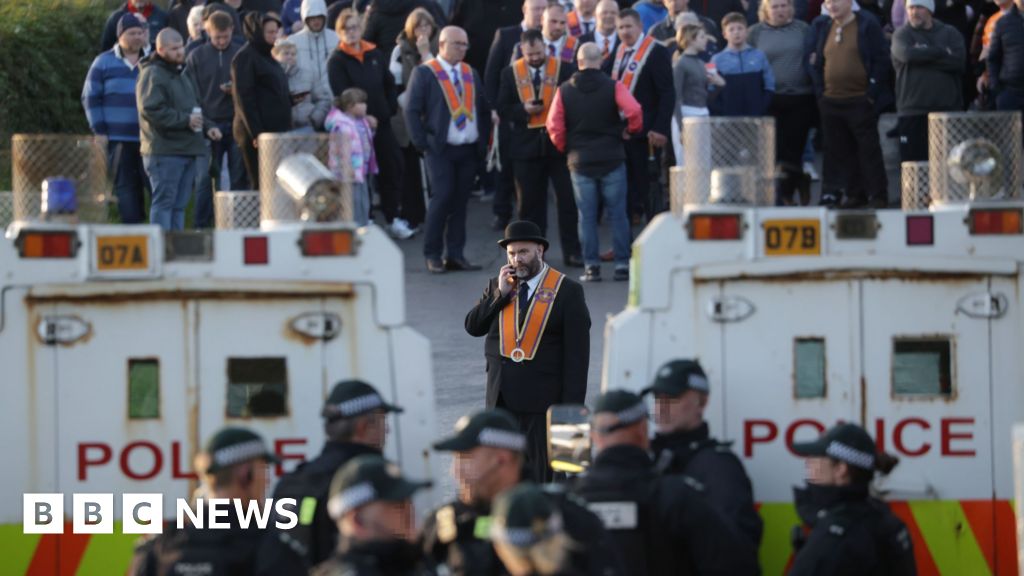
For a number of years in the 1990s, the Drumcree parade dispute was one of the biggest stories in Northern Ireland - and then, for 28 years, it fell out of the public eye.
However, that changed when the Parades Commission ruled that the march on Sunday 27 September could go ahead with restrictions in place.
That parade did not happen and, after a series of legal challenges and talks between residents and Orangemen, the secretary of state banned the procession .
On Saturday, a High Court judge said a legal appeal by Orangemen following the secretary of state's decision was not an emergency case and adjourned the hearing until Monday.
BBC News NI's Political Editor Enda McClafferty assesses the fallout so far.
Where does this leave the secretary of state?
As steep learning curves go, this one was off the scale.
Less than three months into the job, Sir Chris Bryant has had to make what will be the biggest decision of his time in Northern Ireland.
He will be forever remembered as the first secretary of state to ban what was a legal Orange parade.
But he says he was left with no option in the interest of peace.
The police had already ruled out forcing the parade through and when negotiations broke down, he had to step in.
The secretary of state had the power to act alone, but it was politically easier to have the cover of a police request.
Though making such a significant announcement late on Friday night was not ideal.
He clearly wants to move on with Westminster returning from recess on Monday and legacy legislation to be fast tracked through the Commons.
But the legacy of his Drumcree decision will follow him for some time and will likely scupper any hope he had of fostering good relations with unionists.
It could have been a moment of great jeopardy for power-sharing at Stormont.
The moment when the Democratic Unionist Party (DUP) bowed to pressure and effectively collapsed the Executive.
But the party moved quickly to remove that threat within hours of the Orange parade being banned from the Garvaghy Road.
Party leader Gavin Robinson insisted they "will not sacrifice the stability of Northern Ireland and plunge it into further crisis".
To do so, he said, would allow "Sinn Féin an escape route from the spotlight and accountability".
For the DUP, pulling down the institutions was high risk with an election on the horizon.
History shows parties who walk away from Stormont pay a heavy price at the polls.
Especially before a budget is agreed to approve public sector pay rises thus avoiding strikes.
The DUP has opted instead to keep the focus on potential lawbreaking by Sinn Féin ministers.
It allows for more tough talking in the chamber even though the punishment if convicted will result in fines.
Though some in the DUP question if the institutions can be "sustainable" if First Minister Michelle O'Neill and her executive colleagues are found to have broken the law.
That will be a calculation for another time and much will depend on the proximity of polling day.
But the Drumcree dispute has delivered for Sinn Féin.
It provided the platform to supercharge its election campaign and helped deflect from questions around delivery at Stormont.
Though the court ruling clearing the way for the A5 has eased some pressure on the party.
But it delivered on its promise to residents to ensure no parade down the Garvaghy Road.
In truth any prosecutions they may face for standing with residents will be viewed by many within the party as a badge of honour.
The Police Service of Northern Ireland (PSNI) had five million reasons to bring the Drumcree dispute to an end.
That's how much the policing operation has cost for the past fortnight at a time when the police budget is already stretched.
A bill which would have been much higher had officers faced any violent disorder.
But the true cost for the PSNI may come in its relationship with the Orange Order and wider unionist community.
Allegations of two-tier policing have resurfaced but so far there have been no calls from unionist leaders for the chief constable to quit which is telling.
Forcing the parade through was never an option for the police.
Public safety risks aside, the potential to damage relations with nationalists was too great.
With the latest PSNI recruitment campaign being launched on Monday, the service couldn't afford to further alienate potential Catholic recruits.
It was a body set up to resolve parading disputes, not to restart them.
That has been the charge directed at the commission by many over the past fortnight.
Its determination, allowing an orange parade down the Garvaghy Road for the first time in 28 years, caught everybody by surprise, including those in the loyal order.
It also triggered a spat with the PSNI who tried to distance itself from the determination.
The commissioners are now the first to have their decision reversed by a secretary of state, although they will say conditions and the police advice had changed.
But there is no escaping the reality that public confidence in the body has been damaged.
Restoring that trust won't be easy, nor will finding replacements for the current commissioners when their term comes to an end.
Topics in this story
Gathered from external sources. Rights to this text belong to whoever originally published it.