Over 5,500 trees recorded across Sussex in restoration project
The Lost Woods of the Low Weald and Downs project aims to restore some of Sussex's ancient woodland.
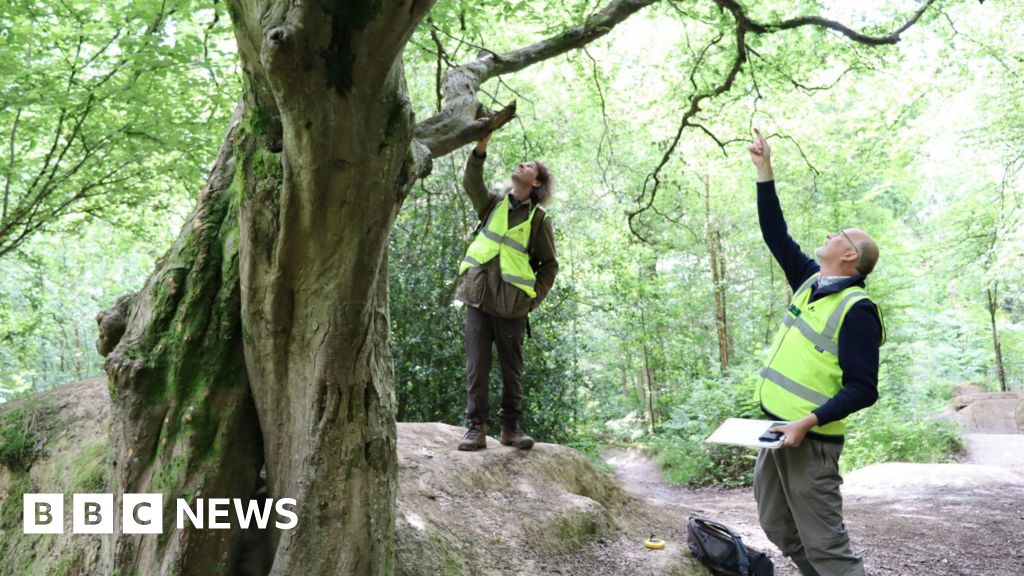
A project which aims to restore ancient woodlands in Sussex has hit a significant "milestone" with over 5,500 trees now recorded.
Since March 2024, volunteers with the Lost Woods project have been recording ancient, veteran and notable trees across a 121-sq-miles (314-sq-km) area from Lewes to Storrington.
According to the latest figures, they have now recorded 5,570 trees, a number which Lost Woods outreach adviser, Bob Epsom, said is more than "we expected" and signifies a "milestone" for the project.
"When we look at the map of it, we can see the new clusters of trees being added...that's where the volunteers have been active," he said.
The Lost Woods is a partnership with four charities: Woodland Trust, Action in Rural Sussex, Sussex Wildlife Trust and Small Woods Association.
The work, funded by the National Lottery Heritage Fund, is part of a wider Lost Woods restoration programme which Epsom said comprises "19 individual projects".
About 20 volunteers are each given a square kilometre area to cover, and once recorded and verified, trees are added to the Ancient Tree Inventory which has been mapping the oldest and most important trees in the UK for 20 years.
The volunteers are working to find and record every ancient and veteran tree in the project area by next year, and Epsom, who leads the team, said they still "have a reasonable amount to cover".
Of the 5,570 trees recorded, there were 348 ancient trees, those that are in the third and final stage of their lives, and 2,467 notable trees, mature trees which are large in comparison with other trees around them.
The biggest proportion of trees, 2,743, are veteran, survivors which have developed some of the features found on ancient trees.
The remainder fall into a different category of tree.
According to Epsom, these trees are "very important for the landscape, (and) very important for biodiversity" because of their fungi.
Epsom said the mapping process was "only the first step", and that ultimately, there was a wider goal.
He said: "We need to make sure that trees are recognised, cared for and protected so that they can continue to support wildlife and communities for generations to come."
Follow BBC Sussex on Facebook , on X , and on Instagram and listen to BBC Radio Sussex on Sounds . Send your story ideas to southeasttoday@bbc.co.uk or WhatsApp us on 08081 002250.
New population of rare dormice found in Sussex
Topics in this story
Gathered from external sources. Rights to this text belong to whoever originally published it.