'No drones or artillery shells flying into your courtyard': Oleshky evacuees reach Ukraine after journey through Russia
Hundreds of residents from the Russian-occupied Ukrainian city of Oleshky have reached Ukrainian-controlled territory after undertaking an extraordinary
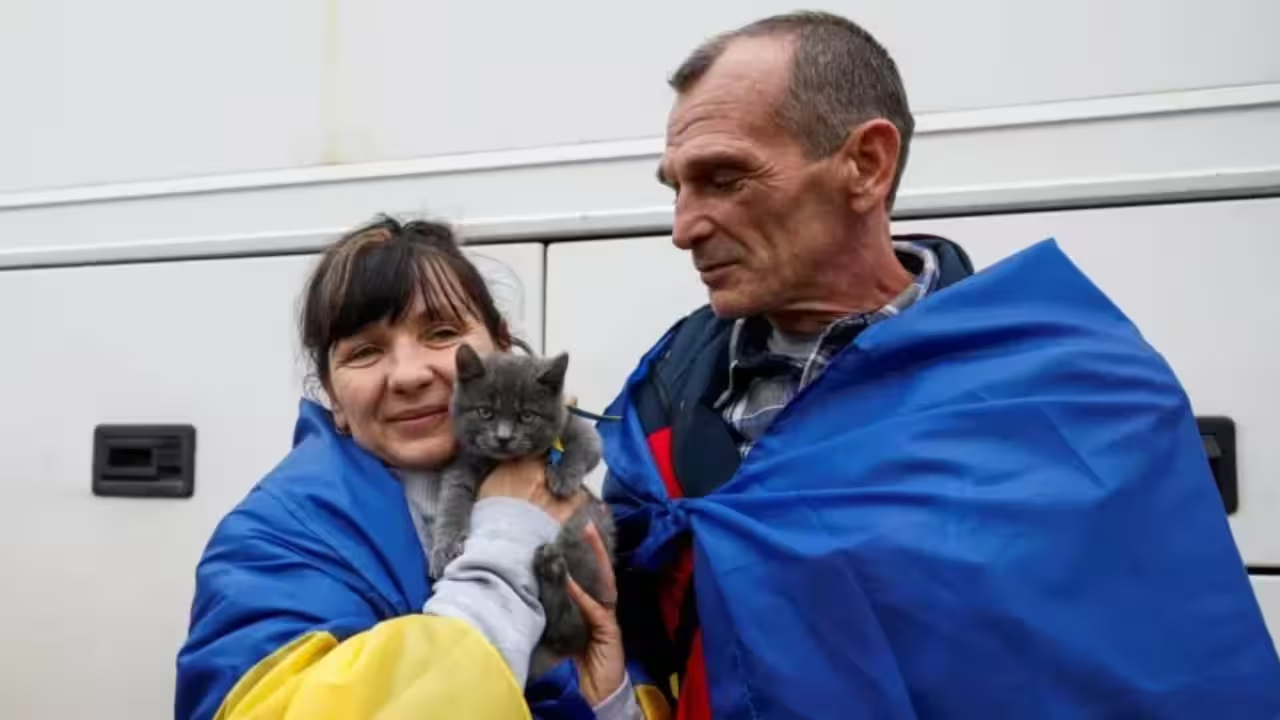
Hundreds of residents from the Russian-occupied Ukrainian city of Oleshky have reached Ukrainian-controlled territory after undertaking an extraordinary journey through Crimea, Russia and Belarus under a temporary ceasefire.According to BBC, the evacuees arrived in Ukraine's Chernihiv region on Saturday after travelling for nearly 19 hours to escape the humanitarian crisis in their city.Ukrainian President Volodymyr Zelensky confirmed the successful completion of the humanitarian operation, saying that all evacuated residents had crossed into Ukraine through the Chernihiv region.He said roads leading to Oleshky were cleared of mines during the temporary ceasefire, allowing humanitarian supplies to be delivered and residents requiring evacuation to be brought out.He also expressed hope that humanitarian access to Oleshky would continue and thanked the US and First Lady Melania Trump for their mediation efforts.The evacuation brought an emotional end to years of separation for several families. Relatives waited at the Belarus-Ukraine border to reunite with family members who had remained in Oleshky under Russian occupation.Among them was 19-year-old Liza Paliy, who had not seen her father for more than two-and-a-half years after he stayed behind when she, her mother and sister fled the city."We thought at that time that it would be a month, two maximum, and we would return, but unfortunately, two years have already passed," Liza told the Associated Press.Another evacuee, speaking to Reuters after reaching Gomel in Belarus, described the constant threat of attacks in Oleshky and why leaving had become unavoidable."Here, there are no drones or artillery shells flying right into your courtyard. Many times we were literally on a brink of death back there," the resident said, adding that large craters had appeared in their vegetable garden.Valera recalled how the prolonged isolation had pushed residents to the brink, with food becoming increasingly scarce and families relying on whatever they could grow in their gardens."There was no bread. Nothing," he told AFP, describing the struggle to find even basic food. He said residents planted vegetables and ate whatever was available to survive.Why did evacuees take such a long route to reach Ukraine?Despite Ukrainian military positions being only around 5 km from Oleshky, residents could not take a direct route into Ukrainian-controlled territory because of the active frontline, the Dnipro River and the danger posed by landmines and drone attacks. The city lies on the eastern bank of the river, opposite Kherson, which remains under Ukrainian control.Destroyed bridges and mined roads made crossing directly towards Ukrainian positions extremely dangerous. Independent attempts to escape had also resulted in casualties. According to the head of the exiled Oleshky City Military Administration, Tetiana Hasanenko, one person was killed and four others injured by landmines while trying to flee the area in September.The evacuation therefore required a carefully coordinated route through Russian-controlled territory before residents could return to Ukraine. Under the temporary ceasefire, designated roads leading out of Oleshky were cleared of mines. A convoy of 25 buses, accompanied by ambulances and humanitarian vehicles, entered the city on October 30. Residents were given a four-hour window to leave, until 14:00 local time.The residents first travelled by bus to Armyansk in occupied Crimea, before continuing to Anapa in Russia's Krasnodar region. From there, they boarded Russian government aircraft to Gomel in Belarus and finally travelled by bus across the border into Ukraine's Chernihiv region.You use AI every day. Now get your AI Quotient. Take the AIQ test.
Topics in this story
Gathered from external sources. Rights to this text belong to whoever originally published it.