South Korea tests hypersonic missile: A new threat to North Korea's underground bunkers?
South Korea has successfully tested a domestically developed hypersonic boost-glide vehicle, with footage showing the vehicle impacting the water at the
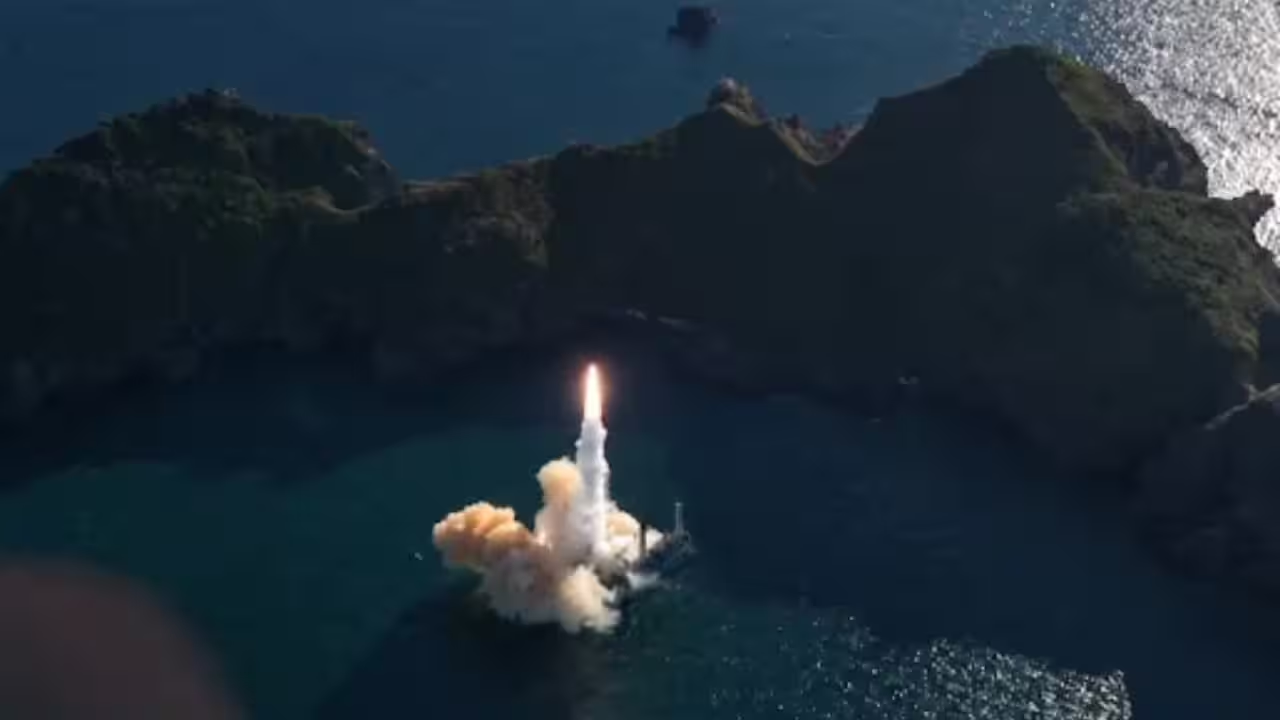
South Korea has successfully tested a domestically developed hypersonic boost-glide vehicle, with footage showing the vehicle impacting the water at the end of its flight. The missile has been tested by South Korea's Agency for Defense Development (ADD). The weapon would give Seoul a significant new way to hold targets in North Korea at risk as the arms race on the peninsula deepens. It follows the Hyunmoo-5, whose massive unitary warhead already lets South Korea threaten deeply buried and hardened targets, and fits the country's Korea Massive Punishment and Retaliation policy.At the very high speeds reached in the terminal phase, boost-glide vehicles also offer bunker-busting benefits. South Korea is also developing an air-breathing hypersonic cruise missile and new air- and sea-launched ballistic missiles for its warships and submarines. It remains to be seen when an operational capability will be fielded. Beyond North Korea, China and Russia have also been growing concerns for Seoul.Hypersonic weapons travel above Mach 5, or about 6,100 km an hour, and fall into two categories. Glide vehicles are boosted by rockets to high altitude and some of these weapons are designed to manoeuvring unpredictably while gliding to their target. Cruise missiles are powered by engines such as scramjets and fly at sustained hypersonic speeds within the atmosphere. Unlike ballistic missiles, which follow predictable arcs, both can change course mid-flight and fly low to exploit the radar horizon.Operation Sindoor showed how hard even a supersonic weapon is to stop. A missile at nearly Mach 3 flying low would be detected by ground radar at around 15 km, giving about 15 seconds to impact. At Mach 5, the same distance is covered in under nine seconds, and since most surface-to-air missiles fly below Mach 5, few systems could intercept such a weapon.Building these systems is hard, hypersonic vehicles face extreme heat and need advanced cooling, scramjet combustion is difficult to sustain, and the plasma sheath around the vehicle disrupts guidance and communications. Materials must also withstand huge stress, flying fast at low altitude demands extra power, and test facilities are scarce and costly.India's projects include the Hypersonic Technology Demonstrator Vehicle, which reached Mach 6, the planned BrahMos-II at around Mach 7, the Dhvani glide vehicle, the Long Range Anti-Ship Missile (LR-AShM) for attacking ships including carriers and the Extended Trajectory-Long Duration Hypersonic Cruise Missile (ET-LDHCM).Elsewhere, the US is pursuing the AGM-183 air-launched weapon, the scramjet-powered Hypersonic Air-breathing Weapon Concept (HAWC) and the US Navy's Conventional Prompt Strike missile. China has fielded the DF-17 with the DF-ZF glide vehicle, capable of Mach 5 to 10, and tested an orbital system in 2021. Russia has combat-tested the Mach 10 Kinzhal in Ukraine and fields the ship-launched Tsirkon at Mach 8. France is developing the V-MaX, Australia is working with the US on the Southern Cross experiment, and Japan is building a glide projectile for island defence, with deployment planned by 2030.
Topics in this story
Gathered from external sources. Rights to this text belong to whoever originally published it.