The Trump-Xi summit exposes a US disadvantage in the Global South
Washington asks for alignment while Beijing offers strategic flexibility without military entanglement.
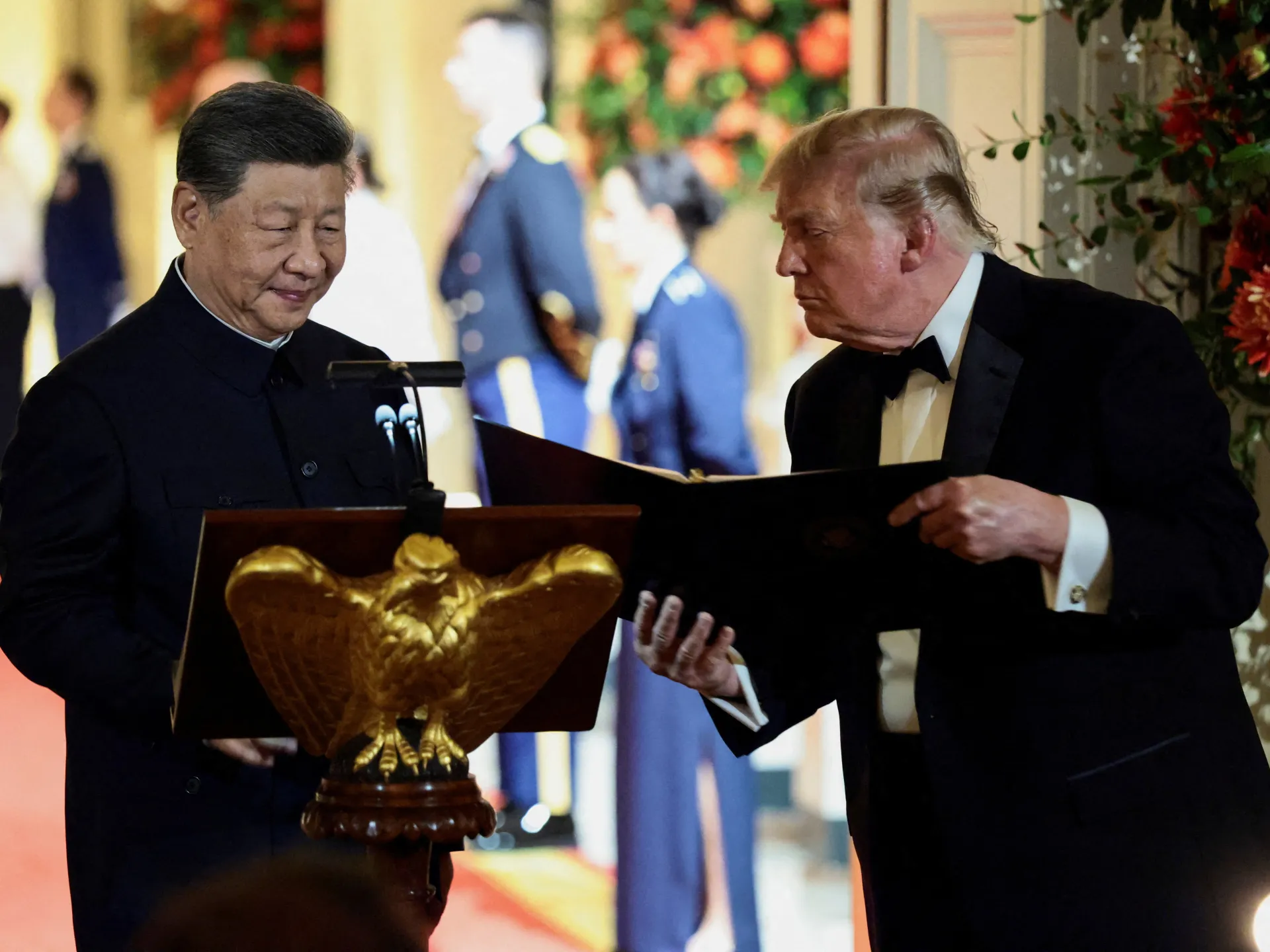
Chinese President Xi Jinping’s state visit to the United States came with all the choreography: a B-2 flyover, pandas, a Nixon-era toast. But for anyone watching from the Global South, the spectacle was beside the point. More important was Beijing’s emphasis on “constructive strategic stability” in its relationship with Washington. For capitals from Riyadh to New Delhi to Jakarta, the summit offered a glimpse of how they may navigate relations with the two powers over the rest of this decade.
Beijing emerged from the summit offering diplomatic cover without military entanglement. Washington, by contrast, came to the meeting already embroiled in the nearly seven-month US-Israeli war on Iran, pressing allies on trade, reasserting US dominance in Latin America, and demanding that the Global South choose sides in its effort to contain China, all while Trump himself toasted Xi and hailed the summit as a success. For governments across the Global South being urged to distance themselves from Beijing, that contrast will not go unnoticed.
Nowhere is this clearer than in the Gulf. Trump wants China, Tehran’s largest trading partner, to help reopen the Strait of Hormuz, choked since the US-Israeli war on Iran began in February. Xi backed a return to a ceasefire and eventual peace talks, but the Chinese readout offered no specifics on reopening the strait and no commitment to pressure Iran. Beijing appears determined to preserve its room for manoeuvre.
For Riyadh, Abu Dhabi and Doha, that has obvious advantages. China can call Tehran, issue a UN statement, or offer to mediate, all without deploying a single soldier or demanding a military base. Meanwhile, Washington is a direct party to the war, and its credibility as a security guarantor is eroded by the very crisis it helped create. Gulf capitals are already calibrating: stay under the US umbrella for hardware, but hedge through Beijing for diplomatic crisis management and energy-market stability. China’s usefulness, in other words, lies partly in the fact that it is not fighting the wars Washington is.
That calculation extends across the wider region. For Iraq, Egypt and Algeria, all watching energy prices spike and shipping lanes choke, China’s restraint has its appeal. The Global South does not need another great power to join the war; it needs someone who can talk to all sides without shooting. Beijing is positioning itself to play that role.
For governments elsewhere across the Global South, this creates a difficult set of choices. They are pressed to distance themselves from China, even as Trump himself re-engages. They are asked to absorb tariffs and supply-chain shocks, while Washington and Beijing extend their own trade truce for another two months. The result is a growing sense that other countries are expected to bear the costs of great-power rivalry while Washington and Beijing retain the freedom to negotiate with each other.
The response is already visible. India deepens its multipolar balancing, buying Russian oil while courting US tech and Chinese investment. Indonesia continues its “free and active” foreign policy, signing defence deals with both Washington and Beijing. South Africa and Brazil use BRICS platforms to hedge, not as anti-Western gestures but as insurance against a system where others write the rules. The summit did not cause this hedging, but it is likely to reinforce it.
Artificial intelligence raises a different problem for the Global South: who gets to set the rules. Xi’s emphasis on “human control” and Trump’s resistance to new AI guardrails represent two competing visions, but neither was designed with the interests of countries across the Global South at its centre. The two sides have agreed to continue a new AI dialogue and are discussing an incident-notification mechanism, but no binding rules exist. Many countries will remain dependent on AI systems, infrastructure and standards developed elsewhere, with little say over the norms that govern them. China’s state-led model may look more attractive than America’s corporate-led alternative, but it is still another form of dependence.
Yet the Global South is not entirely passive. India is building indigenous large language models and exporting its digital-public-infrastructure playbook; the United Arab Emirates has positioned itself as a major AI hub; the African Union is pushing data-sovereignty frameworks aimed at giving African states greater control over their data and digital infrastructure. These efforts are nascent but show a determination to avoid a simple choice between US and Chinese models. Beijing has tried to institutionalise its vision, launching a Global AI Governance Initiative and helping establish the World Artificial Intelligence Cooperation Organization, whose founding agreement was signed by 29 countries in Shanghai in July. For some, this offers an alternative to Western frameworks; for others, it swaps one dependency for another. The question is whether countries across the Global South can coordinate strongly enough to shape the rules themselves.
Beyond the ceremony, the broader message from the summit is already clear. Washington secured the photographs and a temporary tariff truce; Beijing secured something more strategic: recognition of the terms on which it wants the relationship managed. For governments across the Global South, the meeting reinforced an approach many are already pursuing: avoid choosing sides where possible, maintain ties with both powers and use the competition between them to preserve room for manoeuvre.
Great-power rivalry, on Beijing’s terms, is not peace. But for capitals from Riyadh to Jakarta, the space between Washington and Beijing can also create opportunities to build leverage and pursue their own interests. The challenge is to ensure that future deals between the two powers do not leave everyone else simply absorbing the consequences.
The views expressed in this article are the author’s own and do not necessarily reflect Al Jazeera’s editorial stance.
Topics in this story
Gathered from external sources. Rights to this text belong to whoever originally published it.