Indian police accused of sexual harassment against journalists at protest
The allegations were made after police detained dozens of protesters demanding the resignation of the election chief over changes to voter rolls.
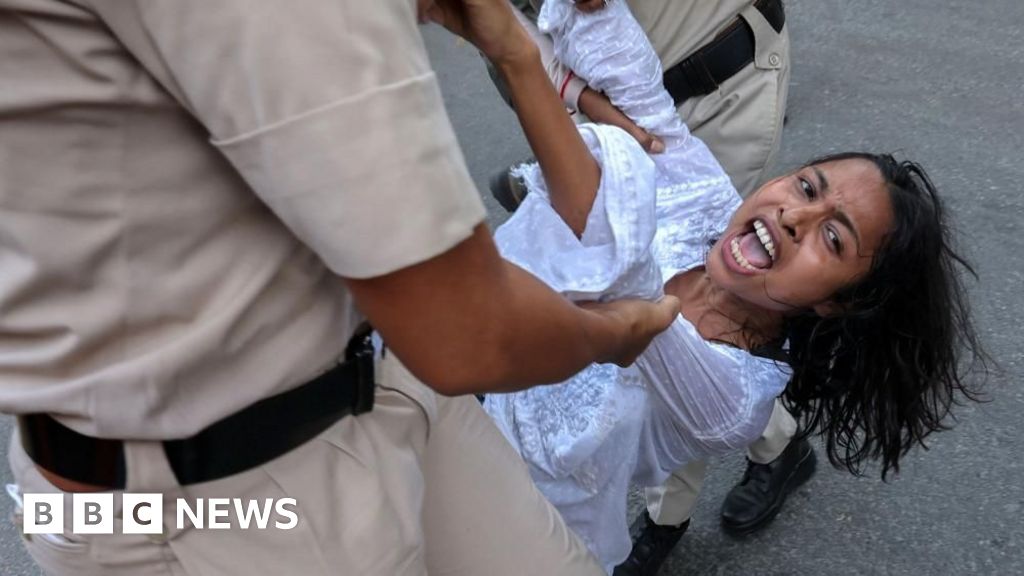
Three female journalists have accused police officers in India of sexual harassment during street protests in the capital Delhi.
The claims were made on Saturday after the force detained scores of young people calling for the resignation of the chief election commissioner.
In a post on social media, Delhi Police said its New Delhi District had received the complaint, and it had been transferred to its crime branch for a "fair and impartial" inquiry.
Thousands of protesters gathered in Delhi and Mumbai cities for a third day on Sunday demanding that Gyanesh Kumar step down over large-scale changes to voter rolls.
The Election Commission says the exercise is intended to remove duplicate and ineligible entries - and so far, 130 million names have been struck off the voters' list.
Videos online show people being physically dragged away from the Jantar Mantar protest site in central Delhi.
The accusations by the women journalists include inappropriate touching by some police.
Opposition leader Rahul Gandhi said women fear for their safety and the home ministry must "answer for this".
"Police dragged me by my hair," Aahna Singh, an activist and student at Jawaharlal Nehru University told Reuters news agency during the protests.
She said the police were resorting to "brutality".
The Press Club of India has demanded immediate action on the complaints against police officers, saying it was "shocked and dismayed" by the treatment of journalists.
"Behaviour of this kind cannot be normalised in a democracy. Journalists must be allowed to work freely, without fear, and document those who gather to raise various issues," it said in a statement.
The protesters say the voter-roll revision will benefit Prime Minister Narendra Modi's Bharatiya Janata Party (BJP).
The Election Commission says the exercise is intended to remove duplicate and ineligible entries.
It says the last revision was done nearly a quarter of a century ago and the voters' list needs to be updated to account for those who have died, left the country or are registered in more than one place as they've moved to a new address.
But the exercise has been mired in controversy from the start with the opposition parties accusing Kumar of manipulating voters' list to favour the BJP during elections. Both the BJP and the Election Commission have rejected the accusations.
The protesters have included supporters of the influential Cockroach Janta Party (CJP) that began as an online satirical movement.
The pressure group recorded its first major victory in July when it forced the then Education Minister Dharmendra Pradhan to resign after weeks of protests calling for education reforms.
The CJP called for the latest protest after a report in The Indian Express said that Kumar's two fellow election commissioners, Sukhbir Singh Sandhu and Vivek Joshi, had formally objected at least 14 times over 10 months to decisions and orders they said had been issued without their knowledge.
The differences were reported to be mostly over the controversial revision of the country's electoral rolls known as the Special Intensive Revision, or SIR, which began last year.
The Election Commission has defended its way of working and said in a statement that "differing views" were part of the "decision-making process" and that all the decisions were taken unanimously.
But the revelations sparked a furore, with opposition leaders demanding Kumar's resignation.
India's 'cockroach' protesters are back - this time asking poll chief to resign
Why India's Election Commission is in the eye of a storm - again
Topics in this story
Gathered from external sources. Rights to this text belong to whoever originally published it.