In 1956, a German doctor paddled and sailed a folding kayak across the Atlantic to test his mind under isolation; he reached St. Martin after 72 days alone at sea
In 1956, Dr. Hannes Lindemann embarked on a daring 72-day solo kayak journey across the Atlantic Ocean. This experiment tested his mental resilience in isolation while investigating survival psychology, making waves in the field of adventure and self-suggestion.
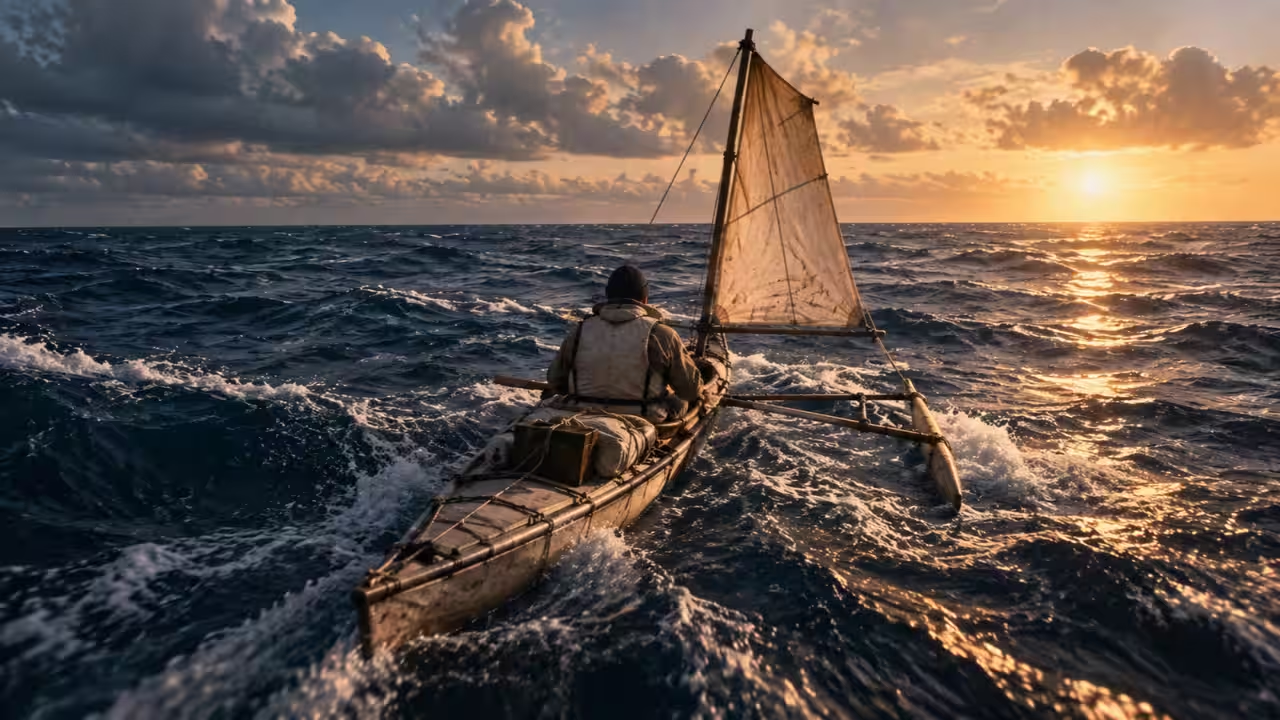
German doctor Hannes Lindemann left Las Palmas de Gran Canaria in a folding kayak barely 5.2 meters long on October 20, 1956. He reached the Caribbean island of St. Martin seventy-two days later, after storms, hunger, thirst, sleep deprivation and two capsize incidents. The boat was a Klepper folding kayak made from a collapsible frame and fabric, and Lindemann had added a simple outrigger for stability and carried two small sails that could provide extra propulsion when the wind was favorable. The Deutsches Museum records the crossing as one of the smallest boats ever used to cross the Atlantic.Lindemann was interested in survival at sea, particularly the physical and psychological problems faced by shipwreck survivors. His Atlantic crossing followed an earlier journey in 1955, when he had crossed the ocean in a larger dugout canoe.He was testing more than the boatThe Deutsches Museum explains that he was particularly interested in the psychological side of survival. He believed that a person's mental state could influence their ability to endure extreme conditions, and he used autogenic training, which is a relaxation and self-suggestion technique developed by German psychiatrist Johannes Heinrich Schultz.Lindemann repeated phrases to himself during the journey to maintain his determination, and his approach was based on preparing psychologically before the voyage as well as continuing the exercises while at sea. During the 72-day crossing, Lindemann capsized twice in stormy weather, on the 55th and 59th days. He spent the night exhausted and soaked beside the boat after one of the incidents, before being able to climb back inside after daylight. The supplies he could carry were insufficient for the entire journey, so he collected rainwater and ate fish he caught along the way.His route ran from the Canary Islands across the Atlantic to the Caribbean, and he reached St. Martin on December 30, 1956, having completed the crossing after 72 days alone at sea. The account of the expedition later became part of the wider public discussion about survival psychology and self-suggestion.The journey became a public experimentLindemann's experiment came at a time when another doctor, French physician Alain Bombard, had already attracted attention for crossing the Atlantic while studying survival at sea. Bombard had carried substantial food and water and had also received additional supplies from ships during his journey. Lindemann argued that such conditions did not accurately reproduce the circumstances of a shipwreck survivor. His own voyage was designed around a smaller amount of carried provisions and greater dependence on what could be obtained from the environment.At only 5.2 meters long and 87 centimeters wide, the folding kayak was extremely small for an Atlantic crossing, and its collapsible construction also meant that it was far removed from the ocean-going vessels normally associated with transatlantic voyages. The trip attracted international attention after Lindemann returned, with his account appearing in Life magazine in 1957, which helped turn the German doctor's crossing into a widely reported story.The Deutsches Museum holds the folding kayak Lindemann used during the 1956 crossing in its maritime collection. Lindemann's Atlantic crossing was not his first attempt to study survival through personal endurance, and it was not simply a demonstration of what a small boat could withstand. He was using the voyage to examine how a person might cope with isolation, limited supplies, physical exhaustion and prolonged exposure to danger.When he finally reached St. Martin on December 30, his Atlantic crossing was complete. His rudder was repaired and he continued for another 50 hours toward St. Thomas after two nights on the island, where friends were waiting for him. The folding kayak remains in the Deutsches Museum, where the small craft provides a physical record of the 72-day experiment that carried Lindemann across the Atlantic in 1956.You use AI every day. Now get your AI Quotient. Take the AIQ test.
Topics in this story
Gathered from external sources. Rights to this text belong to whoever originally published it.