China building 'secret' desert airbase to fast-track next-gen military aircraft: Report
International News: China is expanding a flight-test facility in its western desert to fast track the development of its next-generation military aircraft as Beijing and .
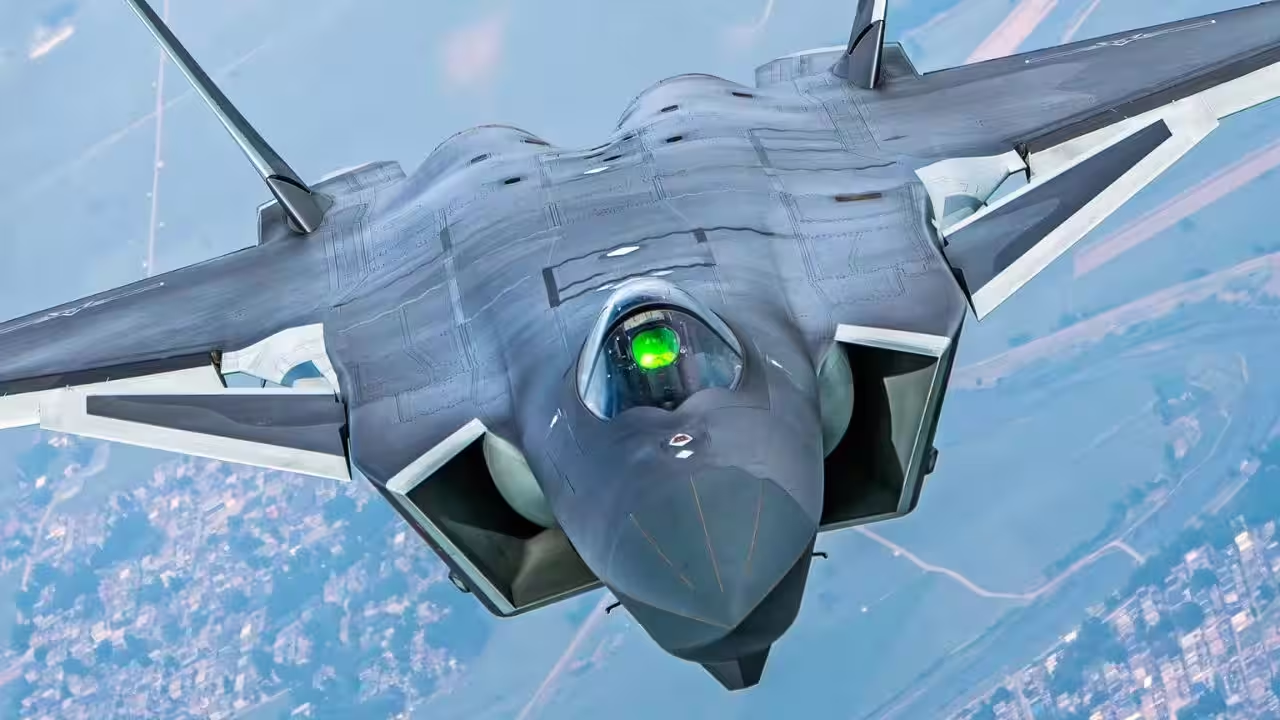
China is expanding a flight-test facility in its western desert to fast track the development of its next-generation military aircraft as Beijing and Washington compete for air-power dominance.Satellite imagery of the Lop Nur facility in Xinjiang shows the construction of four large hangars, new taxiways, a circular pad believed to be used for engine testing or aircraft turnaround, and possible fuel-storage infrastructure, according to the South China Morning Post.The expansion comes as China pursues multiple advanced combat-aircraft programmes at once, potentially giving it greater capacity to test sensitive designs and conduct simultaneous flight-test programmes away from routine observation.Retired US Navy intelligence officer J Michael Dahm, a senior fellow for aerospace and China studies at the Mitchell Institute told South China Morning Post, said the buildout began around August 2025. That was when the tailless aircraft widely identified as China's J-36 sixth-generation fighter was first observed at the facility."Seventeen days later, another next-generation aircraft, commonly referred to as the J-XDS or J-50, was spotted at the site," Dahm said.By February this year, the facility had gained about 60,000 square feet (5,570 square metres) of additional hangar space and more than 300,000 square feet of other infrastructure. Dahm also said that the new facilities likely included testing and evaluation areas as well as accommodation for personnel, effectively doubling the size of the base.The facility already had a 5-km (3.1-mile) runway and had been associated with China's reusable spacecraft programme since at least 2020, the South China Morning Post reported.The facility's location gives China a major advantage for testing experimental aircraft. Lop Nur lies in a vast and sparsely populated part of Xinjiang, allowing sensitive flight trials to be conducted away from major population centres and routine observation.The expanded base could also reduce the burden on China's existing flight-test facilities, allowing different aircraft programmes to operate simultaneously and potentially increasing the pace of testing.Its multiple large hangars could accommodate several programmes at the same time, depending on the size of the aircraft involved.The development is part of a broader expansion of China's aerospace-industrial infrastructure.China is also building a new production complex about 16 km north of an existing facility in Shenyang, northeastern China. The complex is estimated to contain around 4 million square feet of manufacturing space.Race for sixth-generation air powerThe infrastructure buildup comes as China and the United States race to develop a new generation of combat aircraft designed to work alongside advanced drones, sensors and long-range weapons.Beijing has yet to officially disclose the missions, specifications or formal designations of the J-36 and J-XDS/J-50. The Pentagon's latest China Military Power Report described both aircraft as being in the “nascent stages of development” and projected that they could become operational by 2035.The J-36 and J-XDS/J-50 sightings have nevertheless provided rare glimpses into China's next-generation air-power ambitions.Is China's H-20 also in the picture?The Lop Nur expansion has also renewed speculation about the H-20, China's long-rumoured stealth strategic bomber.The aircraft has never been publicly unveiled and its designation has not been officially confirmed. However, the size of the new infrastructure has fuelled questions about whether the facility could eventually support the programme.The War Zone noted that three hangars on the southern apron each measure roughly 80 by 40 metres (262 by 131 feet). That would make them large enough to accommodate aircraft across the PLA's current inventory, including the H-6 strategic bomber, which has a wingspan of about 33 metres.The hangars are also substantially wider than conventional shelters for tactical aircraft, potentially leaving room for future platforms with much larger wingspans.TWZ suggested that the structures could be intended to support the H-20, but stressed that there is no confirmed evidence linking the hangars to the bomber.What is clearer is that China is investing heavily in the infrastructure needed to test and develop its next generation of military aircraft - and Lop Nur appears to be emerging as a key part of that effort.
Topics in this story
Gathered from external sources. Rights to this text belong to whoever originally published it.