Flight disruption: Airlines criticise air traffic control over second glitch in a month
Airlines are angry about the delays, with EasyJet saying the latest incident "once again calls into question the resilience" of the system.
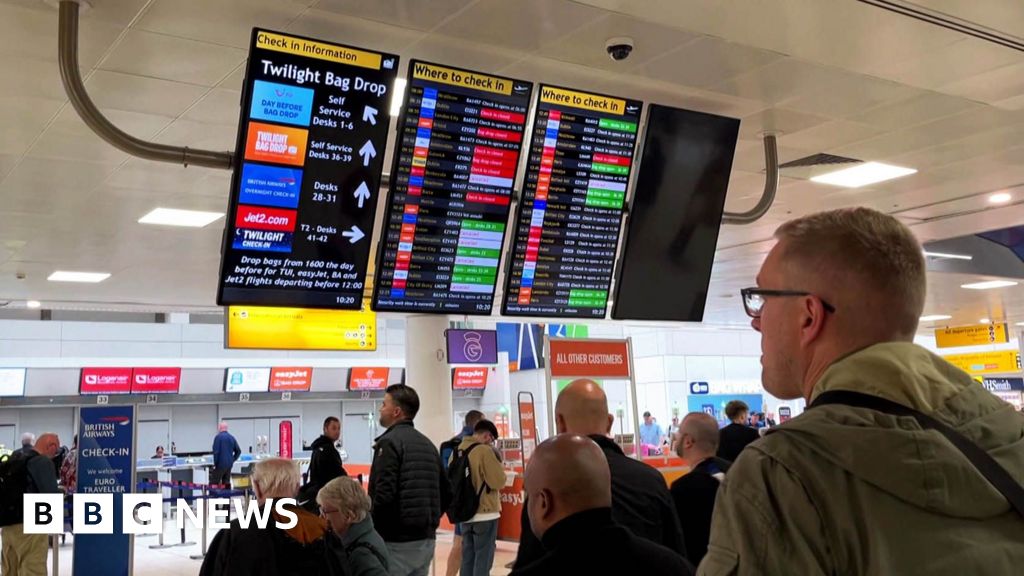
Airlines have criticised the UK's air traffic control system after a second technical problem in two weeks caused major disruption to UK flights
EasyJet said Monday's incident "once again calls into question the resilience" of how the service works, while Wizz Air said there was a "national confidence crisis" in National Air Traffic Services (Nats), which runs the UK's air traffic.
The technical problem at Prestwick caused disruption at airports across Scotland, Northern Ireland and northern England, with around 150 flights cancelled.
Nats said a "connectivity issue" was to blame for the disruption, and that it had "nothing to do" with a separate software defect at Swanwick that led to the cancellation of 2,000 flights earlier in September.
The underlying issue causing Monday's disruption has since been resolved, with Nats saying it was running at "full capacity" although officials warned of knock-on effects.
A spokesperson said they were now "focused on working with our customers to recover their residual delays and help get their operations back to normal".
Easyjet was the worst affected airline, with 47 of its 670 scheduled departures cancelled, while British Airways has seen 12 cancellations from its 513 scheduled departures.
The UK Civil Aviation Authority (CAA) said passengers who had flights disrupted were "unlikely" to be entitled to compensation.
It said the technical issue is "likely to be considered the result of 'extraordinary circumstances' under passenger rights rules", meaning that "although passengers should be looked after by airlines, they are unlikely to be entitled to compensation for delays or cancellations that were directly caused by the incident".
An independent review by the CAA into the resilience of the UK's air traffic control system is under way and the results will be published "within six months", it said.
Repeated air traffic control failures leave us in worrying territory
Flight chaos caused by 'millisecond' software defect, report says
UK flight delays continue after issue with air traffic control in Scotland is fixed
Industry representative body Airlines UK said both passengers and airlines "deserve better" service after "yet another Nats failure".
Managing director of Wizz Air UK, Yvonne Moynihan, called for "urgent reform" of Nats, adding that she did not have confidence in its current leadership.
Asked on BBC Radio 4's World at One programme if Nats chief Martin Rolfe should resign, Moynihan said: "We need to look at the leadership at the top. But more than that, what are the board of directors doing?"
Jet2 boss Steve Heapy called for "urgent and accountable" action to bolster the UK's air traffic control infrastructure.
Ryanair reiterated its calls for Rolfe to resign, saying he had failed to deliver" either a reliable system or an effective back-up". The latest outage affected 140 of the airline's flights and 25,000 passengers.
British Airways said "yet another technical fault with Nats" was "disappointing".
A Nats spokesperson apologised, saying: "In the real world, we accept technology can and sometimes does fail. Our job is minimising disruption where possible.
"What isn't acceptable is any incident where safety is compromised - this is always our first priority."
They added that it was working to return air traffic to normal as quickly as possible and urged passengers to check their flight status with their airline.
Transport Secretary Heidi Alexander acknowledged the situation was "deeply frustrating" for passengers.
Steve Davies, 74, told the BBC he was "cheesed off with air traffic control" as technical issues with its systems seemed to be "happening a lot".
He and his wife Sadie became stuck at Birmingham airport after being told to disembark their EasyJet flight to Edinburgh on Monday morning.
Nicole McCloskey, from Kilmarnock, had been due to go to Disneyland Paris with her family before their flight was cancelled.
She told the BBC her family got a message to say the flight was delayed while they were travelling to Glasgow airport, but only found out it had been grounded altogether once they arrived.
Nicole said they have been rebooked on another flight on later on Monday and were hopeful "it's sorted in time".
Rebecca Freeman became stranded at Bristol Airport after her flight to Edinburgh for a business meeting was cancelled. She described the atmosphere as "chaos".
"I was caught up in the Nats issue earlier this month and spent nine hours at Bristol airport," she told the BBC.
"I can't believe it's happened again. It is very frustrating and I will have to attempt the business meeting again for a third time," adding that she still has not received money back from the associated costs for the last time her flights were cancelled.
Not much is known about what caused the latest Nats problems, except that there was a technical failure at its control centre in Prestwick, which handles traffic across northern England, Scotland and Northern Ireland - catering for about 42% of the UK's air traffic.
The other Nats centre at Swanwick in Hampshire looks after airspace in the southern part of the UK, including the approaches to Heathrow and Gatwick.
Last month's Swanwick incident affected hundreds of thousands of passengers, with some sleeping on airport floors or getting stuck overseas earlier this month.
It was more severe as it affected intercontinental and long-haul travel via UK airspace.
Nats said in a report last week that the software glitch happened "in the space of a millisecond" leading to the system producing corrupted data.
Sources say that behind the scenes, airlines are "furious" that disruption keeps on happening, and that they must bear the costs of refunding passengers and looking after those affected by delays.
There are deep concerns that not enough resources are being put into ensuring the air traffic control system has the resilience it needs.
Rolfe told the BBC at the time of the Swanwick incident that he would not resign, saying the software defect was "very, very obscure".
Topics in this story
Gathered from external sources. Rights to this text belong to whoever originally published it.