In 1961, a retired Georgia waiter began filling his home and yard with handmade figures; decades later became part of the Smithsonian’s efforts to preserve American history
In 1961, Dilmus Hall stepped away from his working life in Athens, Georgia, and began spending more time on the creations that had interested him since
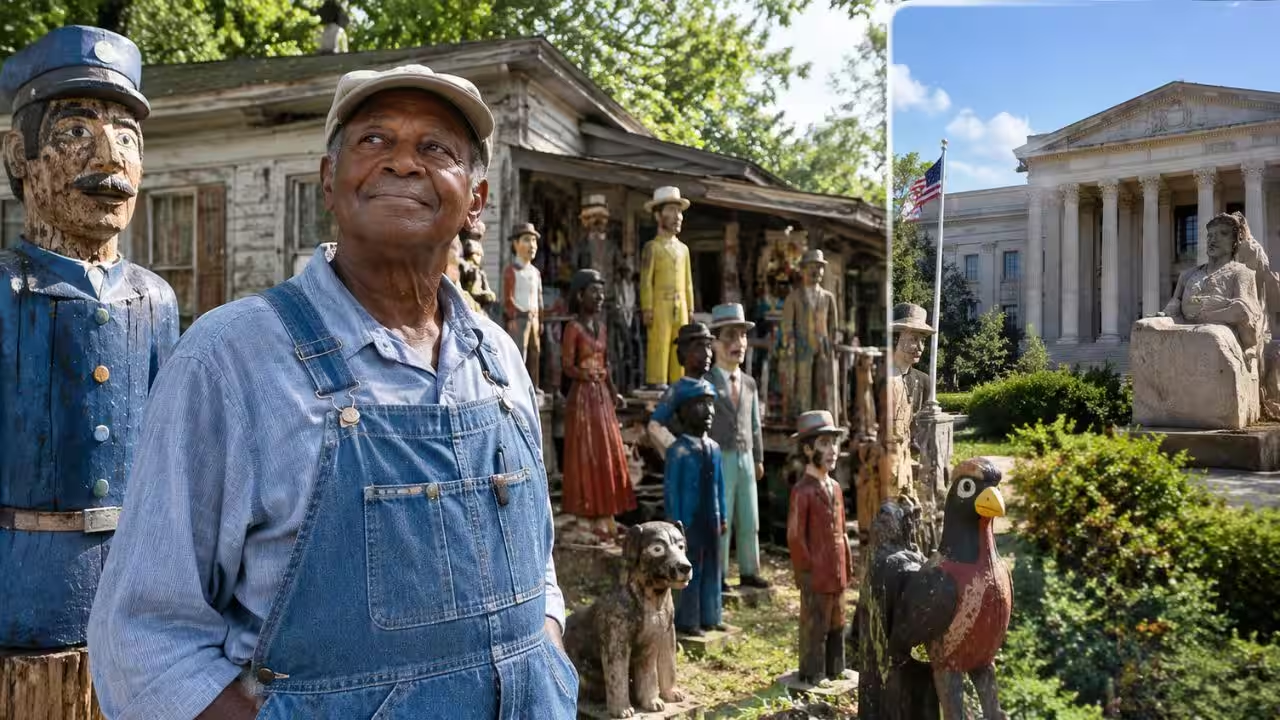
In 1961, Dilmus Hall stepped away from his working life in Athens, Georgia, and began spending more time on the creations that had interested him since childhood. Concrete, wood and whatever else he could find became materials for figures that gradually filled the yard and walls of his modest home. Some depicted religious scenes, while others reflected his understanding of good and evil, with symbols he believed could protect the household. Hall had no children of his own, but he often spoke of his sculptures as the children he continued to make. Years later, his work became part of a wider effort to preserve the artistic traditions of African American communities in the American South.How farming, coal mines and army service shaped Hall’s early yearHall grew up in a farming and blacksmithing family near Athens, where artistic interests competed with the practical demands of rural life. As a boy, he fashioned small animals from clay and a mixture made with flour and sweet gum. His mother welcomed these early efforts, though his father expected him to concentrate on farm work, including picking cotton.Art was not his livelihood for most of his early adulthood. Hall left the family farm and worked in a coal mine before joining a road gang. In 1917, he enlisted in the US Army Medical Corps and served in Europe as a stretcher-bearer. The experience exposed him to European art, which later influenced some of his sculptures.After returning to Georgia, Hall took a succession of jobs. He worked as a hotel bell captain and waiter, served as a busboy at a sorority house at the University of Georgia, and made concrete blocks for a construction company.Hall retired in 1961. By then, he had married Zaydie, whom he remembered affectionately. The couple were unable to have children, a fact Hall later addressed through his own particular understanding of his artistic work.Concrete figures began to change the look of his homeDuring the 1950s, Hall had already started making groups of figures from concrete laid over frameworks of wire and wood. He arranged them in the front yard of his small cinderblock house, turning the space into a setting for scenes drawn from religious belief and everyday conduct.Retirement gave him more time to continue this work. Rather than treating the house as separate from his art, Hall incorporated his creations into its surroundings. The walls, windows, roofline and yard all became places for painted shapes, sculpted objects and handmade decorations.Concrete provided a durable substance for figures and ornaments, while wood, putty, fabric and other found objects allowed him to create different forms. The results were not limited to conventional sculptures intended to stand alone. Hall's work developed across the property, with individual objects contributing to a larger arrangement.One of the best-known examples is The Devil and the Drunk Man, a tableau from the 1950s. It depicts two men affected by alcohol while a threatening devil looms over them. Hall explained the scene through his belief that Satan could influence people's behaviour and draw them towards wrongdoing. The sculpture gave physical form to that understanding of temptation and its consequences.Blue hands, diamonds and symbols of protectionHall's art also extended into the decoration of the house itself. Blue, yellow and red appeared across different surfaces, alongside crosses, diamonds, circles and sun shapes. Some of these motifs were positioned around windows, on the walls or beneath the roofline.A cement ball in the yard, dated 1962, carried two blue hands. The object has been associated with the African American tradition of the mojo or hand, a charm connected with protection and spiritual power. Hall also placed protective objects made from roots along the eaves of his porch. These early constructions were understood in relation to traditions in which particular objects were believed to guard against harmful forces.The blue decorations around his windows were part of a broader Southern and Caribbean tradition in which the colour was associated with protection. Hall used wooden plaques bearing white diamonds, while yellow cement diamonds marked the corners of his house. A rising sun appeared on the gable, with a sun and moon bearing smiling faces on the wall below.According to the account published by Souls Grown Deep, he used crosses and diamonds without knowing their connections to Central African symbolism. He nevertheless believed the forms had protective power.His work has been discussed in the context of African American conjuring culture, a set of spiritual practices shaped by African traditions and Christianity. In this context, objects may carry meanings beyond their physical appearance. They can serve as protective devices, preserve stories or express a person's place within a community.Religious scenes and drawings continued into later lifeHall's interest in religious subjects took several forms. In addition to his concrete figures, he made wooden crucifixions using materials such as putty and scraps of cloth. Some depicted Jesus on the cross alongside the two thieves, with details that gave the scenes a distinctly personal character.One crucifixion, made from wood and painted blue, used a relatively simple design. Other works included a Roman soldier and a spear, with Hall explaining the meaning of a splinter held in Jesus's mouth as an image of death being crushed between his teeth. The descriptions reveal how he interpreted the scenes through his own words rather than relying only on familiar religious imagery.He also painted a horse in the 1940s, which he identified as his first painting. Diamonds appeared above and below the animal. The work brought together his interest in painting and the recurring shapes that appeared elsewhere around his home.In later years, Hall produced hundreds of drawings using coloured pencils and crayons. Many had a cartoon-like appearance, while others returned to religious subjects. His work continued to move between sculpture, painting and drawing, without being confined to a single material or format.How Hall's work became part of a wider artistic historyHall's creations are now documented by Souls Grown Deep, an organisation devoted to preserving and presenting the work of African American artists from the American South. Its profile of Hall, written by Maude Southwell Wahlman, records the development of his art, the objects around his house and the meanings he attached to them.The collection includes photographs and records of individual works, among them the cement ball in his yard, The Devil and the Drunk Man, several untitled sculptures and his crucifixions. Some pieces are dated, including works from the 1930s, 1940s, 1950s and 1980s.The Smithsonian has also helped preserve and present the history of African American art and culture, though the supplied Souls Grown Deep profile does not establish that Hall's individual works are held in a Smithsonian collection. His documented legacy is firmly linked to the preservation work of Souls Grown Deep, which provides a record of the objects and the beliefs behind them.You use AI every day. Now get your AI Quotient. Take the AIQ test.
Topics in this story
Gathered from external sources. Rights to this text belong to whoever originally published it.