Quote of the day by Jeff Bezos: “I knew that if I failed I wouldn’t regret that, but…” - a lesson about risk, failure and regret
Tech News News: There are decisions that become difficult precisely because both choices carry a cost. Staying where things are familiar can offer security, while tak.
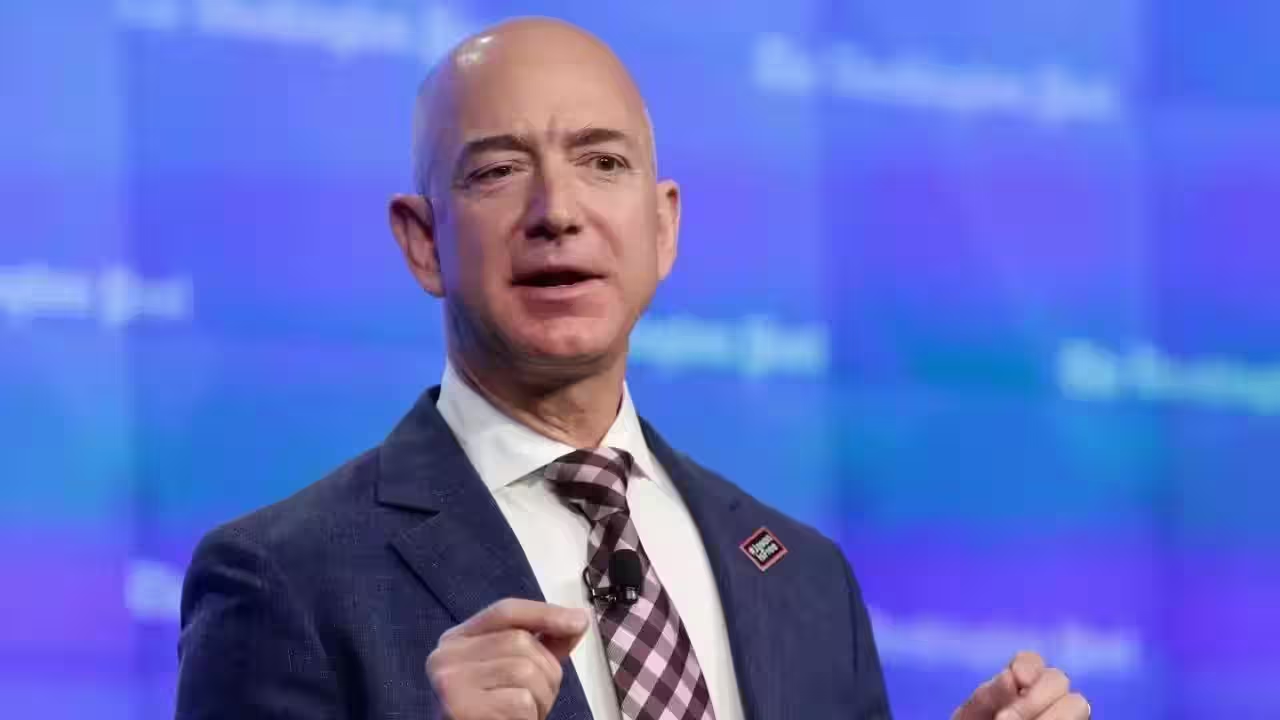
There are decisions that become difficult precisely because both choices carry a cost. Staying where things are familiar can offer security, while taking a chance can leave a person facing an outcome that cannot be predicted. Jeff Bezos encountered that dilemma in the 1990s, when he was working at the investment firm D. E. Shaw began considering an idea built around the rapidly expanding internet. Leaving a well-paid job for an online bookseller was hardly a guaranteed route to success. Bezos knew the business could fail. What mattered to him was a different possibility: that years later, he might look back and wish he had given the idea a chance. He eventually left his job and founded Amazon. The decision became one of the defining moments of his career, but the reasoning behind it came before anyone knew how the company would turn out.Quote of the day by Jeff Bezos“I knew that if I failed I wouldn’t regret that, but I knew the one thing I might regret is not trying.”What Jeff Bezos meant by the quoteBezos was describing the way he weighed the risk of leaving his established career. He did not know whether Amazon would succeed. In fact, he considered failure a realistic possibility.His thinking centred on regret rather than prediction. He imagined himself much older and considered how he might view the decision with the benefit of hindsight. If the business failed, he would at least know that he had attempted it. If he stayed in his job and never tried, there would be no answer to the question of what might have happened.The quote is therefore not simply about being unafraid of failure. It is about recognising that inaction can also have consequences. Sometimes the safest decision in the short term can leave a person with a longer-lasting question.The modest beginnings behind a much bigger companyIt is easy to view the original Amazon through the scale of the company that exists today. That can distort what Bezos was actually deciding in 1994.Amazon did not begin as a plan to create a vast technology and retail company. It began as an online bookstore. The first version of the business was focused on selling books through a website at a time when buying something online was still unfamiliar to most people.The company opened its virtual doors in July 1995.Within its first weeks, Amazon had shipped books across the United States and to customers overseas. The catalogue also gave the business an advantage that physical shops struggled to match. It could offer a huge range of titles without having to keep every book on shelves.The early success did not prove that Bezos had known what would happen. It showed what happened after he decided to try.The long-term view behind a risky choiceThe phrase most closely associated with Bezos's decision is his “regret minimisation framework”.Rather than trying to predict every detail of the future, he imagined reaching old age and looking back at the choice. From that imagined future perspective, he considered which decision was more likely to cause regret. The framework simplified the problem. If Amazon failed, Bezos could return to the job market and continue with his career. If he never tried, he might spend years wondering whether the business could have worked.It was not a mathematical formula. It was a way of changing the time frame of the decision. A difficult choice in the present can look different when viewed from decades later.Why failure mattered less to him than uncertaintyFailure produces an answer. If a business closes, a person knows that a particular approach did not work. If an application is rejected, there is a definite outcome. Even an unsuccessful project can reveal what needs to change.Not trying provides none of that. The possibility remains hypothetical. There is no evidence showing whether the idea could have succeeded or failed.For Bezos, that unresolved possibility was harder to accept than failure itself. That is perhaps the most precise way to understand the quote. He was not claiming that failure feels good. He was saying that failure was an outcome he could live with, while never making the attempt might leave a question that could not be settled.A lesson about decisions rather than ambitionThe quote can be applied without turning every difficult choice into an entrepreneurial gamble. A person considering a career change, a new qualification, a business idea or a creative project might ask a similar question: which outcome would be harder to live with years from now?Sometimes the responsible decision is to stay put. Financial obligations, family circumstances, timing and the consequences of failure all matter. Bezos's framework cannot account for every situation.What it can do is introduce another consideration into the decision, the cost of never finding out.Trying can be smaller than people thinkThere is also no need for “trying” to involve quitting a job or risking a life's savings.It might mean testing an idea on a small scale. Applying for an opportunity. Taking a course. Speaking to someone in an industry you are considering. Building a first version of a project before deciding whether to pursue it seriously.Those steps can reduce uncertainty without requiring an immediate leap. In that sense, the useful part of Bezos's thinking is not necessarily the size of the risk he took. It is the way he separated the fear of failure from the question of future regret.Lessons to learn from Jeff Bezos’ quoteFailure is not always the worst outcomeConsider the cost of inactionThink beyond the present momentRegret can be a useful decision-making toolTrying does not always mean taking a huge riskDo not confuse uncertainty with failureSecurity has a cost tooA decision does not need a guaranteed outcome to be worthwhileLearn to separate fear from judgementThe goal is not to avoid every mistakeGet the latest technology news and updates. Download the TOI App.
Topics in this story
Gathered from external sources. Rights to this text belong to whoever originally published it.