Kentucky mother and daughter rejected more than $26 million for farmland sought by a data-centre developer, but the land has not been placed under a permanent easement
US News: A Kentucky mother and daughter have turned down a $26 million offer for their historic farmland, chosen over potential profits, in a growing conflict between agricultural land and expanding AI infrastructure.
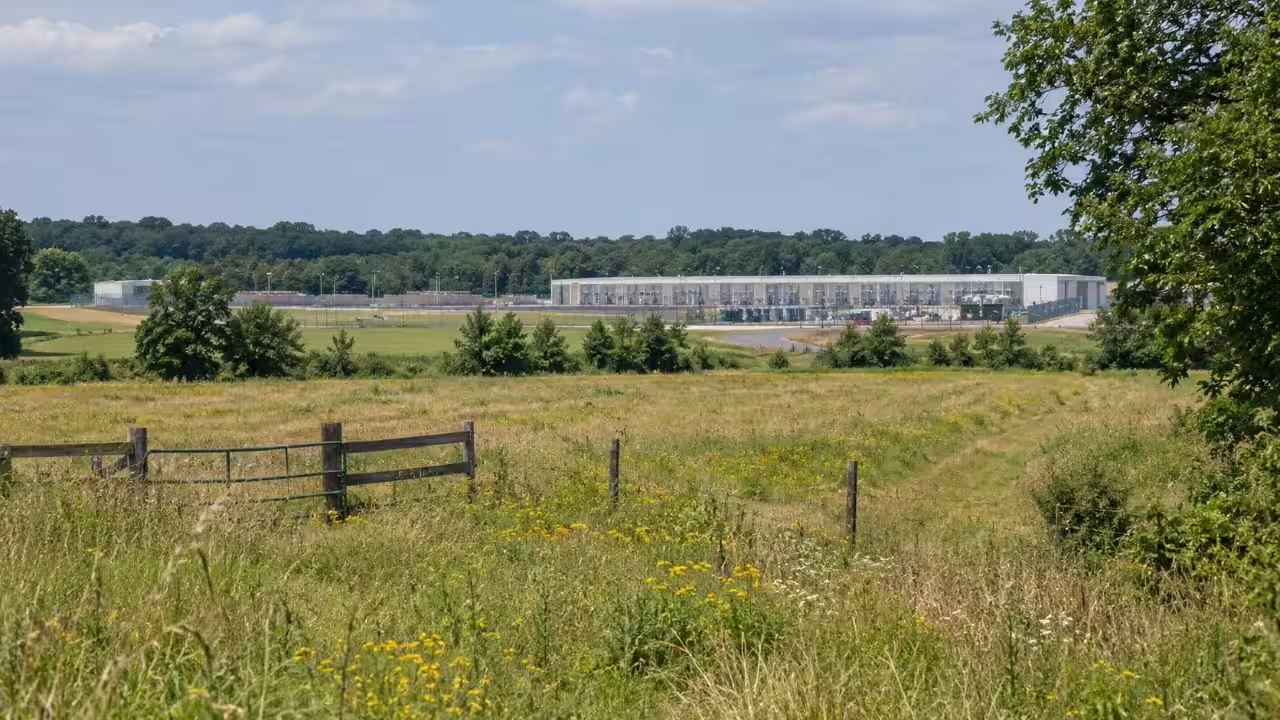
A $26 million offer can change the course of a farm in an instant. For two women in northern Kentucky, however, the decision eventually became less about the money and more about what would happen to the land their family had worked for generations. Ida Huddleston and her daughter, Delsia Bare, agreed initially to sell part of their farmland near Maysville, only to withdraw from the deal after learning that the property was being sought for a huge artificial intelligence data centre.According to local reporting, the proposed Mason County development would span about 2,080 acres, with 28 properties rezoned to make way for a hyperscale data-centre campus. The project has become part of a broader debate across rural America, where the rapid expansion of AI infrastructure is increasingly bringing technology companies into competition with farmland. The women, meanwhile, have chosen to keep their property rather than sell it, and it has not been placed under a permanent conservation easement.The offer that changed everythingThe Huddleston family owns roughly 1,200 acres of farmland outside Maysville. Huddleston, now 82, has spent decades on the property, while Bare, 54, has continued the family's connection to the land. The farm has reportedly been in the family for more than 200 years, giving the property significance well beyond its value on the real-estate market.According to The Wall Street Journal, an unidentified company was acquiring Kentucky farmland for a proposed data centre and offered Delsia Bare $48,000 an acre for 463 acres, while her mother, Ida Huddleston, was offered $60,000 an acre for 71 acres. Together, the proposed purchases would have brought the family $26.48 million. The women initially agreed to the sales, partly because they believed the buyer might ultimately use eminent domain to acquire the land if they refused. They had previously seen family land taken through eminent domain proceedings for the construction of a highway and two landfills, contributing to their concern that rejecting the offer might not guarantee that they could retain control of their property.The women later learned that the land was being assembled for a massive data centre rather than an unspecified development. Once they understood what the property would become, they decided they did not want to sell. Their agreements were subsequently revoked. For Huddleston, the value of the farm could not be reduced to its sale price. She had built a log home there with her husband more than six decades ago, raised her family on the property and continued to regard the land as something to pass to future generations.Farmland meets the AI boomThe dispute comes as data centres are expanding rapidly to support cloud computing and artificial intelligence. Unlike conventional buildings, hyperscale data centres require enormous amounts of electricity and sophisticated cooling systems, making their location a major infrastructure decision.Research published in Nature Sustainability estimated that the expansion of AI servers in the United States could produce an annual water footprint of 731 million to 1.125 billion cubic metres between 2024 and 2030, alongside additional annual carbon emissions of 24 million to 44 million tonnes of CO₂-equivalent. The researchers found that the eventual environmental footprint would depend heavily on where servers are installed, the electricity used to power them and the efficiency of the technology. That helps explain why the location of a proposed facility matters to communities. A data centre does not simply occupy land. It can also create new demands for electricity, transmission infrastructure, roads and, depending on its cooling system, water.In Mason County, local officials have presented the proposed project as an economic opportunity. The development is expected to create construction employment and eventually permanent jobs, while supporters argue that the investment could broaden the county's economic base and generate additional tax revenue. But those potential benefits have been weighed against concerns about the conversion of farmland and the project's scale. The identity of the company behind the proposal has also remained confidential, adding another layer of tension. A rezoning application eventually sought to change the designation of roughly 2,080 acres across 28 properties from agricultural use to industrial use for the proposed hyperscale data centre. County officials gave final approval to the rezoning in May 2026, although the unidentified company still has the final decision on whether to proceed.Keeping the farm does not mean the fight is overThis choice made by Huddleston and Bare is significant precisely because it is not like a conservation easement on the farm. In a conservation easement, the future use of the farm is restricted, but the land is retained by the owners. In their case, the two women have retained complete ownership of the farm without the restriction. Therefore, the land is still considered private property, and its future can be determined by property laws. Furthermore, the decision of the two women has not prevented the construction of the data centre. Other plots of land are being assembled for the project, and it is going through planning and zoning procedures. There is a unique situation created where the development can arise around the land that is being shunned by its owners.For the mother and daughter, however, the decision was ultimately about more than opposing a particular building. This farm symbolises a tradition of continuity that money cannot replicate. The farms have been used for agricultural production and livestock rearing, and have been part of a family’s landscape for years. On the other hand, the proposed data centre is symbolic of a new age that comes with great speed and seeks large plots of land with power access.This has become an increasingly common conflict as AI expands into real-world landscapes from the screens of computers. The farmers in Mason County showed just how valuable this piece of land was to tech firms when a $26 million offer was made to buy the land. Huddleston and Bare, however, showed just as importantly that not all pieces of farmland have a monetary price tag that would make their owners sell them.Catch the latest World News and Live updates. Download the TOI app.
Topics in this story
Gathered from external sources. Rights to this text belong to whoever originally published it.