Over 20 years, a New York painter hand-dug a lake and planted thousands of native trees; the private landscape survives as Olana State Historic Site
Explore the remarkable story of Frederic Edwin Church, a Hudson River School painter who transformed his estate into a stunning landscape with a hand-dug lake and thousands of native trees, now preserved as Olana State Historic Site.
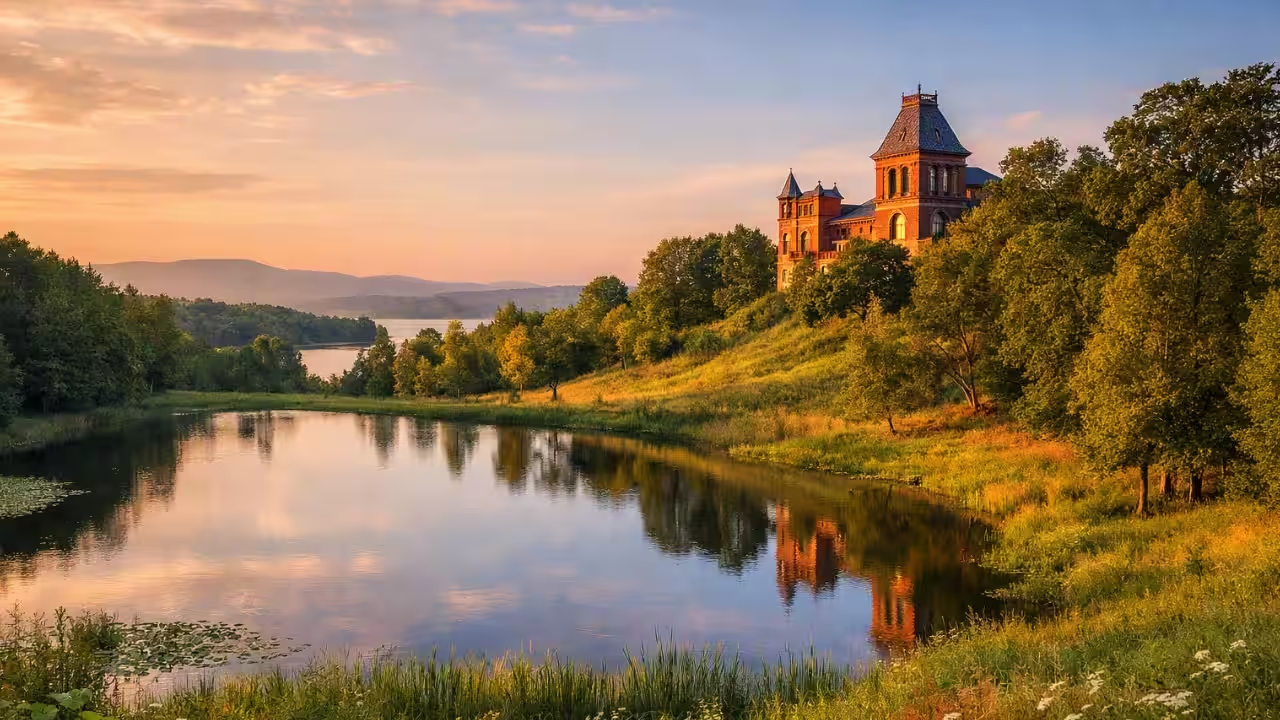
Frederic Edwin Church is best known as a Hudson River School painter, yet he treated the land around his home as a large-scale landscape composition. New York State Parks describes Olana as the 19th-century home, studio, and designed landscape of Hudson River School artist Frederic Edwin Church, his wife Isabel and their four children. The estate sits near Hudson, New York, and the state agency notes that 2026 marks the bicentennial of his birth. Two parts of that landscape are especially striking: a 10-acre lake largely excavated by hand from muck and woodlands of thousands of native trees. The Olana State Historic Site's history of the landscape explains that the lake took about twenty years to form, beginning when Church bought his first parcel of land. The lake and portions of the planted woodland survive, although both have been altered and managed over time. The Olana Partnership works with the state's parks office to care for them.A 126-acre farm bought in 1860 grew to 250 acresIn 1860, Church purchased a 126‑acre farm two months before marrying Isabel Carnes, according to the Olana Partnership’s official history of the landscape. He called the property "The Farm" and operated it as both a working and ornamental farm. Throughout the years, Church acquired additional acreage, which included the hillside known as Sienghenberg, upon which he constructed his primary residence with help from the architect Calvert Vaux. Olana's history of the landscape and its account of Church's life show that he bought 18 acres at the top of the hill in 1866 and added the 50-acre North Meadow in 1878, with further parcels bringing the estate to the 250 acres maintained today. Olana's biography of Church presents him as a farmer and landscape artist as much as a painter. It says he planted crops, kept a dairy herd, turned a swampy area into a lake and set out thousands of trees.Hand excavation beginning in 1860 formed the 10-acre lake over about 20 yearsThe initial formation of the lake took place from a bog area of the property. The lake was created through hand excavation of the muck over about two decades, before machinery capable of the task existed. The process started when Church purchased his first parcel of land. Muck was not just dirt. It was fertile soil which was spread by Church on his lands as fertilizer for his planting efforts. Church also made a deal with a laborer, who cleared muck in return for half of it. The construction of the dam ensured that the basin would be filled with water, and the lake's shape followed the contours of the land. The lake's outline and still surface echo Inbocht Bay, several miles south on the Hudson River.The Lake was overflowing in 1878 and 1879 and later fed the main house cisternAccording to Olana's history of the landscape, activity surged in 1878 and 1879, when Church wrote that the lake was overflowing and his birch canoe was ready. The basin was already holding water and in use while the twenty years of excavation were still underway. The lake served purposes other than aesthetic ones. It was used for boating, skating, and fishing. The lake also supplied water. Church installed a system that pumped it up to a cistern in the main house, and water is still pumped from the lake to a water tower near the main house today.Thousands of native trees planted on land deforested by 19th-century industryThe woods solved a particular problem. The history of Olana notes that the Hudson River functioned as an industrial river that led to New York City throughout the nineteenth century, and much of the land near the river, which included the Olana property, had been denuded as a result of industry and commercial activity. Church planted thousands of trees in the region, including maple, birch, hickory, hemlock, chestnut, pine, and oak. Church noted that for several years after he selected the site, his thoughts did not veer far from it. The plantings served varied purposes. Some were used to create dense woods, others to frame distant views and still others to conceal structures like the stables. He arranged the trees in the meadow as well as in groups and singly, and lined the roads with them.About five miles of carriage roads, including Ridge Road and Crown Hill Road in 1884Church linked the lake and woodlands through the roads. One can take a self-guided walk through the farm, the orchards and the lake formed out of swampland, says New York State Parks. The road system of the estate extends for about five miles. Lake Road cut through the woods adjacent to the lake and afforded views of the lake from the park and house above it.There were two roads built in 1884, namely Ridge Road and Crown Hill Road, which guided people through a unique land formation. In an August 1887 letter to the writer Charles Dudley Warner, cited in the journal Art History, Church said he was busy "landscape architecturing." In an 1884 letter, according to Olana's history of the landscape, he wrote that building roads let him make more and better landscapes than "tampering with canvas and paint" in the studio. Dynamite was used to blast certain routes, and workers covered the roads with red shale mined from the property.Restoration since 1966 dredged the lake and reopened views of the Hudson RiverOlana was preserved from demolition in 1966, and from that time restoration and stewardship have tried to reclaim elements of the design created by Church while preserving Olana as a historic public site. The work has included dredging the lake and managing aquatic invasive plants so that the full water surface stays visible. In addition, second growth of woodland and invasive plants have been removed to restore the view of the Hudson River, and the fields of farms have been uncovered together with stone walls. The North Meadow restoration is under way. The place that visitors walk around is thus not only a historic document but also a living project. A lake dug largely by hand and thousands of trees planted under one artist's direction, created a personal landscape that later became a public one.You use AI every day. Now get your AI Quotient. Take the AIQ test.
Topics in this story
Gathered from external sources. Rights to this text belong to whoever originally published it.