Supreme Court allows Trump to use controversial database to check voter citizenship
Critics have questioned the reliability of the data, warning it could result in US citizens being wrongly removed from electoral rolls.
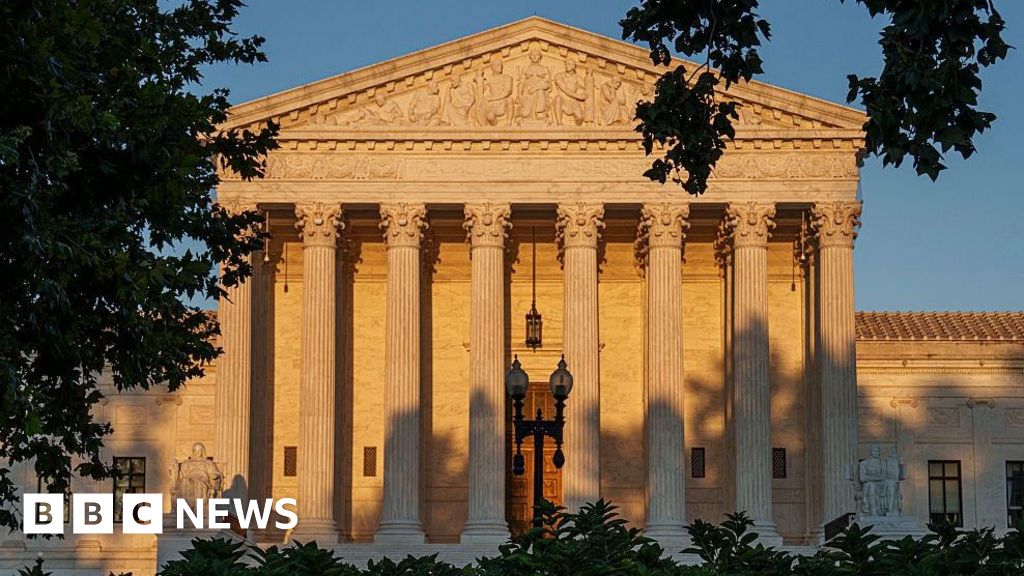
The US Supreme Court has lifted restrictions on the Trump administration to use a controversial federal database that uses citizenship information and other sensitive data to identify voters suspected of being non-citizens.
Critics have questioned the reliability of the data, warning it could result in US citizens being wrongly removed from electoral rolls.
In June, a federal judge ruled that the system was illegal and violated the privacy rights of Americans.
But the top court's conservative majority ruled that the National Voter Registration Act prohibits broad purges of voter rolls in the weeks before an election, which limits any "potential impact" of the decision ahead of the midterms.
But states can still check the citizenship of individual voters.
The three liberal-leaning justices on the Supreme Court dissented from the majority decision.
One of the dissenting Supreme Court justices, Ketanji Brown Jackson, expressed concern that this could mistakenly revoke the voting rights of eligible voters.
"The harm caused by burdening or disenfranchising even a few lawful voters outweighs the non-existent harm that the government experiences when it is prevented from taking an action that it likely lacks the authority to take," she wrote.
The Department of Homeland Security programme, known as Systematic Alien Verification for Entitlements (Save), allows officials to verify the eligibility of voters on their rolls.
The database was first created in 1986 to help officials verify the citizenship or immigration status of those applying for public benefits.
But the Trump administration last year expanded its search capabilities by allowing bulk searches using sensitive information from Social Security rolls.
In June, however, US District Judge Sparkle L Soonnan - a Biden-appointee - ruled that the revamped system shows that the federal government "knowingly trampled on the privacy rights" of US citizens "in a manner that threatens the sacred right to vote".
A federal appeals court allowed her ruling to stand, only to be overridden by the Supreme Court on Friday.
The top court ruled that a 1996 law allows DHS to seek citizenship and immigration data from federal agencies, and has "an obligation to respond" to states seeking that information.
The use of the Save programme by individual states is voluntary.
The previous judge's order, the Supreme Court ruled, "prevents the federal government from using the programme it believes is best suited to the task".
Voting rights groups called the ruling "profoundly disappointing".
"...it puts millions of Americans at risk of being unlawfully targeted by the administration's unreliable voter purge database weeks before the midterm elections," the League of Women Voters, the lead plaintiff in the case, said in a statement.
"We will be doing everything in our power to protect Americans' voting and privacy rights by ensuring that the district court decision stands," it said.
Lawyers for the Trump administration have long argued that the system is lawful and necessary to prevent non-citizens from voting. A total of 27 states currently use the system to check voter citizenship.
Critics, however, have pointed to a number of cases of the system already having led to mistakes.
For example, officials in Travis County, Texas, found that of nearly 100 voters identified as non-citizens, at least 10% of them - and potentially more - were US citizens, according to US media reports.
Since the state began checking its voter rolls with the Save system last year, only three non-citizen voters have been charged with illegally voting in Texas.
Since returning to the White House in January last year, the Trump administration has sought to reform the US electoral system, a process that has included a bid - rejected by the Supreme Court - to reign in mail-in ballots.
In 2024, for example, Texas Governor Greg Abbott announced that 1,930 people with a "voter history" had been removed from electoral rolls out of a total of nearly 18 million registered voters.
The figures are far below the hundreds of thousands of non-citizen voters that Trump and the Department of Homeland Security have previously suggested were on voter rolls.
Topics in this story
Gathered from external sources. Rights to this text belong to whoever originally published it.