Every winter, West Virginia collects families’ discarded Christmas trees and sinks them in state lakes; the branches replace woody cover used by young fish
US News: Discover how West Virginia turns discarded Christmas trees into vital underwater habitats for fish, addressing habitat shortages in state reservoirs through an eco-friendly recycling program.
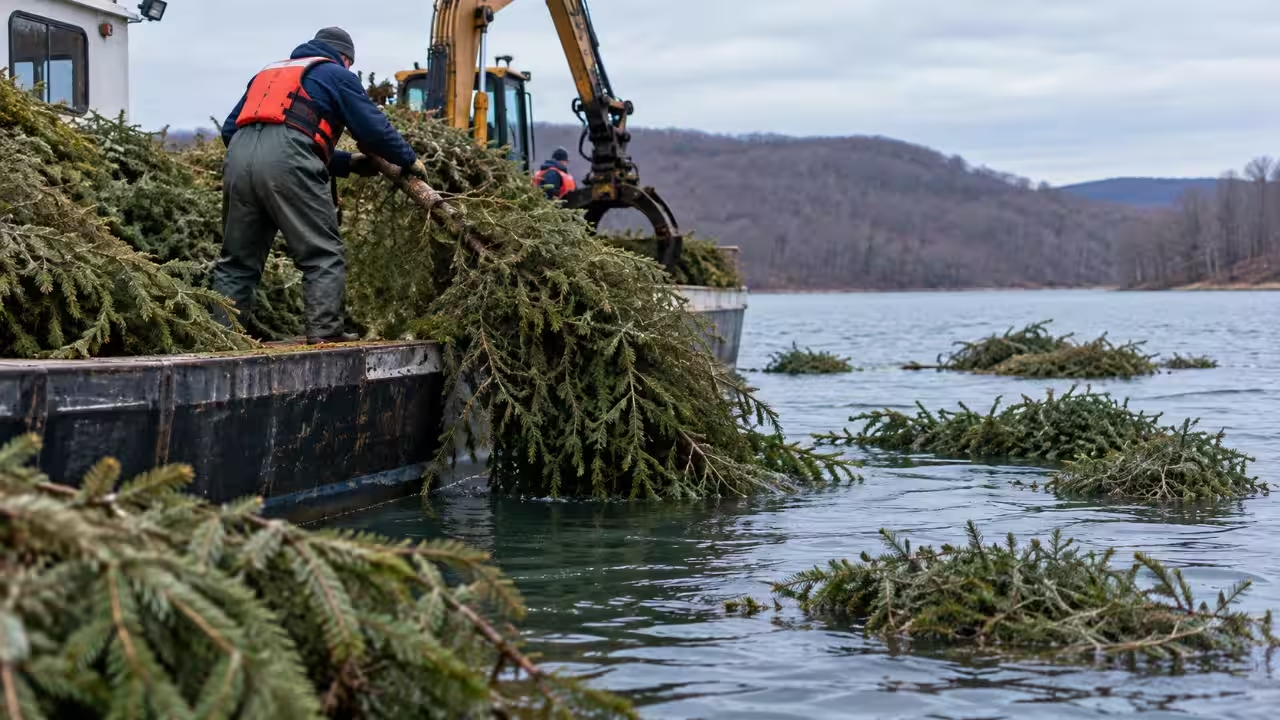
The Christmas tree that once stood in a family's living room does not always end its life at the kerbside in West Virginia. After the holiday season, real trees collected through the state's recycling programme can be taken to lakes and submerged, where their branches become part of an underwater landscape used by fish. What looks like a simple disposal problem on land becomes a habitat shortage being addressed beneath the surface.According to the North American Journal of Fisheries Management, the state has partnered with the West Virginia Division of Natural Resources to recycle used Christmas trees as fish habitat in lakes. The programme has operated through annual collection events, including public drop-offs at Charleston's Capitol Market, where residents have been asked to bring real trees with lights and decorations removed. Earlier state records show that more than 500 trees were collected at one event and later placed in selected lakes to provide structures where fish could hide and find food.Why the trees are neededOne reason the structures are needed is that many West Virginia reservoirs were built by damming rivers. Compared with natural lakes, reservoirs created by damming rivers can lack complex woody structure underwater. Vegetation that once grew there was cleared before flooding, leaving parts of the lake bottom without structure that could shelter small fish. In this context, a Christmas tree becomes more than recycled waste. According to the West Virginia DNR, its reservoirs often lack complex woody structure, and submerged trees can provide refuges for younger fish while also serving as ambush points for older fish.How a Christmas tree becomes fish habitatThe process is more deliberate than simply tossing a tree into a lake. An unsecured tree could be moved by currents or heavy rainfall, so fisheries biologists secure the trees before submerging them. The DNR says crews place the trunk through a cinder block and secure it with nails and boards. Once lowered into the water, the weight anchors the tree so that its branches remain upright and form a three-dimensional shelter.The resulting structure creates a maze of branches and spaces where smaller fish can take refuge. It can also provide surfaces for aquatic organisms to colonise, adding another layer to the habitat around the tree. Research published in Hydrobiologia found that fish used structurally complex littoral habitats more than unstructured areas, while experimentally added deadwood brush piles provided suitable microhabitats for several fish species. The study also found that the use of these structures varied with season and species, showing why the physical complexity of underwater habitat matters.Research published in the North American Journal of Fisheries Management has also examined the use of artificial habitat structures, including bundles of conifer branches such as discarded Christmas trees, in reservoirs. These structures can provide extra cover for fish and create areas where fish gather, making them useful tools for fisheries management. However, attracting fish to a particular location does not necessarily mean that the overall fish population has increased. West Virginia has used discarded Christmas trees in reservoirs for this purpose, giving the trees a second life while creating additional habitat for fish. From holiday decoration to long-term habitatThe practice has continued beyond individual Christmas-tree recycling events. In its fiscal 2025 annual report, the West Virginia DNR said fisheries staff deployed 1,341 habitat structures across eight impoundments, including 1,131 recycled Christmas trees. Trees were placed at Beech Fork, Burnsville, East Lynn, Mount Storm, Summersville and Tygart lakes. The agency said the structures were installed in coves, points, drop-offs, littoral areas and shoreline fishing areas that lacked sufficient habitat.This has made the program part of a broader strategy for managing artificial reservoirs. The trees do not remain whole forever, and there is a need to place them and secure them appropriately. However, when the trees remain intact, their branches can make open areas of the lakebed more complex, giving smaller fish places to hide from predators and larger fish places to hunt. It also reduces waste by giving real Christmas trees a use before they break down underwater. The practice links two very different times of year. A tree that decorated a home in December later ends up underwater. For donors, the trees become part of fish habitat in West Virginia waters rather than holiday waste.Catch the latest World News and Live updates. Download the TOI app.
Topics in this story
Gathered from external sources. Rights to this text belong to whoever originally published it.