In a Croatian road test, wood ash boosted weak clay’s load-bearing capacity by up to 235%; it rose another 31%-39% in just 14 days
A groundbreaking Croatian study reveals that wood ash can significantly enhance the load-bearing capacity of weak clay roads by up to 235%, with ongoing strength improvements even after construction.
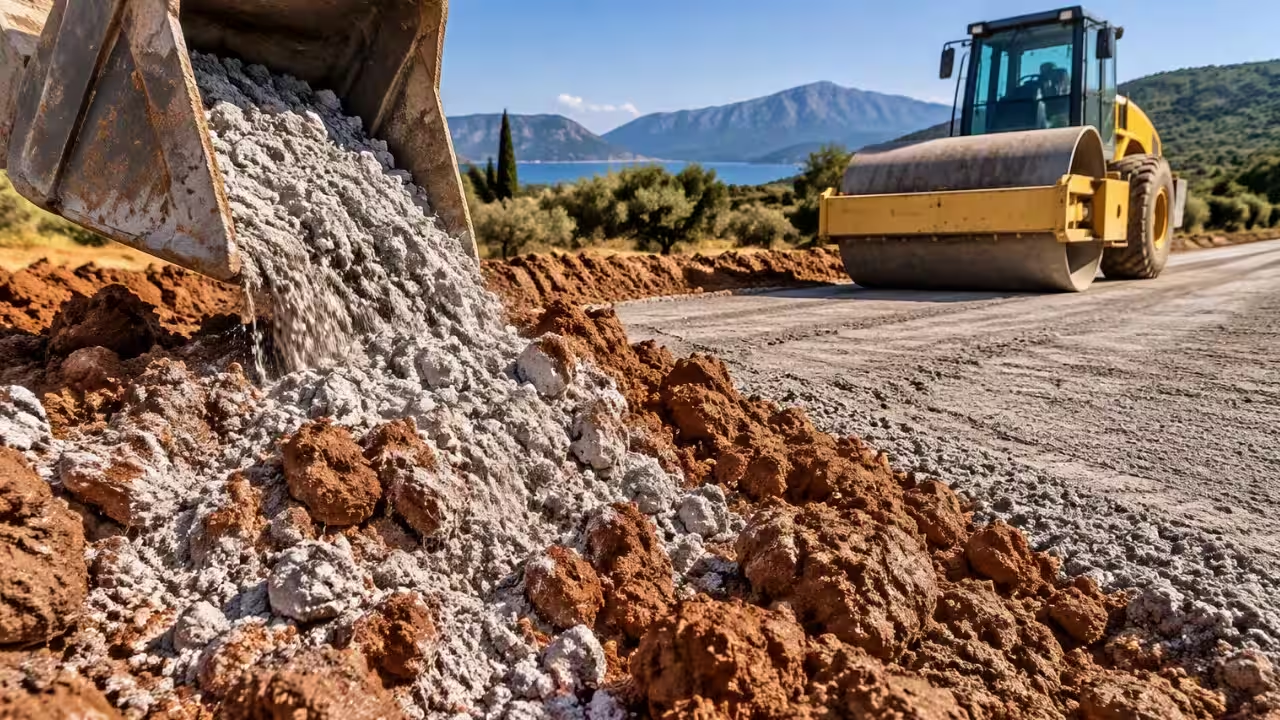
Roads built on clay have a familiar weakness. When the soil is wet, it softens and a soft subgrade cannot carry the loads that the layers above it pass down. The usual remedies are to add binders such as lime or cement, or to bring in gravel and sand and each of these has a cost, especially where good stone is scarce and transport makes up a large share of the bill. A possible source of help is biomass plants and wood-processing factories. Wood combustion results in ash, which is generally dumped in a landfill. The ash contains calcium that reacts and hardens over time, which raises a question for road builders whether a waste product can replace a purchased binder or imported aggregate.The Strizivojna Hrast test section, built in 2023Sanja Dimter, Goran Kuburić, Ernest Ević and Goran Vrhovac tested that question in Road building using wood ash, published in the December 2024 issue of Građevinar. The experiment took place on an internal road at the Strizivojna Hrast factory, which makes parquet and other wood products, in Strizivojna, Osijek-Baranja County. The factory had a cogeneration plant that burned about 110 tonnes of wood biomass per day, and the ash accumulated in a landfill next to the plant. Eight to ten heavy trucks with log trailers, weighing 36 to 40 tonnes, travelled the access roads daily.Bearing capacity rose 155% to 235% on a 50:50 clay and wood ash subgradeThe test section, 80 square metres in total, was built in two fields, the first in June 2023 and the second in September 2023. The first field placed the pavement on the natural subgrade and the second placed it on an ash-stabilised subgrade. The soil consisted of medium-plasticity clay with a laboratory California Bearing Ratio of 2%. In the field, the natural subgrade had a compressive modulus of 12 MN/m², well below the 30 MN/m² minimum in Croatia’s general technical conditions for road works, as cited by the authors. Factory employees mixed the excavated clay with the wood ash mixture from the landfill in equal parts, then compacted it in a layer 15 to 17 cm thick. According to the abstract, this increased the subgrade’s bearing capacity by 155% to 235% compared with natural clay. That is roughly 2.6 to 3.4 times the bearing capacity of the natural clay.In laboratory tests, a 50:50 mixture of clay and wood ash reached a California Bearing Ratio (CBR) of 9%, compared with 2% for untreated clay, which the authors describe as a 350% increase. This is a different measure from the field figures above. The authors’ conclusions describe the subgrade as reaching up to four times the bearing capacity of natural clay, which appears to reflect the highest field reading (48.4 MN/m² against 12 MN/m²) and not the 155% to 235% range in the abstract.A further 31% to 39% gain after 14 daysThe team tested the subgrade on 20 September and again on 3 October 2023. The abstract reports that its bearing capacity rose by 31% to 39% within 14 days of construction, as the wood ash continued to bind the soil. The paper’s table shows more variation. Five points gained between 11% and 57%, while a sixth point, in a wet area, fell from 48.4 to 36.1 MN/m² but still met the 30 MN/m² minimum. The authors attributed the gain to the binding properties of the ash. Calcium oxide made up 33.38% to 46.9% of the ash by mass, depending on the fraction. The 50:50 mixture reached a compressive strength of 0.48 MN/m² after seven days and 0.55 MN/m² after 28 days, above the Croatian minimums for lime-stabilised mixtures of 0.40 MN/m² at seven days and 0.50 MN/m² at 28 days.A 2022 laboratory study on replacing part of the lime A separate study approached the material in the laboratory. Martina Zagvozda, Tatjana Rukavina and Sanja Dimter tested wood ash as a partial replacement for lime in Wood bioash effect as lime replacement in the stabilisation of different clay subgrades, published in the International Journal of Pavement Engineering. The authors found that the best blend depended on soil plasticity. High-plasticity clays tolerated only 25% to 50% replacement of lime, while medium- and low-plasticity soils could take 50% to 75% and still match or beat the reference mixture in CBR.Across all mixtures, CBR ranged from 18.82% to 107.34%, and linear swelling dropped below 1%. The authors cautioned, however, that some aspects of wood-ash chemistry may limit wider use.A wood ash base course remeasured in June 2024Both fields used an ash base layer covered by a 10 cm layer of crushed stone. The ash base reached compressive moduli of 60 to 80 MN/m², the same range the paper reports for the sand base layers commonly used in Slavonia and Baranja. Heavy trucks used the road daily after construction. In June 2024, one year after the first field was built, the authors remeasured the traffic surface and found compressive moduli of 75 to 85 MN/m², with no deformation or damage observed. The paper, published in December 2024, reported no later measurements.What one 80-square-metre test section does and does not establishThe above-mentioned study was a preliminary note covering only a small area of private factory road. The 50% ash content was chosen for practical reasons, not from a laboratory mix design and the authors said better results could be expected with further testing at different ash contents. The authors did not analyse current material prices, so the case for cost savings rests on wood ash being free of charge. Taken together, the two studies support a balanced conclusion. Locally produced wood ash stiffened poor clay soils in eastern Croatia and performed comparably to sand as a base course under heavy trucks. Whether the same holds on public roads, and with other clays and other wood ashes, remains to be shown.You use AI every day. Now get your AI Quotient. Take the AIQ test.
Topics in this story
Gathered from external sources. Rights to this text belong to whoever originally published it.