Rescuers rappel into Nepal hydropower tunnels in scramble to find flood survivors
Nepali authorities say the search for workers who could be trapped inside hydropower tunnels after last week’s catastrophic flooding is now the “highest priority.” Follow for live updates.
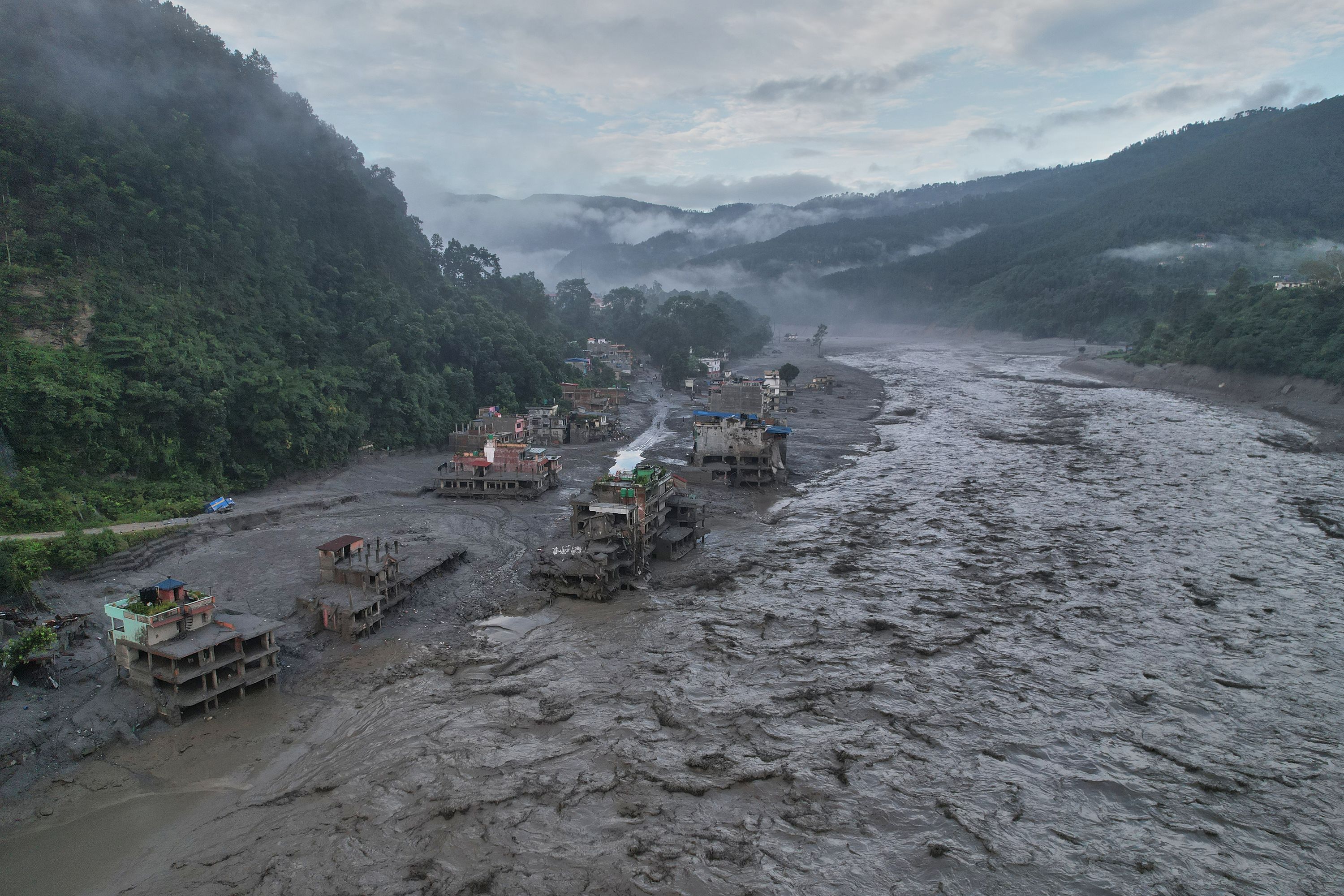
• Spike in missing people: The number of missing people in Nepal has risen sharply following last week’s catastrophic Nepal-China flooding, as authorities reported more than 4,200 unaccounted for — up from about 2,500 a day ago. When figures from China are included, the total death toll now stands at 919, with 4,793 missing on both sides of the border.
• Tunnel searches: Nepali authorities say the search for workers who could be trapped inside hydropower tunnels is now the “highest priority.” More than 900 workers at various projects are missing.
• Risks remain: China flagged eight “high-risk geological disaster points” for intensive monitoring at the disaster-hit Gyirong Port. Authorities also warned that a crater from the initial glacial collapse that triggered the disaster is “the biggest risk point” for the resulting barrier lake.
The death toll from last week’s catastrophic flooding at the Nepal-China border region has reached 903, Nepal’s disaster authority said on Monday, from 788 previously recorded. The death toll in China was 16 as of Sunday.
The number of missing people in Nepal rose to 4,247, including 592 foreign nationals, the National Disaster Risk Reduction and Management Authority said in its latest update. This is a sharp increase from Sunday, when 2,502 persons were reported to be unaccounted for.
Chinese authorities reported on Sunday that 546 people were missing.
On both sides of the border, 919 people have died and 4,793 are missing.
Emergency workers in Nepal have rescued 10,451 people, according to the update on Monday.
This post has been updated with additional information.
A list compiled by Nepal’s Independent Power Producers’ Association (IPPAN) details the number of people missing at the various hydropower projects impacted by the flooding, as of Saturday.
At least 933 workers are unaccounted for at the projects, according to the country’s disaster agency, while the breakdown below carries an earlier, slightly lower total.
Number of missing at affected hydropower projects (as of August 29):
Total listed missing as of August 29: 898
Some context: An urgent effort is underway at a handful of the sites to search for any survivors who may be trapped inside tunnels at the hydropower projects. At the Trishuli-3A project , a hole has been bored into a tunnel so rescuers can access it to located anyone inside.
Rescue teams began rappelling into a tunnel at a hydropower plant in Nepal late Sunday, as part of an urgent mission to search for survivors who might be trapped inside several days after the devastating flash flood.
A roughly two-feet-wide hole has been drilled through the heavily fortified exterior of the tunnel at the Upper Trishuli-3A hydropower project, officials said, adding that rescue teams were hoping to get inside to identify where in the kilometers-long tunnel the workers might be.
They “descended through the opening using ropes and called out to those trapped inside, but received no response,” the prime minister’s office said on Sunday.
Video showed the workers rappelling downward into the dark cavern, wearing harnesses and helmets.
“The team is preparing to reach the suspected working space approximately 180 meters inside the tunnel from the portal, where it will assess the actual conditions, determine the possible location of the trapped individuals, and evaluate the safety situation as accurately as possible.”
Earlier, the team had also pumped air into the tunnel, and sent food inside.
A total of 90 personnel are on site, including from the Nepal Army, Nepal Police and the Armed Police Force, as well as sniffer dogs and search-and-rescue teams, officials said.
Foreign rescue teams are working to clear and search other hydropower projects, which are scattered along the Trishuli river winding through multiple districts. The Indian team, for instance, is monitoring the Chilime and Langtang areas by helicopter, while the Chinese team has already searched the tunnel of the Upper Trishuli-1 hydropower project, said the ministry’s news release.
Authorities met with the families of missing workers on Sunday, and told them the government “is leaving no stone unturned to save the lives of its citizens,” the ministry added.
Searching for survivors trapped in tunnels at hydropower projects is now a “highest priority” for Nepal authorities. More than 900 hydropower workers are still missing since catastrophic floods devastated the Nepal-China border region last week.
Residents are returning to ruined villages and mourning lost family members and loved ones . Dozens of children were reunited with their families after massive rescue efforts.
Workers trapped: A massive effort is underway to bore down into some of the tunnels of Trishuli 3A and 3B hydropower plants, according to Nepal’s Minister of Energy, Water Resources and Irrigation. As many as 100 workers are believed to be trapped inside the Trishuli 3A hydropower station, one of 27 such facilities damaged or destroyed .
Devastating toll: At least 788 people died in Nepal , according to local police, and at least 16 deaths were reported by Chinese authorities. Officials buried nearly 200 unidentified bodies in Nepal as authorities struggle with the large number of remains.
Hazards flagged: Eight “high-risk geological disaster points” have been flagged for intensive monitoring around Gyirong Port area, as China’s Ministry of Natural Resources on Sunday called for drone aerial surveys and manual patrols to provide early warning of possible collapses and landslides.
Signals restored: Communication signals have been restored at Gyirong , the remote Chinese border post devastated by the flooding, state media Xinhua reported. It was one of the first places to be hit by water, mud and rocks during the disaster.
Tales of survival: Several workers made a hellish escape out of flooded hydro tunnels, they told CNN . A 6-year-old girl who paramedics rescued on Friday after being trapped under the rubble for 60 hours is now with her parents, her aunt told police. Dozens of children were also reunited with their families or guardians this weekend, according to Save the Children. In one of the worst-hit areas, a group of schoolchildren survived as they left their classroom for their lunch break.
A team tasked with probing hazards around the Gyirong Port area in Tibet identified eight “high-risk geological disaster points” for intensive monitoring as rescue efforts after Wednesday’s flooding continue.
China’s Ministry of Natural Resources on Sunday called for drone aerial surveys and manual patrols to conduct risk assessments and monitoring to provide early warning of possible collapses and landslides, according to the ministry’s official social media account.
Rescuers on both sides of the China-Nepal border have been grappling with the risks of additional flooding and landslides – complicating already perilous rescue and recovery operations in the disaster-hit areas.
A crater from a glacial collapse that triggered the disaster is “the biggest risk point” for a barrier lake created from the resulting landslide, the ministry warned on Sunday morning. Water was continuously flowing from that crater, posing risks to water-logged downstream areas, the ministry said in its latest update.
The barrier lake had caused significant concern for rescue teams in recent days. The lake has been largely emptied, the ministry added.
On Monday, weather authorities in China said there would be light rains, with showers also forecast for Tuesday.
From his office in Melbourne, Dix has been reviewing technical drawings, satellite images and aerial videos to determine the best way to access the tunnels.
“Normally, they collapse and I’m trying to get people out. This time, they haven’t collapsed, but everything around them has, and I’m trying to get in,” he said.
The entrance to the Trishuli 3A power station was completely buried, but in the last few hours, Dix said workers had confirmed that they’ve found it – though they’re still hundreds of meters from the turbine room where survivors could be trapped.
“We don’t know how much of that tunnel is full of mud or water… So, we might only have to dig 10 meters, or we might have to dig 100 meters,” Dix told CNN on Monday local time.
He said there’s a risk the emergency shutdown systems failed and the turbine rooms filled with water.
If that happened, rescuers could potentially drown if they break through rubble that’s acting as a plug.
“Another thing we’re trying to do is to drill from the top… But that’s really difficult because we need special equipment to get through the steel and everything that’s surrounding the turbine room. So, it’s layer upon layer of technical difficulties,” Dix said.
“I think it’s quite likely that the turbine room’s intact, and certainly that’s what we’re planning on.”
He said anyone trapped inside could survive for weeks if a water supply is available.
Dix also advised the rescue of 41 Indian workers trapped in a collapsed tunnel under the Himalayas in 2023.
As we continue to cover rescue and recovery efforts on the ground in Nepal and China, here’s a closer look at how the catastrophe started. This graphic maps the glacier’s swift descent — and the devastation that followed:
Officials in southern Nepal were forced to lay 199 unidentified bodies to rest in the middle of a forest over recent days, according to police, after medical stocks to preserve the remains for DNA testing dwindled.
In total, rescue crews had recovered 272 unidentified bodies originating from Tibet, an autonomous region of China, following lethal torrents in the Himalayan region that washed away entire villages and sank towns under debris and mud.
The remains swept south down toward Chitwan, a district in Nepal that borders India, a local police inspector, Anil Thapa, told CNN on Sunday. Emergency workers retrieved the dozens of bodies along the riverbanks of southern plains.
“Bodies are still being recovered. But we want to manage those dead bodies to avoid the risk of fast decomposition,” said Thapa. The lack of DNA collection equipment ultimately delayed the burial process, he added.
Paramedics have been searching landslide-stricken neighborhoods for days, with Nepal’s government bringing in international assistance to beef up operations on the ground . Earlier on Sunday, a police official in the Nepali capital, Kathmandu, warned that mud-filled sludge was hampering rescue work, telling China’s state broadcaster CCTV that heavy rainfall was adding to the quagmire.
CNN’s Jared Formanek contributed reporting.
Living in the shadow of the world’s spectacular, ice-capped mountains has always carried dangers , but the devastating flood wave that carved a path of destruction on the Nepal-China border this week shows how life for the millions worldwide who live downstream of these peaks is becoming more unpredictable and more deadly.
Nepal is a country of jagged, towering peaks with sheer slopes sweeping down to narrow valleys, cut through by powerful rivers. Its stunning landscape attracts hordes of tourists; it’s also treacherous.
Nestled in the rapidly warming Himalayas, the country has long been a hotspot for flooding and landslides. But what happened on Wednesday “was of significantly larger scale than what we have seen in the recent past,” said Prashant Baral, a cryosphere analyst at ICIMOD, a Nepali climate organization.
An enormous chunk of glacier around 2,000 feet wide sheared off Langtang Lirung mountain in northern Nepal, accompanied by landslide, according to satellite analysis. It sent a deadly mix of ice, water, rock, sediment and boulders the size of cars crashing 7,000 feet downward, causing such a powerful tremor, it was initially mistaken for an earthquake.
This torrent – described by some as “ liquid concrete ” – surged through narrow gorges, wiping out homes, buildings, power plants, bridges and roads.
Topics in this story
Gathered from external sources. Rights to this text belong to whoever originally published it.