Farmers grieving over bluetongue urged to talk
Bluetongue has hit farmers hard and they have dreaded seeing the impact on their livestock.
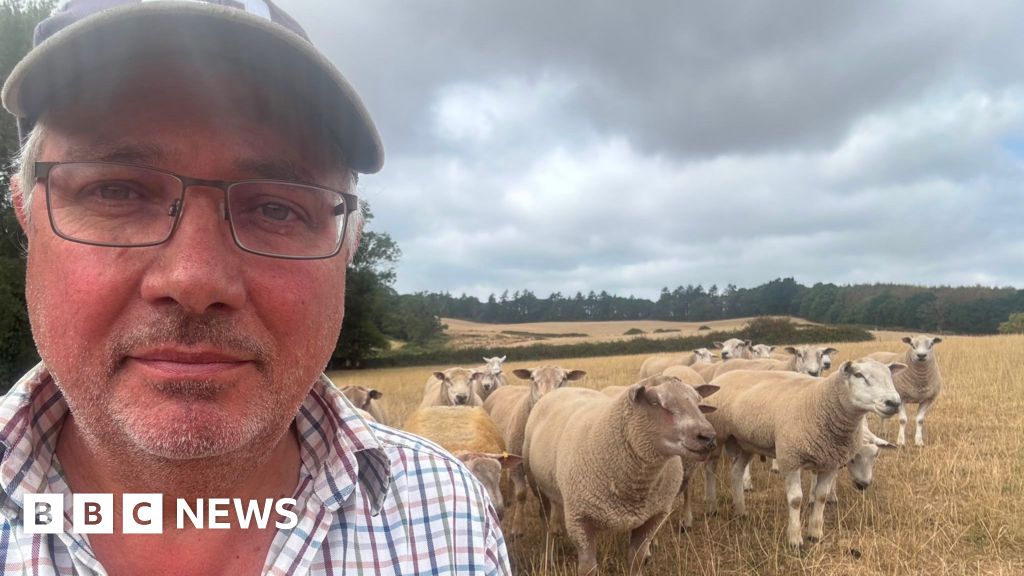
Farmers and support workers say bluetongue has hit agriculture hard and fear it will have a "lasting impact".
South-west England has been particularly badly affected by the virus. Farmers who have lost animals to the virus are feeling "a tremendous sense of grief", said Andy Jerrard, the Methodist Church's rural support worker.
Jerry Sanders-Carr, who runs Exe Valley Lamb, near Exeter, and has lost 15% of his sheep to bluetongue said farmers were offering each other support.
He said: "Talking to some of the guys who've been going out picking up large numbers of dead animals every morning, some of these guys I'm sure there's going to be a lasting impact on them."
How bluetongue virus exploded in the South West
Sanders-Carr said: "I know talking to people who have experienced foot-and-mouth they came out of it with PTSD-type symptoms and I wouldn't be surprised if that some guys who've had it far worse than I've had it will be materially affected mentally."
He has vaccinated just under 700 sheep at a cost of £15,000 and said "had a huge impact" but it had been distressing at the height of the virus on his farm.
Bluetongue can make sheep and cattle lethargic and lame, it can cause birth defects or spontaneous abortions and it can be fatal and is spread by midges.
Sanders-Carr said: "During the peaks of it when we were going out in the morning and treating 40 plus animals that were showing symptoms it was horrendous.
"You didn't want to go out and find sick animals, but you had no choice you've got to get out there and treat them, it was incredibly stressful."
If you or someone you know is affected by this subject and is in need of support, you can find more information at the BBC Action Line .
There were 670 places in the UK with recorded cases of bluetongue by Wednesday 26 August, including 332 in Devon and 110 in Cornwall, according to government figures.
Sanders-Carr said he was getting messages of support from all over the country and farmers have been sharing experience and guidance.
"I've never had so many WhatsApp messages and phone calls from farmers that I maybe only speak to once or twice a year but we've speaking almost weekly in some cases," he said.
Rural support worker Jerrard, who is based in Crediton, said it has had a huge impact of farmers at affected farms in west Somerset, Devon and north-east Cornwall.
He said: "There's a tremendous sense of grief, I think, because these folks are entrusted with animals for their lifetime and there is a sense of having let the animals down by seeing them ill, and that is emotionally exhausting."
Jerrard added farmers have also treated animals "they thought would survive and didn't" and added "seeing animals suffering is hard for them to bear".
He said: "To say they are on their knees is an understatement, a lot of them are on their backs."
Jerrard said the heat had added to the pressure, as farmers were going round inspecting their animals and having to catch them and inject them in heatwave conditions, which had been exhausting.
He said farmers were supporting each other and although they were robust they could be "quite vulnerable".
The rural support worker added: "There are a lot who went through foot-and-mouth who have said this is as bad.
"When something like this hits, then it hurts."
He said farmers were also faced with worries about the impact of bluetongue on animals' fertility next spring.
Cornish farmer Luke Thomas represents Cornwall on the National Farmers' Union livestock board and lost 40 sheep to bluetongue with some lambs orphaned.
He said: "I think people are pretty demoralised, along with the long spell of dry weather.
"Farmers are facing a lot of risk. This summer has exposed the fact that we're so open to risk."
The experience is going to make him change the way he farms, Thomas said.
He explained that his farm had lambs in the summer and feared that had made the flock "more vulnerable" with sheep feeding two lambs the "most badly affected".
Bluetongue has also affected the fertility of a bull and he had to buy in another, which was an "additional expense".
Thomas said one positive was that farmers were talking to each other with a culture "where it's actually ok to talk about how you're feeling".
He added: "I think it takes practice and the more we learn to do it and the more we learn to encourage it, that can only be good."
Follow BBC Cornwall on X , Facebook and Instagram . Follow BBC Devon on X , Facebook and Instagram . Send your story ideas to spotlight@bbc.co.uk .
What is the potentially deadly bluetongue virus?
Bluetongue dominates vets' workload as cases rise
Farmer has vaccinated 1,700 sheep for bluetongue
Bluetongue fears 'on par with foot and mouth'
'I felt so alone when my sheep caught bluetongue'
Topics in this story
Gathered from external sources. Rights to this text belong to whoever originally published it.