North Korea’s threat to moral norms
Author Aaron Rhodes argues that President Trump’s diplomatic overtures toward North Korea and the proposed Peace on the Korean Peninsula Act risk legitimizing the regime’s systemic human rights violations and corruption of international moral standards.
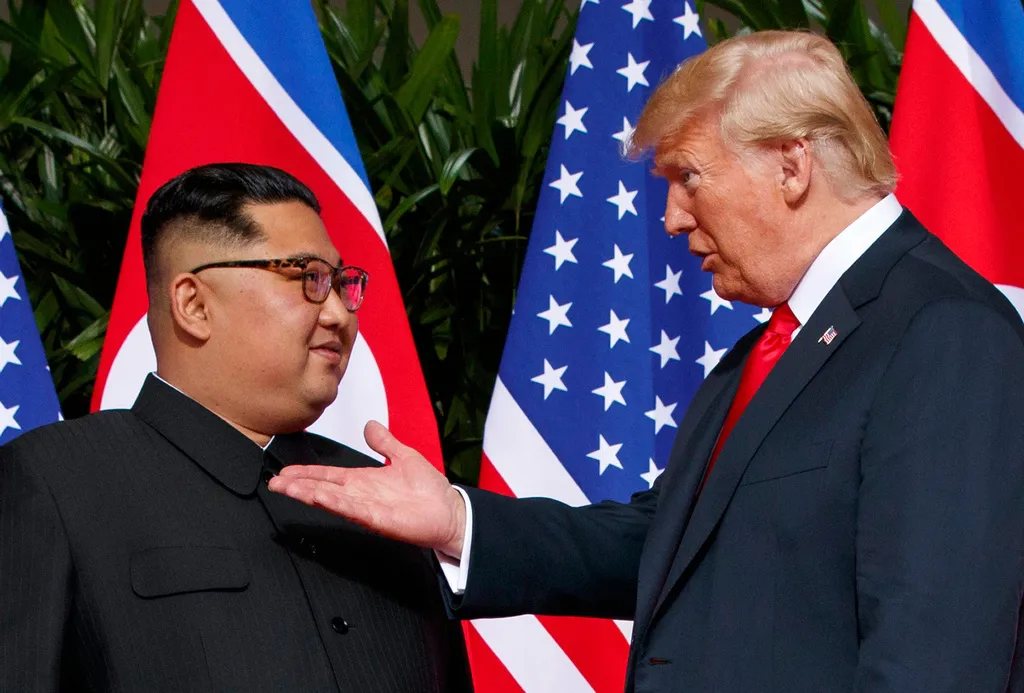
President Trump’s reduction of military pressure and overtures to reopen direct diplomacy with Kim Jong Un downplay and legitimize North Korea’s assault on human rights standards all governments are morally obligated to respect. North Korea’s growing nuclear arsenal, ballistic missiles and massive army threaten South Korea, Japan and world peace. But the regime’s horrific treatment of its people challenges fundamental principles of decency shared by civilized societies.
Trump is not the only one to ignore the Kim regime’s totalitarian abuses. Media coverage and political commentary surrounding Trump’s latest overtures to the North Korean dictator have not even mentioned crimes against humanity and violations of human rights and freedoms, which are arguably worse than in any other country on Earth. Human Rights in North Korea, an independent nongovernmental organization, said around 160,000 individuals were being detained there for “political crimes,” highlighting an increase from previous estimates. According to a 2014 United Nations commission report , detainees are subjected to “murder, enslavement, torture, rape, forced abortions and other sexual violence,” atrocities that the organization says are ongoing. Twenty-seven of these camps have been documented by satellite imagery and witness testimonies.
A “political crime,” thanks to North Korea’s ascriptive Songbun classification system , can mean coming from a family deemed insufficiently loyal to the Kim dynasty by virtue of actions committed by relatives decades ago. Outside of the system of gulag-style concentration camps, people’s access to employment, education and food is determined by whether they belong in the “core,” “wavering” or “hostile” class. The latter includes, inter alia, descendants of capitalists (as of 1948), Christians, Buddhists and their descendants, and descendants of those who have been executed.
Torture in North Korean detention facilities takes forms too awful to describe. As a human rights advocate I have interviewed many torture victims, and developed a protective emotional crust, but the stories I heard from North Korean defectors brought tears to my eyes and made me nauseous. Of course, in United Nations forums, regime diplomats deny that torture is used, and that any political prison camps exist. Like all communist states, North Korea asserts that equality is its main governing principle, and that Songbun is a fabrication meant to “smear” the regime.
But the effort to keep the horrors endured by North Koreans and the regime’s malign foreign policies on the international political agenda is faltering. In UN reviews of its human rights record, North Korea has been applauded for ratifying the United Nations Convention on the Rights of Persons with Disabilities. The posture of the current South Korean administration of President Lee Jae-myung and the Democratic Party of Korea is to sweep the issue under the rug, consistent with a policy of appeasement.
In testimony before the U.S. Congress, Suzanne Scholte, chair of the North Korea Freedom Coalition, said: “President Lee has abandoned the people of North Korea. … For the first time the Republic of Korea has ended all its radio broadcasting to North Korea and … has ended all support for the North Korean defector organizations.” Scholte noted that the Democratic Party has criminalized sending leaflets across the border to the North.
Congress could go in the same direction if the pending Peace on the Korean Peninsula Act were to pass. The bill directs the U.S. secretary of State to pursue a peace agreement, replacing the 1953 armistice still in effect, and mandates that military resources be reallocated.
The legislation would reward a state that not only brutalizes its own citizens, but also sends soldiers and weapons to assist Russia’s attempted conquest of Ukraine, and defends Iran’s slaughter of protesters.
Critics have charged that, absent prior denuclearization, the legislation would harm regional and international security. But President Trump’s claims of warm friendship with Kim and that North Korea is “non-threatening” and “respectful” erode moral distinctions between civil society and tyranny. Entering into negotiations with North Korea could frame the rogue state as simply another established nuclear power. A failure to call out North Korea’s humanitarian atrocities in the context of engagement on other issues implicitly corrupts standards that are vital to defending freedom and dignity everywhere.
Aaron Rhodes was formerly executive director of the International Helsinki Federation for Human Rights and president of the Forum for Religious Freedom-Europe. He is the author of “The Debasement of Human Rights” and “Human Rights Without Illusions.”
Topics in this story
Gathered from external sources. Rights to this text belong to whoever originally published it.