In 2004, two Georgia Airmen sank Christmas trees to give Scout Lake’s fish protective cover; such habitat can concentrate fish near fishing piers
US News: In 2004, Airman First Class Gary Yates and volunteer Marilyn Rodgers transformed Scout Lake into a thriving fishing spot by sinking Christmas trees as fish habitats, boosting local angling opportunities.
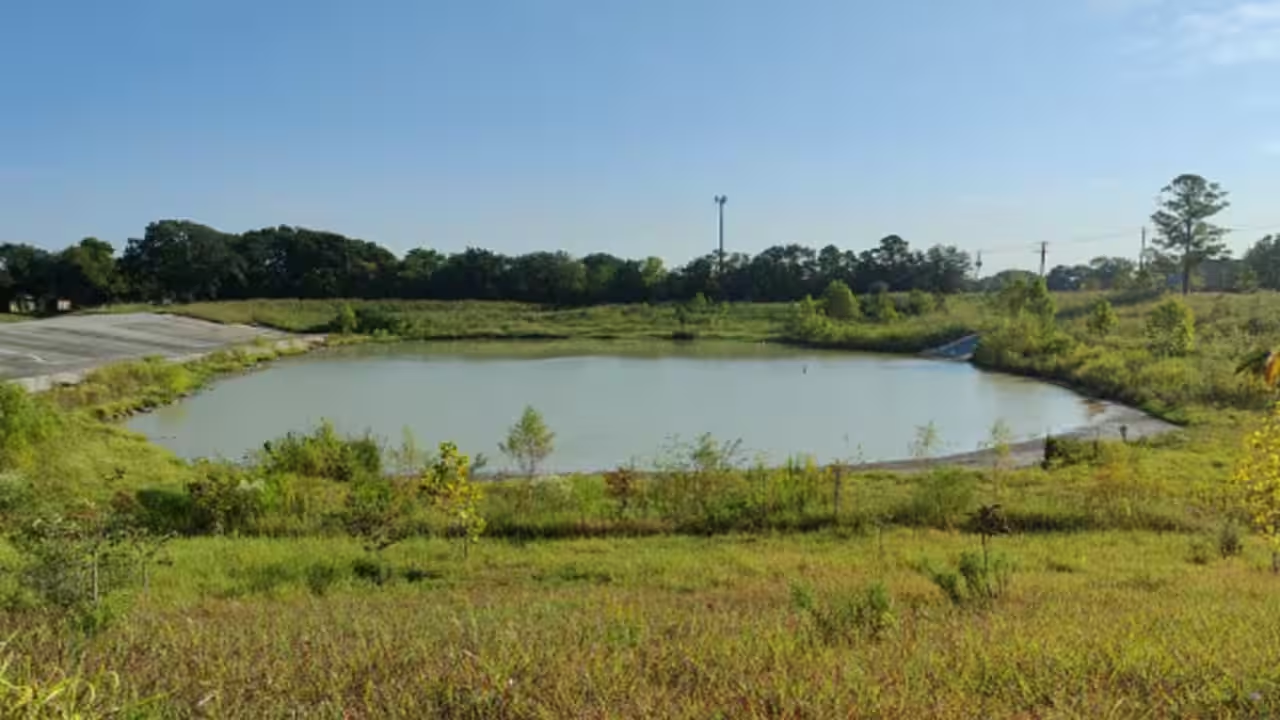
In the winter of 2004-2005, Airman First Class Gary Yates and a volunteer named Marilyn Rodgers lowered a used Christmas tree into Scout Lake on Robins Air Force Base in Warner Robins, Georgia, sinking it to create fish habitat, according to a Robins Air Force Base article on the program. Artificial ponds like Scout Lake lack the dead wood, logs, stumps and drift piles that naturally accumulate in natural ponds over decades. The absence of such structures leaves no room for small fish to hide from predators and for the entire aquatic chain to form and ensure a balanced game fishery. Placing Christmas trees in the water is an inexpensive way to address this issue: the dense web of needles and branches provides protection to the forage fish while attracting algae and aquatic insects on the outer branches where smaller fish can feed on them.Fisheries agencies responsible for managing such projects don't rely on attracting fish from long distances; instead, the goal is to concentrate nearby fish in a spot anglers can reach. As per the guidance provided by state agencies responsible for the conservation of wildlife resources, the attractors gather fish in a small area rather than drawing fish from a large distance and that is exactly the reason they are deployed close to the boat docks and fishing piers. That logic applies just as well to a small base lake as it does to a large reservoir: a tree sunk within casting distance of a pier turns a quiet stretch of shoreline into a spot anglers can actually reach and fish productively.A 1980 creel survey on Norris Reservoir measured the payoff for anglersIt is hard to give any proof about the efficiency of such structures for both anglers and fish, but the results of the creel survey conducted in the Norris Reservoir of Tennessee are an obvious exception. There, 1,435 fishing parties were interviewed over 7.5 months in 1980: 115 anglers who fished only attractor areas, 2,582 who fished only open water, and 358 who fished both types of areas. On average, there were 9.8 brush-pile attractors per each of 259 coves in the reservoir. Anglers who fished near the attractors caught more fish per hour and in total weight compared to anglers who fished open water and the biggest increase was noticed among anglers who fished crappie. The authors note that fishermen who used attractors fished more successfully, caught more fish per man-hour and kilograms per man-hour and crappie anglers fished best of all. This study, titled Effects of Fish Attractors on Sport Fishing Success on Norris Reservoir, Tennessee, was deposited in the University of Tennessee’s graduate research repository and remains one of the best pieces of evidence that concentrating fish at fixed points increases catching opportunities rather than merely relocating them.Sonar imagery later showed why material choice still mattersThe second, more recent study, carried out in two turbid Piedmont reservoirs in North Carolina (Lake Townsend and Lake Cammack) by biologists working for the North Carolina Wildlife Resources Commission, has employed dual-frequency identification sonar (DIDSON) to assess the longevity and efficiency of various fish habitat attractors. The habitat cubes created from PVC and corrugated plastic pipes were compared to the bundle of evergreen trees using the number of fish found near them. There were significantly more fish near each type of attractor than there were in the water without the attractor; however, according to the study's report, the evergreen tree bundles deteriorated much faster than the artificial attractors, losing substantial branch volume within the first year and showing major structural breakdown by the third year. The study was titled Evaluating the Effectiveness of Artificial Fish Habitat Designs in Turbid Reservoirs Using Sonar Imagery. More than 800 fish habitats have been placed in the state due to research similar to the aforementioned.The fish attractor map provided by the North Carolina Wildlife Resources Commission now shows more than 800 fish attractors in more than 60 bodies of water, some of which have attractor sites with markers while others don’t. The page containing the map offers buttons allowing users to download the visible attractor sites in GPX and CSV format. As the Norris Reservoir study suggests, an attractor’s value lies in keeping fish concentrated where anglers can reach them. The North Carolina sonar research adds a caveat: Christmas trees provide that effect quickly, but they need replacing every few years because they decay faster than synthetic structures.A small project with a familiar patternThere is little documentation that gives an exact account of how Yates and Rodgers picked their dropping site and how the base measured their success thereafter. However, the program is just one of those that follows the trend found in all kinds of bodies of water in the United States, from Tennessee Valley Authority lakes to municipal ponds, where free, biodegradable Christmas trees continue to offer fish protection, draw in predators and give fishermen a fighting chance at a Georgia base and beyond.Catch the latest World News and Live updates. Download the TOI app.
Topics in this story
Gathered from external sources. Rights to this text belong to whoever originally published it.