In 1687, Isaac Newton published the book that explained gravity, with Edmond Halley paying for its printing; after passing through a British lord's family, a first edition sold for Rs 5.49 crore in 2026
A book published in 1687 helped change how humanity understood the universe.
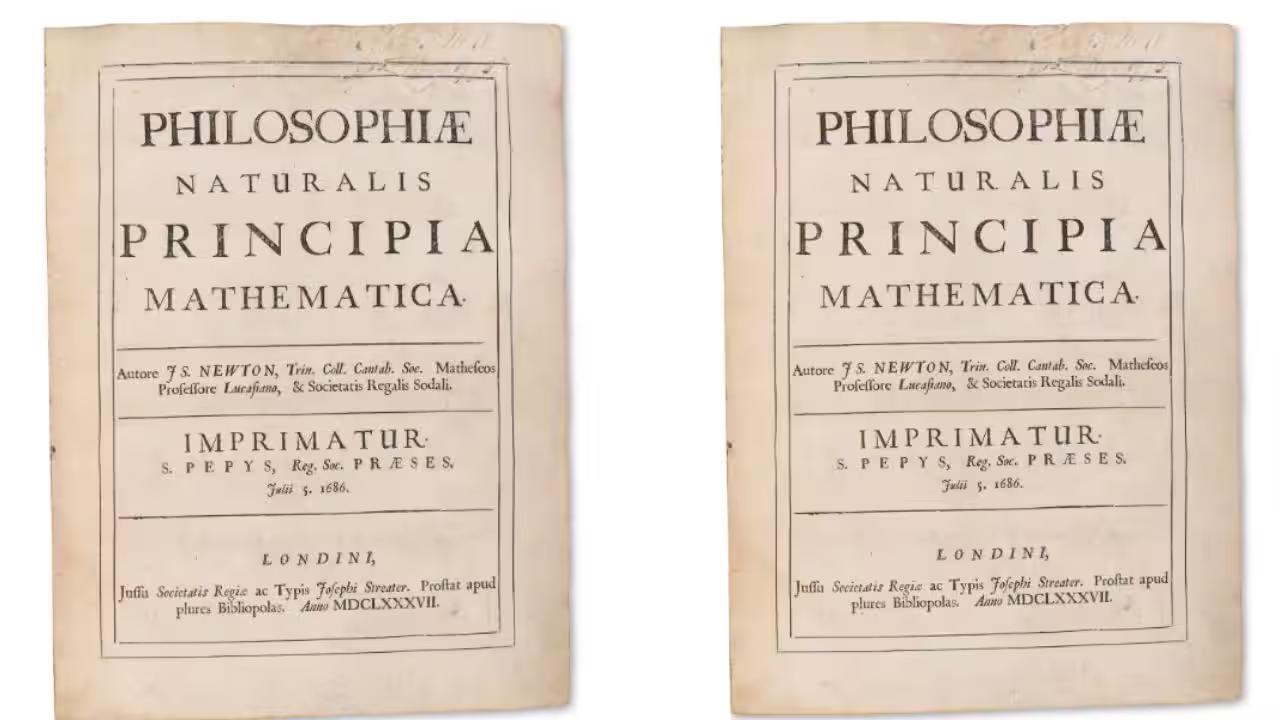
A book published in 1687 helped change how humanity understood the universe. Written by English mathematician and physicist Isaac Newton, Philosophiae naturalis principia mathematica presented mathematical laws that explained the movement of objects on Earth and the motion of planets and other celestial bodies.Nearly 340 years later, a first edition of this historic work sold for US$576,000, approximately Rs 5.49 crore, at Christie’s on October 13, 2026. The sale drew attention not only to Newton’s scientific legacy but also to the book’s survival through centuries of ownership. The copy featured a contemporary calfskin binding, a folding engraved plate illustrating a comet’s orbit, and diagrams printed alongside the text. Its ownership history included Lord Kennet of the Dene and the late Lady Kennet, connecting the scientific landmark to a British aristocratic family.The book that changed how the universe was understoodNewton’s Principia, as the work is commonly known, was published in London in 1687. It brought together ideas about motion and gravity in a mathematical framework that helped explain phenomena that had previously been studied separately. The book set out Newton’s three laws of motion and his law of universal gravitation. Together, these principles helped explain why objects fall towards Earth, how moving bodies behave and how the movements of planets can be understood through the same underlying physical laws.Before Newton, astronomers such as Nicolaus Copernicus, Galileo Galilei and Johannes Kepler had made important contributions to understanding the heavens. Newton built on earlier discoveries and showed how mathematical principles could connect motion on Earth with the movements of celestial bodies. The achievement became one of the most influential developments in the history of science. Although modern physics has expanded and revised aspects of Newtonian theory, his laws remain important in fields such as engineering, astronomy and classical mechanics.Edmond Halley helped bring Newton’s ideas to printThe story behind the book is also one of scientific collaboration. Astronomer Edmond Halley encouraged Newton to develop and publish his work after learning about his mathematical explanations of planetary orbits. Halley did more than support the project intellectually. According to the Christie’s catalogue, he helped correct the proofs, supervised the preparation of diagrams and persuaded Newton to make the work public. He also paid the printing costs because the Royal Society, which supported the publication, had run short of funds.Newton acknowledged Halley’s contribution in the book’s preface, crediting his efforts and persistence for helping bring the work before readers. This support was crucial. Newton’s ideas might have remained less accessible without Halley’s determination to see the manuscript through publication. The episode illustrates how major scientific advances can depend not only on an individual’s discoveries but also on people who help communicate and distribute them.A rare first edition with a distinguished ownership historyThe copy sold in October 2026 was the first edition published in 1687. Its title page belonged to a version identified by a two-line imprint, a detail that helps specialists distinguish it from another issue bearing a three-line imprint and naming bookseller Samuel Smith. The book measured approximately 24.5 by 18.9 centimetres and retained its contemporary sprinkled calf binding, with the edges of its pages coloured yellow. It also contained a folding engraved plate depicting a comet’s orbit, along with woodcut and typographical diagrams.Its condition showed signs of age. The title page had a short tear that had been strengthened from the back, while the pages displayed occasional spotting and light browning. The binding had been repaired, its endpapers renewed and its corners restored. A black protective clamshell box accompanied the volume. The provenance was another notable feature. The catalogue traced the copy through an earlier owner identified as E. James, whose signature was dated 1773, and bookseller Bernard Quaritch. It later belonged to Lord Kennet of the Dene and the late Lady Kennet, who sold it at Christie’s in 2015. The current owner acquired it at that auction.Why Newton’s book remains valuable centuries laterThe Rs 5.49 crore sale reflects more than the age of a printed volume. First editions of historically important scientific works are valued for their rarity, condition, documented ownership and influence on human knowledge. Principia occupies a special place because it helped establish a mathematical approach to understanding nature. It connected the behaviour of objects on Earth with the movements of bodies in space, shaping scientific thought for generations.The book’s history also reveals the people and institutions behind its publication, from Halley’s financial support to the printers who produced the edition. Its journey through private ownership and auction rooms adds another layer to its significance. More than three centuries after its publication, Newton’s work continues to represent a turning point in science. Its sale demonstrates how an object created to communicate revolutionary ideas can become a historic artefact in its own right.You use AI every day. Now get your AI Quotient. Take the AIQ testGet the latest Lifestyle News and more. Download the TOI app.
Topics in this story
Gathered from external sources. Rights to this text belong to whoever originally published it.