In 1979, wood chips covered a U.S. coal-haul road and made dust control last 10 times longer than water spraying alone in a field test without repeat spraying
Discover how a groundbreaking 1979 field test by the U.S. Forest Service demonstrated that wood chips can significantly extend dust control on coal-haul roads, lasting ten times longer than water alone.
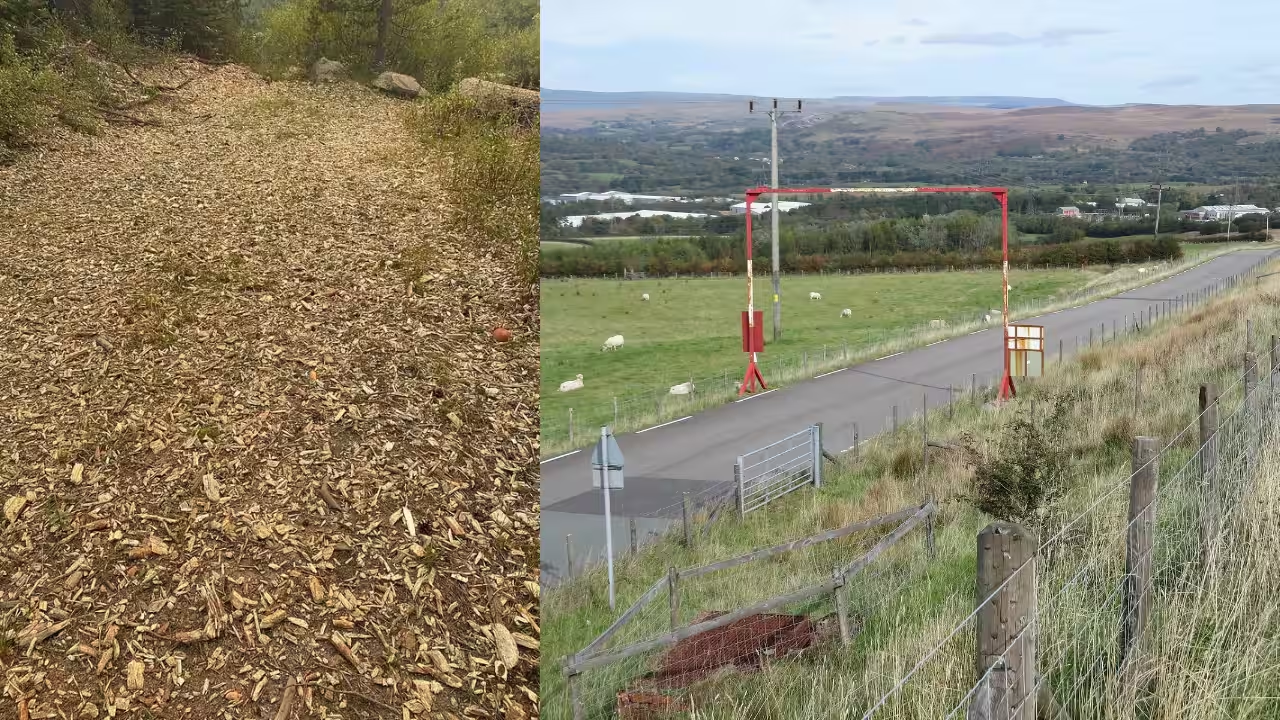
A 1979 U.S. Forest Service field experiment found that a layer of wood chips could keep dust under control on a coal-haul road for roughly 10 times longer than the untreated road when it is under comparable traffic and weather conditions. The result came from a preliminary test in Breathitt County, Kentucky, where researchers covered a 100-meter section of a mine spur road with wood chips and compared it with adjacent untreated sections. The study was published as Forest Service Research Note NE-277.Mine operators were already dealing with a problem, which was that even though water sprinkling could suppress dust, the effect did not last long. The Forest Service report said that increases in traffic, temperature and wind, along with lower humidity, could quickly dry a road surface. Water trucks then had to make more frequent passes or use more water, which increased the number of trucks needed to cover a haul-road network and could become difficult when water supplies were limited.The wood-chip approach worked differently, wherein researchers placed a physical layer over the road surface instead of relying entirely on repeated wetting. The chips helped keep existing fine particles from being lifted by passing trucks, reduced the direct pounding of tires on the road and slowed evaporation from the surface. The report said that the chip blanket therefore addressed both the moisture problem and the mechanical forces that turn road material into airborne dust.The test used waste trees from a mine siteThe researchers used whole trees that had recently been cleared from the mine site, including oak, hickory and gum. The trees were processed into chips, transported about 50 miles to the test location and spread over the road with a motor grader. The researchers treated about 100 meters of the section, where the chip layer varied from about 3 to 6 centimeters thick, and used approximately 28.4 cubic meters of chips. Researchers also monitored temperature, humidity and moisture in the road material while counting the vehicles that passed through the test section. The Forest Service report records 57 loaded coal trucks, 53 empty coal trucks and 33 passenger or service vehicles during the observation periods. Truck speeds averaged about 22 mph for loaded trucks and 27 mph for empty trucks.On the chip-covered section, it took five hours of traffic use and 21 hours of elapsed time for the dust plume to approach the level that was already seen on the untreated road after roughly half an hour. The treated road also lost moisture more slowly, and the report calculated that the overall moisture-loss rate on untreated sections was 2.5 times that of the section protected by chips. The road had been sprayed shortly before the chips were applied, and the researchers did not present the wood layer as a complete replacement for sprinkling; instead, the study examined whether the chips could extend the period before another application of water was needed.The researchers warned against reading too much into the resultThe chip blanket itself began to deteriorate under traffic, and after six hours of traffic-related stress, the average width of the chips had fallen by about 25 percent. Fast-moving trucks also disturbed the blanket, which pushed chips toward the sides of the road and exposed some areas. The report said a motor grader could redistribute the material, but repeated reworking would mix more road dust into the chips and further break them down. The 10-fold advantage observed during the limited test was unlikely to continue unchanged over the medium or long term, and the conclusion was that under traffic and weather stresses similar to those in the experiment, wood chips could reduce the need for dust-control sprinkling substantially.A U.S. Environmental Protection Agency technical report from the period described watering as a common method for suppressing fugitive dust from unpaved roads and noted that effectiveness depended on weather, road conditions and traffic. Another Mine Safety and Health Administration dust-control handbook notes that haul trucks can account for a large share of particulate emissions at surface mine sites and that dust from haul roads can reduce visibility as well as expose workers to airborne particles.The Forest Service noted that, when a temporary haul road was eventually abandoned and reclaimed, the deteriorated chips could be incorporated into the soil as an organic mulch. The original study therefore ended with a practical proposition that material that began as waste from clearing a mine site could serve a temporary road-management purpose before becoming part of reclamation work.You use AI every day. Now get your AI Quotient. Take the AIQ test.
Topics in this story
Gathered from external sources. Rights to this text belong to whoever originally published it.