In 2019, a Miami artist built a ceramic underwater reef to give coral a place to grip; her sculptures became a nursery-like habitat for reef animals instead of only gallery art
Discover Beatriz Chachamovits' innovative ceramic underwater reef, designed to mimic coral and provide a habitat for marine life, while addressing critical issues like coral bleaching and plastic pollution. Join the movement to preserve our oceans.
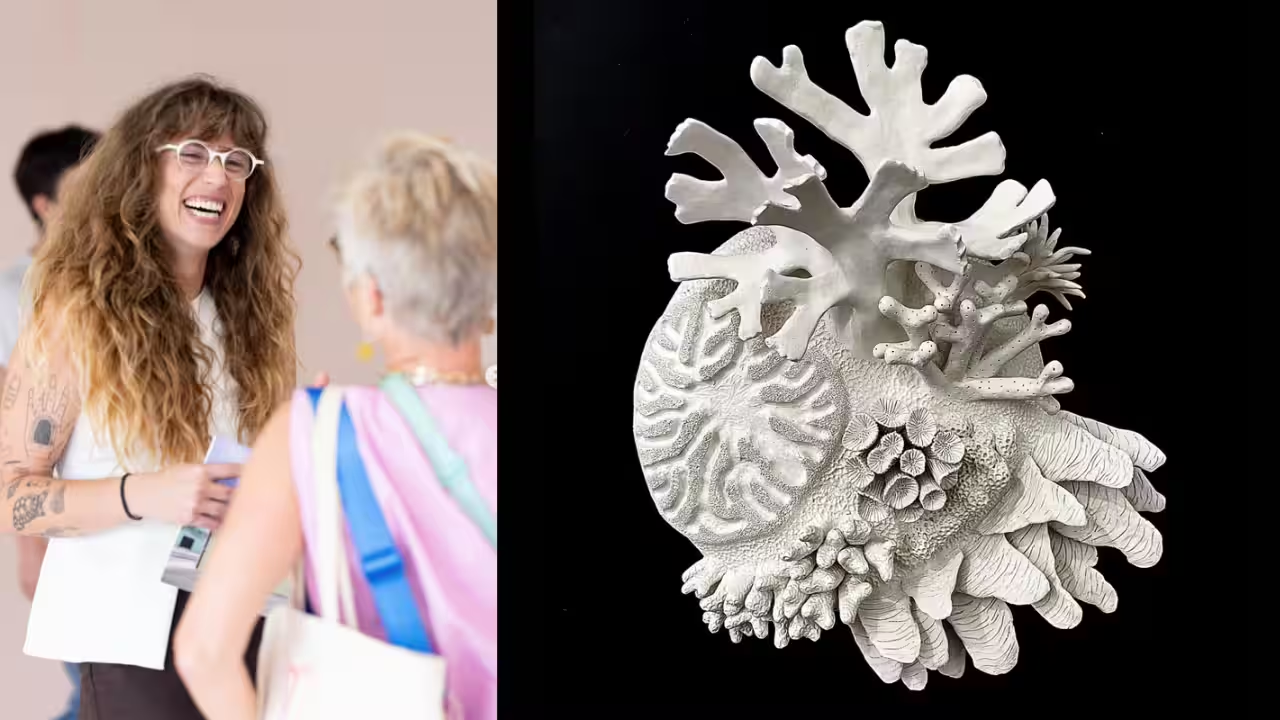
Beatriz Chachamovits is a Brazilian-born artist based in Miami who created To Replenish With Water as an artificial reef for the Underwater Museum of Art off Florida's Gulf Coast. The work depicts bleached corals and sponges that are mixed with forms resembling plastic waste, with the expectation that living coral would eventually grow over its surface.The sculpture was part of the museum's 2019 installation, which placed 12 new artworks underwater near Grayton Beach State Park in South Walton, Florida. The Underwater Museum of Art was created in partnership with the South Walton Artificial Reef Association, and the sculptures were intended to serve a purpose beyond attracting divers. The organisations describe the museum as a way to create marine habitat while also providing cultural and educational opportunities.Chachamovits' piece was made to resemble several Florida coral species, including elkhorn, staghorn, brain and fire corals, as well as tube, vase and barrel sponges. The sculpture was primarily modelled from clay by making use of a 3D printer and then cast in clean white cement. The white surface was intentional, and represented coral bleaching at the starting point of the installation rather than trying to imitate a healthy, colourful reef.The artwork was meant to change underwaterThe Underwater Museum of Art says that the forms were designed to be covered over time by new and healthy corals, and the artificial object would gradually lose its original white appearance as organisms colonised the structure. That approach fits Chachamovits' wider work since her practice combines ceramics with marine research and education, and she has repeatedly used sculptures to represent coral bleaching, plastic pollution and changes to reef ecosystems. Her own account of the project says that she became interested in artificial reefs after creating To Replenish With Water and has since focused on the structures as a way to provide surfaces where corals can attach and grow. Chachamovits describes artificial reefs as potential spaces where corals can attach, while reef animals can use the structures as habitat. The sculpture’s intended role was to provide a hard underwater structure that could be colonised over time.The Underwater Museum of Art sits in the Gulf of Mexico roughly a mile from shore, at a depth of about 58 feet, and divers need certification to visit the submerged works. The 2019 deployment added the work to a collection that already treated underwater sculpture as more than an art installation, and the museum's partnership with the artificial reef organisation meant that the pieces were selected and placed with marine habitat in mind. Chachamovits' sculpture was one of several works in that year's group, alongside structures such as Depth of Decision, which is a series of concrete doorways designed with openings that could be used by marine life.Her ceramics became part of a larger reef projectChachamovits continued developing work around the same idea after the 2019 installation, and her projects have included ceramic representations of endangered Florida reef species surrounded by objects such as bottles, cigarette butts, plastic caps and discarded toothbrushes. In those works, the waste is also made from ceramic rather than being actual marine debris.Through her Modeling the Reef project, she has used sculpting activities to teach children about coral ecosystems. Her larger body of work examines the physical changes taking place on reefs through objects that can be seen and handled rather than through scientific charts alone. For To Replenish With Water, however, the most unusual part of the work remains its intended transformation, as the sculpture was placed underwater as a representation of a bleached reef, with the expectation that living organisms would eventually cover the manufactured surface and turn it into part of the surrounding marine habitat.You use AI every day. Now get your AI Quotient. Take the AIQ test.
Topics in this story
Gathered from external sources. Rights to this text belong to whoever originally published it.