Ukraine’s battlefield optimism is ebbing as Russia threatens its ‘fortress belt’
Iryna Rybakova is horribly aware that the front line is inching toward Kramatorsk. Having served in eastern Ukraine for several years, she has watched her units being pushed from one strategic hub after another. But she said the past few weeks have been “insane.”
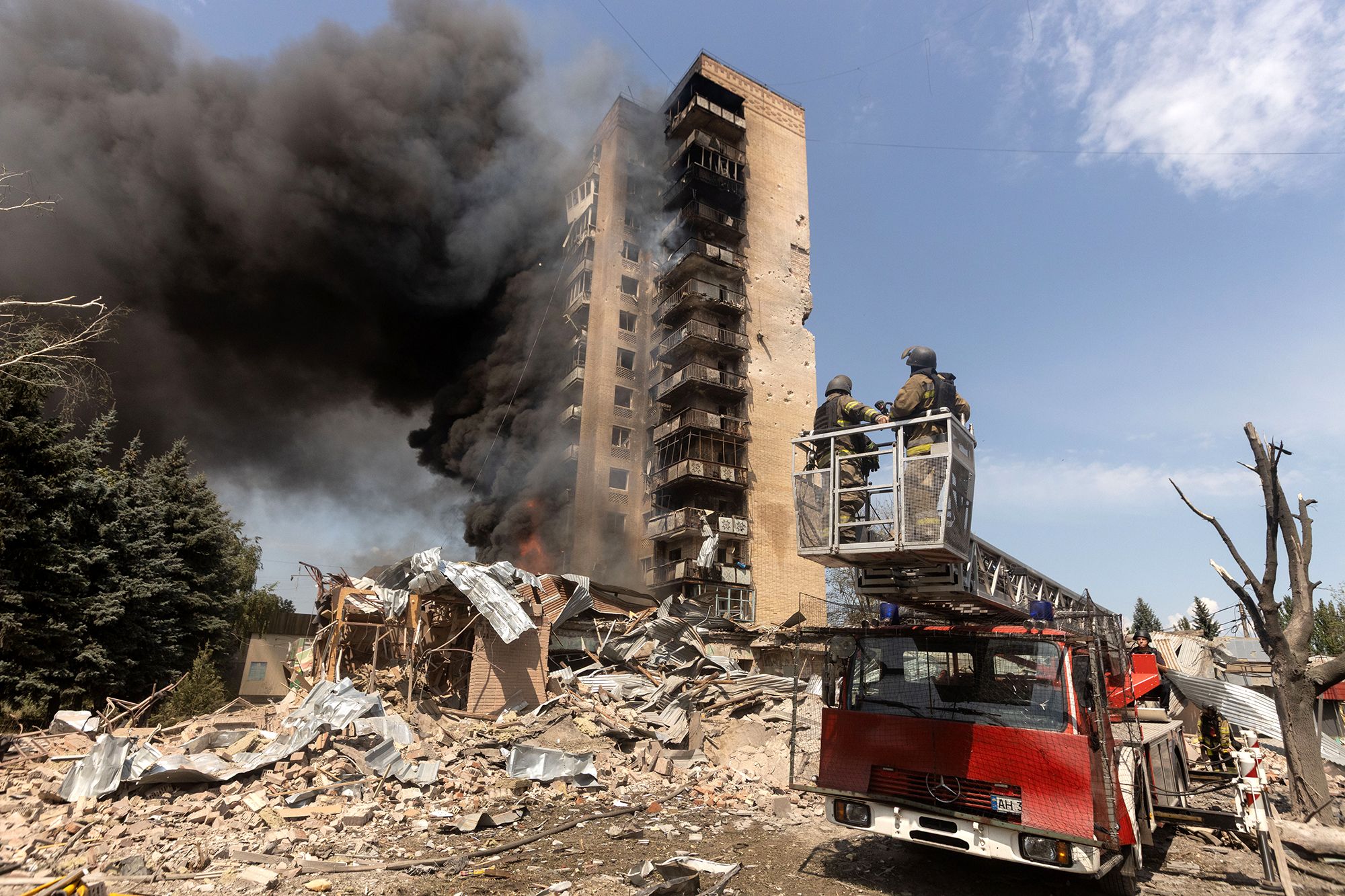
Iryna Rybakova is horribly aware that the front line is inching toward Kramatorsk. Having served in eastern Ukraine for several years, she has watched her units being pushed from one strategic hub after another. But she said the past few weeks have been “insane.” The city remains one of Ukraine’s last strongholds in the Donbas region, but the Russians are getting dangerously close. Nearly all of the city’s bridges have been destroyed, and barrages of guided bombs and drones are now a daily reality. “The attacks happen dozens of times a day. Dozens of cars, utility buildings, residential buildings, administrative buildings, and garages have been hit; they’re just setting everything on fire,” Rybakova, who serves as a press officer with Ukraine’s 93rd mechanized brigade and is based in Kramatorsk, told CNN on Monday. “Toward the evening and in the morning, almost no one is out and about,” she said. “During the day, there are gunmen everywhere … everyone walks around with a rifle, goes out for a coffee with a rifle, heads to the store with a rifle and so on because drones are everywhere now and you never know. They can strike at any moment.” As the first visit to Kyiv by US President Donald Trump’s envoy Steve Witkoff and son-in-law Jared Kushner came and went Sunday without a major breakthrough, Ukraine is increasingly finding itself on the backfoot in many spots along the eastern front line. It’s a major change in fortune compared to the spring, when Kyiv was liberating more land than it was losing. Jennie Olmsted, a Russia analyst at the Institute for the Study of War (ISW), a US-based conflict monitor, said that while a quick breakthrough is unlikely, there has been a shift. “(The Russians) are conducting continued infiltration missions and are slowly making progress towards Sloviansk and Kramatorsk and are advancing in Kostyantynivka, but at a really slow pace,” she said. Russia advanced or infiltrated into about 124 square kilometers (47.8 square miles) of Ukraine’s territory in August, roughly a quarter of the amount of terrain it seized in the same month last year, according to ISW. ISW has calculated that at their current pace, Russian forces would not take over Donetsk until 2032 — if they can seize it at all. This is a glacial pace, and it comes at a massive cost to Moscow. Western intelligence services estimate Russia is losing some 40,000 troops a month – a rate of roughly 340 casualties for every square kilometer. But unfortunately for Ukraine, Russia is chipping away at the so-called “fortress belt” in the east, a string of four industrial cities that form the backbone of Ukraine’s eastern defenses. The belt is key for defending what remains of the Donbas region, but also for the rest of eastern and central Ukraine. The topography and the population centers, with the roads and railroads that connect them, create a natural barrier before the less defensible, sparsely populated flat plains to the west. The concern is that if Russia were to break through here, it could then advance deeper into Ukraine at a much faster pace. That’s why Ukraine has spent the last few years pouring resources into fortifying the cities that form this defensive line: Sloviansk, Kramatorsk, Druzhkivka and Kostyantynivka. The fortress belt has slowly eroded over the past four and a half years. Its southernmost anchor, Kostyantynivka, has now been effectively lost as a stronghold. The Russians have spent almost a year trying to seize it and, while pockets of Ukrainian resistance remain in the north of the city, any operational value for Kyiv is long gone. It’s a recurring theme along the front lines. The Russian military cannot take over cities and towns in a quick offensive that leaves most of the infrastructure intact. Instead, Moscow wages slow, grinding warfare that renders them uninhabitable. It took Russian forces nine months of fighting to seize the nearby city of Bakhmut and nearly two years to take Pokrovsk, another supply hub. By the time they managed to gain full control, the two cities were mostly destroyed – and their strategic value to Ukraine lost, Olmsted said. Even so, each small gain made by Russia carries major propaganda potential. Russian President Vladimir Putin has repeatedly made it clear, including over the weekend, that he is not willing to give up on his war goals in Ukraine, which include seizing all of the Donetsk and Luhansk regions. Russia already occupies about 81% of Donetsk and almost all of Luhansk. Moscow said in April that it had managed to seize the latter in its entirety, but Kyiv says it maintains some pockets of control. According to Kremlin aide and negotiator Yury Ushakov, Putin told Witkoff and Kushner that the Russian army was making “tangible advances” on the battlefield and that it would soon achieve its objectives there. CNN has been unable to verify the claim but it points to the importance of Russia’s information war. Putin has reportedly said he expects Russian forces to seize the remainder of the two regions by the end of the year (after his reported 14 previous deadlines to do so came and went). Laying the ground According to the Ukraine-controlled Donetsk regional military administration, nearly 93,000 Ukrainians, including more than 4,800 children, are still living in the areas that remain under Kyiv’s control. But life is becoming increasingly difficult there. Hennadiy Yudin, a police officer with the “White Angels,” a special unit which helps the military evacuate civilians from frontline villages, said it was now impossible for his officers to drive into the town of Dobropillya and neighboring villages. “The military are evacuating people on foot and our guys are picking them up about 10 kilometers from Dobropillya – that’s the closest we can get. Otherwise, evacuation is completely impossible there; the whole area is mined and the number of drones is just insane,” Yudin told CNN. Rybakova told CNN there are still many civilians living in Kramatorsk, although she said she expected the situation to change. “Life is still going on. (The authorities) haven’t imposed a curfew yet … this had a huge impact (in towns further to the east) – all the businesses started leaving. They say they’ll be imposing one soon,” she said. Kramatorsk has long served as a strategic rear point for the Ukrainian units serving along the eastern front lines – and as a place to which exhausted troops can retreat for a few days of rest before their next mission. But that is no longer an option. “There’s shelling here every day. Guided bombs, a massive barrage, eight at a time,” Rybakova said. “Just last night, they bombed the house where I used to live. We moved out of there a few months ago and it’s just completely destroyed there now.” As Russia continues to inch towards these cities, the remaining residents fear Moscow is laying the ground for a future attack. “They are setting conditions and preparing the battle space for offenses against Sloviansk,” Olmsted said. “They’re really trying to degrade Ukrainian logistics and defenses in the area, and they are making it difficult for Ukrainian forces to get logistics up to their forward positions, and in the city.”
Topics in this story
Gathered from external sources. Rights to this text belong to whoever originally published it.