Oil-covered debris travelled more than 5,000 miles from Brazil to Florida, revealing how plastic can carry pollution across oceans
Oil-covered plastic bottles, glass containers and rubber fragments found on Florida beaches in 2020 have been traced to a major oil spill off Brazil's
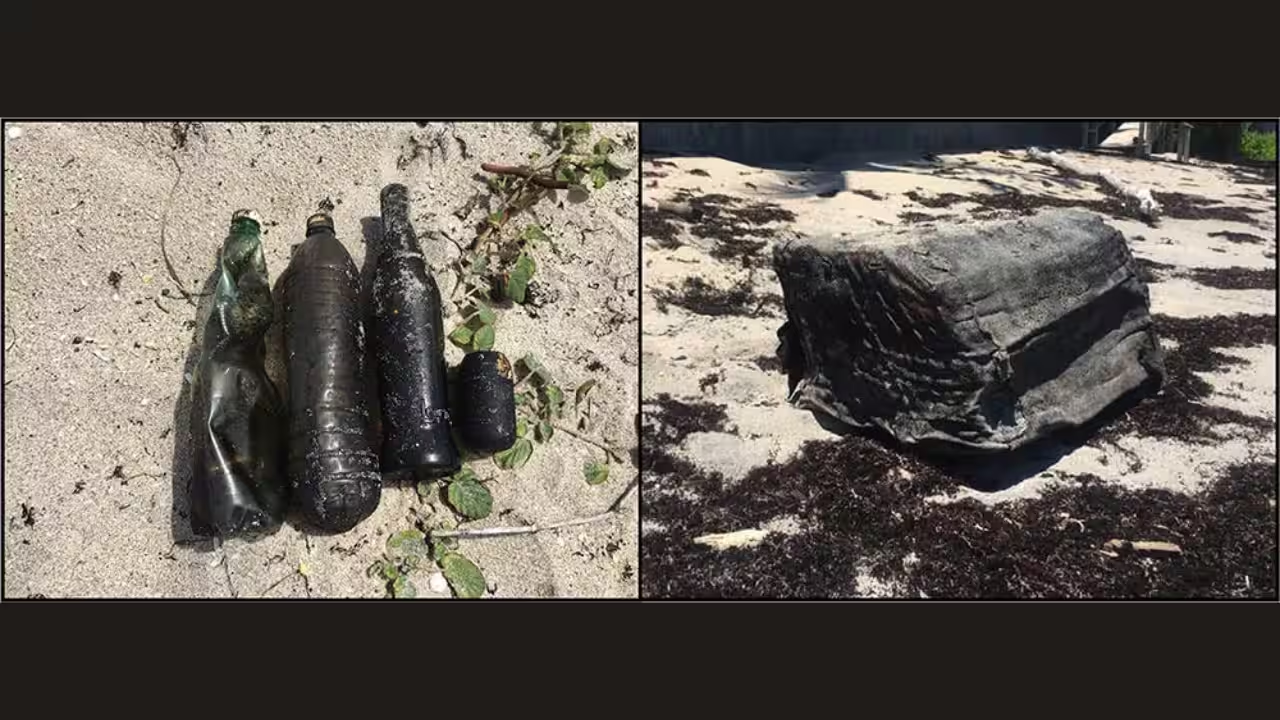
Oil-covered plastic bottles, glass containers and rubber fragments found on Florida beaches in 2020 have been traced to a major oil spill off Brazil's coastline in 2019, revealing how marine debris can carry pollution across entire ocean basins. Scientists from Woods Hole Oceanographic Institution and Northeastern University found that petroleum residues travelled approximately 8,500 kilometres (more than 5,000 miles) over 240 days before reaching Florida. According to the study published in Environmental Science & Technology, titled ‘Long-Range Transport of Oil by Marine Plastic Debris: Evidence from an 8500 km Journey’, ocean-current modelling and chemical fingerprinting to establish the connection, highlighting how floating plastic waste can extend the reach of oil pollution far beyond its source.How did oil-covered debris reach Florida beaches from thousands of miles awayThe investigation began when members of Friends of Palm Beach, a non-profit organisation involved in cleaning Florida's coastline, noticed an unusual increase in debris covered with black residue. From late May through September 2020, volunteers found plastic and glass bottles, along with large rubber fragments, arriving on beaches in Palm Beach. The bottles carried labels in Portuguese, Spanish and English, with some identified as consumer products from South American and Caribbean countries. The researchers noted that there was no known local oil spill during the period under investigation.The scale and persistence of the discovery made the incident unusual. According to the research paper, between 10 and 12 residue-coated items were removed during daily beach clean-ups at the height of the event in June and July 2020. The number subsequently declined to between one and three items by mid-September. Friends of Palm Beach shared photographs and observations of the debris online, attracting the attention of researchers. The organisation's observations became an important starting point for the investigation, allowing scientists to examine an environmental event that might otherwise have remained unexplained.Scientists trace Florida's oil-covered debris to Brazil's 2019 oil spillThe researchers investigated whether the petroleum residues could have originated from an oil spill that affected more than 3,000 kilometres of Brazil's coastline between August and December 2019. The incident was described in the study as the worst oil spill in Brazil's history. Oil contamination had been reported along the country's coastline, but its precise source remained unresolved. The researchers considered whether some of the petroleum had attached itself to floating marine debris and travelled towards Florida through ocean currents.To investigate the possibility, the team used ocean-current simulations to reconstruct potential routes taken by floating objects before they reached Florida. The researchers also examined historical drift-bottle experiments conducted in the Western Tropical Atlantic and Caribbean Sea. These experiments had previously recorded bottles released north of northeastern Brazil reaching southeastern Florida after travelling between 4,600 and 5,700 kilometres. The combined modelling and historical observations supported the possibility of long-distance transport. The researchers estimated that the journey from Brazil to Florida took approximately 240 days, consistent with the timing of the two pollution events.Chemical tests link Florida's oil-covered debris to Brazil's 2019 oil spillOcean-current modelling alone could not establish the origin of the black residue. Researchers therefore conducted detailed chemical analyses of samples collected from the Florida debris and compared them with oil samples previously obtained from Brazil's 2019 spill. The investigation used several techniques, including gas chromatography, mass spectrometry and petroleum biomarker analysis. These methods allowed the team to compare the chemical composition of the residues and identify similarities between the samples.The results showed that several Florida samples matched the Brazilian oil samples. In particular, samples labelled FOPB-01, FOPB-02, FOPB-05, FOPB-08 and FOPB-09 showed evidence linking them to the 2019 spill. However, the researchers did not find that every sample had the same origin. FOPB-03 had a different chemical composition and was considered unlikely to have come from the Brazilian spill. The chemical findings, combined with the oceanographic evidence, provided the researchers with evidence that petroleum residues had travelled across the Atlantic while attached to floating debris.What is petroplastic, and how can it transport oil pollution across oceansThe findings highlight the interaction between plastic waste and petroleum contamination in the marine environment. Oil released into the ocean generally undergoes weathering through processes such as evaporation, dissolution, sunlight exposure and microbial activity. These processes usually limit how far spilt oil can travel. However, when petroleum residues attach themselves to floating plastic and other debris, they may remain in the marine environment for longer and move across much greater distances.WHOI chemical oceanographer Christopher Reddy described the process as an additive contaminant effect. In the institution's January 2026 announcement, he said: “Plastic doesn't just pollute on its own—it can act as a vehicle for oil, transporting petroleum contamination across oceans.” The researchers used the term “petroplastic” to describe this interaction between plastic pollution and petroleum contamination. Their study demonstrates how debris originating in one region can carry pollutants into another, creating environmental consequences beyond the location of the original spill. The researchers also noted that further investigation is needed to understand how floating debris protects attached oil from the processes that normally break it down.The study, Evidence from an 8500 km Journey, was led by Bryan D. James and published in Environmental Science & Technology, volume 60, pages 2649–2661. It concluded that floating marine debris can facilitate the long-distance movement of oil pollution, demonstrating how contamination originating in one part of the ocean can have consequences across national and regional boundaries.You use AI every day. Now get your AI Quotient. Take the AIQ test.
Topics in this story
Gathered from external sources. Rights to this text belong to whoever originally published it.