Italy's students take to streets over cost of living, dockworkers block arms trade
Tens of thousands of people, mostly students and workers, took to the streets across Italy on Friday to demand higher wages, better public services and
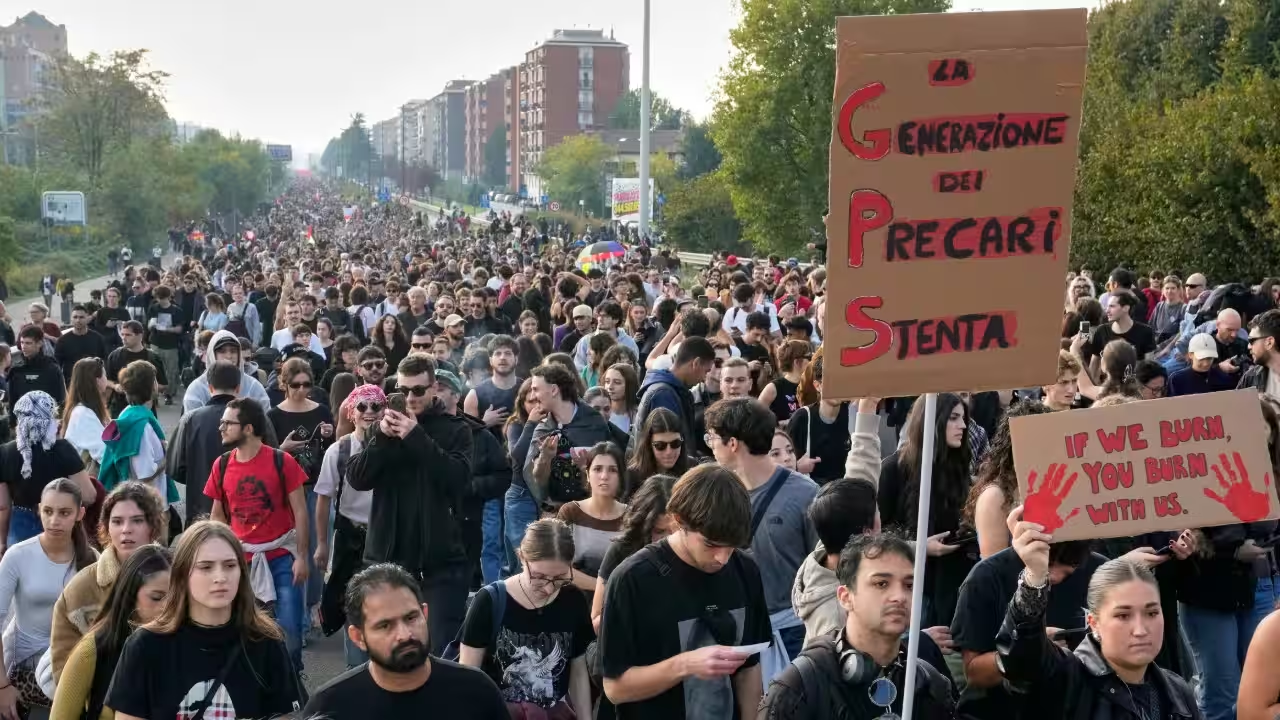
Tens of thousands of people, mostly students and workers, took to the streets across Italy on Friday to demand higher wages, better public services and relief from rising living costs. They also opposed increased military spending and the use of ports for arms shipments amid conflicts in the Middle East and elsewhere.The demonstrations were held in more than 40 cities as grassroots union Unione Sindacale di Base (USB) called a 24-hour general strike. The action was part of a wider international campaign by dockworkers against the transport of weapons through ports and for better working conditions.The protests were largely peaceful, despite clashes earlier this month in which demonstrators fought with police, looted shops and vandalised property. In Turin, however, police used a water cannon to push back students and left-wing activists who approached security cordons around the prefecture building.In Rome, a large march passed near the Colosseum. Protesters said they planned to put up tents and stay there over the weekend. Some rubbish bins were placed across streets and set on fire. In Milan, demonstrators marched onto the city's ring road before ending their march outside the Politecnico di Milano university.In Genoa, around 15,000 port workers, students and other demonstrators entered the port. They protested against the use of ports for arms shipments and highlighted the deaths of seafarers in conflicts stretching from the Gulf to the Black Sea.The Italian demonstrations coincided with strikes and protests in several other countries. Unions in France, Italy, Greece, Spain, Turkey and Morocco had jointly called for an end to wars in the Middle East, including the conflict in Gaza, and “an end to the militarization of ports.”“Ports must not be used for the transport of weapons, ammunition, military equipment and troops,” the joint statement said. “Dockworkers do not work for war!”Organisers said more than 100 ports across several countries had joined the campaign. The action was expected to affect operations across Europe, the Mediterranean and North America.In Greece, dockworkers' unions called a strike at Piraeus, the country's largest port. A separate seafarers' strike over pay, working conditions and safety also kept ships docked at several ports, disrupting ferry services.Giorgos Gogos, president of the Dockworkers Union of Piraeus Port Authority, said: “We don’t want to participate in any war, all around the world. We don’t want our ports to be hubs of military material, transferred so as to kill people.”In Turkey, protesters gathered outside Istanbul's Haydarpasa port under a banner reading: “No to war, no to armament!”In France, the CGT ports and docks federation called a one-day strike at major ports, including Le Havre, Marseille, Dunkirk and Rouen. It opposed what it described as the militarisation of port facilities under European policies and French government budget proposals that it said threatened social protections.The scale of disruption remained unclear, with participation expected to range from full-day strikes to shorter walkouts and demonstrations. In Italy, the general strike caused less disruption to transport than anticipated after the government ordered transport workers back to work.Supply chain management company C.H. Robinson warned clients of possible operational disruptions and shipment delays. However, experts expected the impact on global supply chains to remain limited.Marcus Baker, global head of marine, cargo and logistics at insurance broker and risk adviser Marsh, said a 24-hour strike was unlikely to significantly disrupt global trade, although it could affect perishable goods and time-sensitive shipments.He said the action would further complicate supply chains already under pressure from Middle East tensions, climate-related events including El Niño, restrictions affecting the Rhine and Panama Canal, and shifting tariffs.Judah Levine, head of research at online shipping marketplace Freightos, said the strike could worsen congestion at ports such as Genoa, where vessels already face waits of one to two days for a berth.Ed Anderson, a professor of supply chain and operations management at the University of Texas' McCombs School of Business, said the protests were unlikely to cause outright shortages.“Just one day is not that much in terms of disruption,” he said.You use AI every day. Now get your AI Quotient. Take the AIQ test.
Topics in this story
Gathered from external sources. Rights to this text belong to whoever originally published it.