In 2012, The Simpsons co-creator Sam Simon funded a Sea Shepherd ship; it later helped recover a reported 72 km of illegal nets during a 110-day poacher chase
Rest of World News: In 2012, The Simpsons co-creator Sam Simon financed a Sea Shepherd ship that removed 72 km of illegal nets and participated in a historic 110-day chase of poachers. Discover how this initiative impacted ocean conservation.
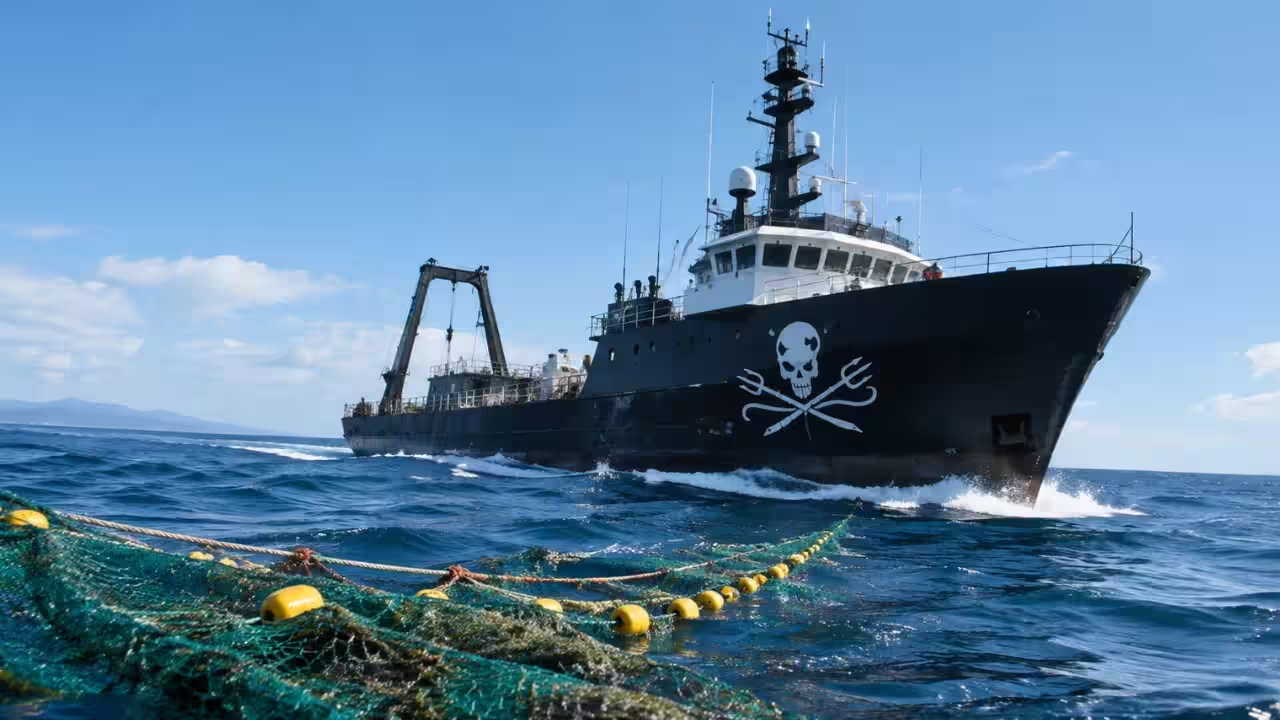
This transition occurred near the end of 2012 when Sea Shepherd Conservation Society bought a former research ship owned by the Japanese government via a Delaware shell corporation called New Atlantis Ventures LLC. This corporation was listed on the documents as the owner of the ship while the involvement of Sea Shepherd was hidden, according to ABC News. After the purchase, a Japanese crew sailed the vessel to Australia and handed it over to Sea Shepherd. It was initially renamed New Atlantis, then publicly unveiled in Hobart, Tasmania, in December 2012 as the MY Sam Simon. It was renamed for Sam Simon, who co-created The Simpsons and had provided the money to buy the ship, according to his biography on the Television Academy's website.A television writer turned his royalties toward ocean conservationBefore joining Matt Groening and James L. Brooks in producing The Simpsons in 1989, Simon was already rich from writing scripts for shows such as Taxi and Cheers. Simon left the show after its fourth season but kept his executive producer credit, which earned him dollars in royalties over the years. In his later years, he channeled most of his money into animal-related charities like PETA, Save the Children and the Sam Simon Foundation. Through his connection with Paul Watson of Sea Shepherd, he decided to finance a boat for the group. The cost of MY Sam Simon was around $2 million, a price mentioned by media sources like The Guardian through Common Dreams and other coverage associated with Sea Shepherd.The ship's first mission targeted a whaling fleet's fuel supplyFirstly, the MY Sam Simon’s maiden voyage was utilized for targeting the Japanese whaling ships in the Southern Ocean under the mission called “Zero Tolerance,” as per Sea Shepherd’s own history of campaigns. They located the refueling vessel of the whaling fleet, Sun Laurel, and attempted to disrupt fuel transfers between this vessel and the harpoon vessels, as described by Sea Shepherd Australia. During the chase, there was a report of diesel leakage from the tanker, which they captured on video. As per reports in the media from ABC News about the 2012-2013 Antarctic season, the MY Sam Simon was working along with two more Sea Shepherd vessels, namely Steve Irwin and Bob Barker, following the Japanese whaling factory ship Nisshin Maru and trying to obstruct its refueling by February 2013.Operation Icefish sent two ships after six illegal trawlersIn December 2014, the two ships left New Zealand and Australia for a mission called “Icefish”, which was meant to serve a single purpose. The goal of the mission was to hunt down six fishing vessels labeled as the “Bandit 6” by Sea Shepherd, which were illegally fishing Patagonian toothfish using gillnets in the Southern Ocean, which was a practice outlawed by CCAMLR, the organization that manages the fisheries of Antarctica. On December 17, 2014, the Bob Barker stopped a ship belonging to the Bandit 6 fleet, the Thunder, as it tried to recover its gillnets from the Southern Ocean, as reported in the Operation Icefish reports of the Sea Shepherd Conservation Society. The Thunder released her gillnets and sped off.The Thunder chase ran 110 days across three oceansAccording to Sea Shepherd, the chase was the longest pursuit of an illegal fishing boat it had documented. Although the Bob Barker pursued the Thunder for 110 days through more than 10,000 nautical miles of the seas, covering the Southern Ocean and traversing two seas and three oceans, the Sam Simon refueled the first boat and gathered evidence during its pursuit, according to the report published by the United States Government Printing Office on Sea Shepherd. The hunt ended on April 6, 2015, when the ship ran aground within the exclusive economic zone of São Tomé and Príncipe in the Gulf of Guinea, as reported by Sea Shepherd in its incident report.Bob Barker, captain Peter Hammarstedt, said the Thunder showed clear signs of having been deliberately scuttled, its hatches tied open rather than sealed, which he suggested was meant to send any evidence of the illegal catch to the bottom of the ocean. Sea Shepherd's own account, corroborated by CNN and NBC News, says the Bob Barker and the ship Sam Simon together rescued all 40 of the Thunder's crew from life rafts before it went down, transferring them to the Sam Simon, whose crew then handed them over to the São Tomé coast guard. That October, the Supreme Court of São Tomé and Príncipe convicted the Thunder's captain and two of its engineers of forgery, pollution, and other charges tied to the sinking.Sam Simon's crew hauled up 72 kilometres of abandoned netWhile Bob Barker gave chase, Sam Simon stayed behind long enough to retrieve the illegal gillnet the Thunder had dropped in the Southern Ocean. Sea Shepherd said the net held toothfish worth an estimated $3 million. Sam Simon, who had been diagnosed with colorectal cancer in 2012, did not live to see the chase's end: he died on March 8, 2015, at his home in Los Angeles.Why gillnets and IUU fishing matterThe scale of the illegal toothfish fishing that produced groups like the Bandit 6 has been documented in fisheries research going back two decades. A 2000 paper in Marine Policy, "The illegal and unregulated fishery for toothfish in the Southern Ocean, and the CCAMLR catch documentation scheme" by David J. Agnew of Imperial College London, found that unregulated toothfish catches had grown so large that by the late 1990s they were running at about four times CCAMLR's regulated catch. The paper reveals that the fishing of Patagonian toothfish had started in the 1980s, and the illegal catches increased fourfold by 1997. It goes on to describe how the CCAMLR Catch Documentation Scheme of 1999 was developed in order to employ trade control to prevent IUU products from getting into the market. Nine years later, Agnew led a larger team, including researchers from Imperial College London and the University of British Columbia, on "Estimating the Worldwide Extent of Illegal Fishing," published in PLOS ONE in 2009, which put the annual value of illegal and unreported catches worldwide at $10 billion to $23.5 billion.Catch the latest World News and Live updates. Download the TOI app.
Topics in this story
Gathered from external sources. Rights to this text belong to whoever originally published it.