Americas First: Trump and Latin America
While Secretary of State Marco Rubio’s recent travels to Colombia, Ecuador and Peru faced criticism regarding legal overreach and geopolitical tension, the article argues that the United States must prioritize deep economic and security partnerships in Latin America to counter China’s growing influence.
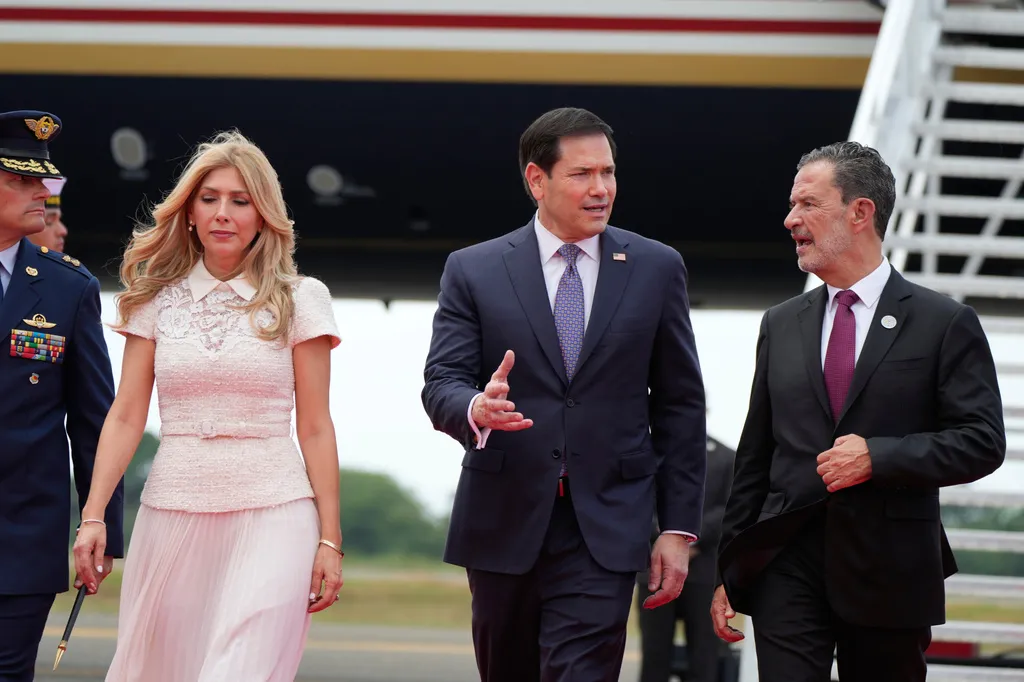
Secretary of State Marco Rubio’s most recent expedition to Colombia, Ecuador and Peru — his fifth trip crisscrossing the region as secretary — drew familiar criticism. Washington has made the Western Hemisphere a centerpiece of U.S. foreign policy, raising questions over legal overreach, anti-China arm-twisting, and the revival of backyard geopolitics.
Some of those concerns about tactics have merit. But Rubio is right to prioritize this neighborhood.
At its heart, foreign policy should keep Americans safe, prosperous and free. No other region touches American lives so directly and at such scale. For decades, Washington “rediscovered” Latin America only when migration surged, drugs spilled north, or a rival power moved in. That entire approach is gets it backwards.
Start with prosperity. In 2024, U.S. trade in goods and services with Canada, Latin America and the Caribbean reached $2.32 trillion — nearly one-third of all U.S. trade. That is more than U.S. trade with the European Union and United Kingdom combined. Much of this commerce moves directly by truck, rail and pipeline across a continent we share.
The region also shapes U.S. security, first, through pressure on U.S. borders. U.S. authorities recorded about 2.2 million southwest-border encounters in fiscal 2024. A year later, the number had fallen to roughly 444,000. Despite the swing, both figures make the point: what happens in Latin America does not stay there. Not to mention, more than one half of all immigrants living in the United States were born in Latin America, compared with only about 27 percent in Asia .
The drug trade follows the same map. Mexico’s Sinaloa and Jalisco New Generation cartels are the principal suppliers of fentanyl and other illicit drugs entering the U.S. Of the cocaine samples seized in the U.S. and analyzed by the DEA in 2024 , 84 percent traced back to Colombian coca. Yes, it is worth debating the effectiveness — and legality — of U.S. boat strikes on suspected drug trafficking vessels. But that debate should not obscure the larger truth: These networks cannot be broken without coordination across the Americas.
Energy tells the opposite story: Geography creates strategic advantage. Pipelines and power lines already stitch the continent together. Canada sent the United States about 4.1 million barrels of crude oil a day in 2024, and the U.S. sent Mexico a record 6.4 billion cubic feet of natural gas per day. North American energy integration cushions global shocks. The reason Americans have felt the financial pain of the Iran war much less than other countries is that only about 2 percent of U.S. petroleum consumption depends on crude moving through Hormuz, nearly 90 percent of which flows to Asia instead.
Critical minerals could become the modern version of that energy advantage. Under the mountains and deserts of the Americas lie major deposits of lithium, copper, nickel, graphite, niobium, and rare earths. Yet China still dominates mining and the chokepoint that matters most: processing. The International Energy Agency says China is the leading refiner for 19 of 20 key strategic minerals . The U.S. has the opportunity to link mines to refineries to factories across the hemisphere — and loosen Beijing’s grip on the industries of the future.
Beijing understands the stakes and actively influences the region. China is already the largest goods-trading partner of Argentina, Brazil, Chile, and Peru and most other countries in the region. Chinese companies have helped build 37 ports . Those ports move containers today. In a military crisis, some could provide eyes, ears and logistical footholds for Beijing .
So Washington is right to pay attention, but it should do so with some humility and consistency. Latin American countries do not want orders to choose between Washington and Beijing. China buys their copper, soybeans, lithium, and shrimp. It finances roads, ports and infrastructure that Americans too often declined to build. It is worth listening to our neighbors when they express wariness over instruments of U.S. realpolitik .
The answer is not another Monroe Doctrine where Washington seeks to dominate the hemisphere. It is to compete, be the better partner, invest more, trade more. It is to help build ports, power grids, and mineral-processing plants — and, unlike the Chinese, respect local workers and the environment.
It is to share intelligence where interests align and strengthen local security forces — as Rubio wisely did on this trip — rather than threatening to fight criminal gangs ourselves. Treat sovereign governments as partners, not squares on a geopolitical chessboard.
America should not seek to control its hemisphere, but it can no longer afford to neglect it.
Anja Manuel is executive director of Aspen Strategy Group and Aspen Security Forum. She is a former diplomat, author and advisor on foreign policy.
Topics in this story
Gathered from external sources. Rights to this text belong to whoever originally published it.