In 2004, a New York truck driver began cutting tiny buildings from balsa wood; 22 years later, his handmade New York of more than 300 sections entered a city museum
Discover the inspiring journey of Joe Macken, a truck driver who handcrafted an astonishing 800,000 miniature buildings representing New York City, now showcased at the Museum of the City of New York.
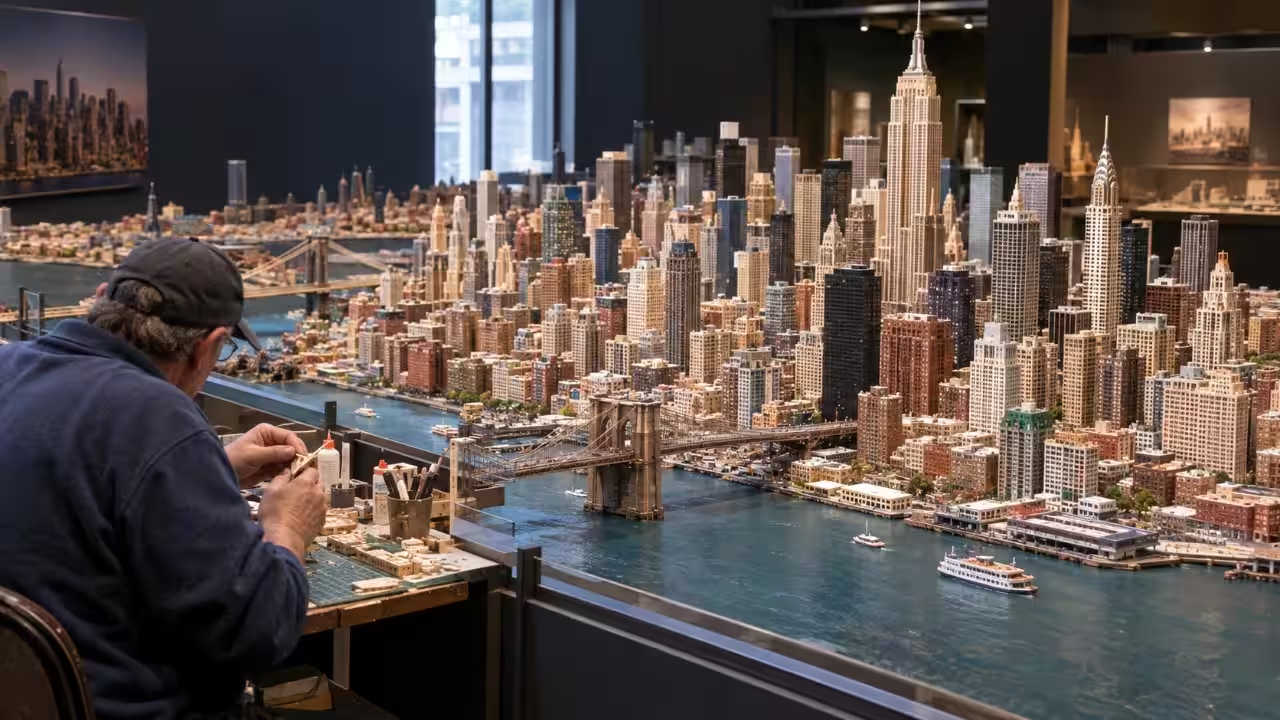
For more than two decades, Joe Macken quietly built another New York in his spare time. A Queens-born truck driver with no formal training in architecture or model-making, Macken began constructing his handmade version of the city in 2004. According to the Museum of the City of New York, he started with the Comcast Building at 30 Rockefeller Plaza and then continued building neighbourhoods, landmarks and other parts of the city by hand using balsa wood, cardboard and glue. By 2025, the project had grown into a vast model covering about 50 by 27 feet and comprising more than 340 individual sections. In 2026, what began as a private project moved into the Museum of the City of New York as the exhibition He Built This City: Joe Macken’s Model.From a childhood memory to a basement projectMacken's fascination with miniature New York began when he was a child. According to CBS News, during a school visit to the Queens Museum, he saw the Panorama of the City of New York, the enormous model created for the 1964–65 World's Fair. The experience stayed with him for years. After moving from Long Island to the Albany area, he eventually began making his own version of the city from memory. The project started modestly, with Macken first building a model of 30 Rockefeller Plaza, better known as 30 Rock. Once that was finished, he made another building, then another, and eventually spent about a decade building out Midtown Manhattan.The materials were purposely simple. The main construction materials were balsa wood and cardboard; foam board and glue were used to create the landscape. There was no architectural studio behind the construction, and there were no professional model makers involved in the process. As he repeated the process, Macken became faster and more experienced. Buildings that once took him hours became more familiar to him. As the model grew from a few buildings to a full cityscape, it came to represent all five boroughs, as well as parts of New Jersey and Long Island.A city built from memoryThe model is not just a miniature New York; it also captures the city as Macken remembers it. That becomes clear from the buildings and landmarks he chose to include. Along with familiar sights such as the Empire State Building, Brooklyn Bridge, Yankee Stadium and the Statue of Liberty, the model features places that have a personal connection to him. The Twin Towers appear alongside One World Trade Center and newer buildings in Lower Manhattan, while the old Kosciuszko Bridge remains part of the miniature city even though it was demolished in 2017. Macken has also recreated one of his favourite Queens landmarks, adding a personal touch to a model that otherwise represents an entire city.The museum describes the sculpture as a personal architectural portrait of New York, combining geographic accuracy with Macken’s own impressions and choices. Binoculars in the gallery let visitors move from a view of the whole city to the smallest details of individual neighbourhoods. The sculpture’s scale makes its size easier to appreciate. Its area is approximately 1,350 square feet, and it consists of more than 300 sections. In this way, even a small residential house becomes a part of a larger system of streets and blocks, while well-known skyscrapers turn into tiny landmarks of a huge handmade environment.From a basement to a museumFor years, Macken’s miniature New York was something he built simply because he wanted to. He worked as a truck driver and spent his spare time adding to the model, piece by piece. The finished creation covers about 50 by 27 feet and is made up of more than 340 sections. It began reaching a much larger audience when Macken’s daughter started posting videos of it on TikTok. Millions of people watched the videos, bringing the basement project to the attention of the Museum of the City of New York.The museum eventually invited Macken to put the model on display. He Built This City opened in February 2026 and is scheduled to run until October 12, 2026. This is the first time the complete model has been shown publicly in New York City, the place it has been built to represent. In the Dinan Miller Gallery, visitors can look across the miniature skyline from above and then move closer to spot individual buildings and familiar landmarks.Part of the appeal is being able to see New York from a viewpoint that is difficult to have in the real city. Instead of moving through one street or neighbourhood at a time, visitors can view the miniature city as a whole and then look more closely for places they recognise. The model is therefore more than a miniature map of New York; it gives visitors another way to look at the city.You use AI every day. Now get your AI Quotient. Take the AIQ test.
Topics in this story
Gathered from external sources. Rights to this text belong to whoever originally published it.