'Everywoman' statue unveiled on Trafalgar Square's Fourth Plinth
Tschabalala Self's Lady in Blue will sit atop the Fourth Plinth in Trafalgar Square for the next two years.
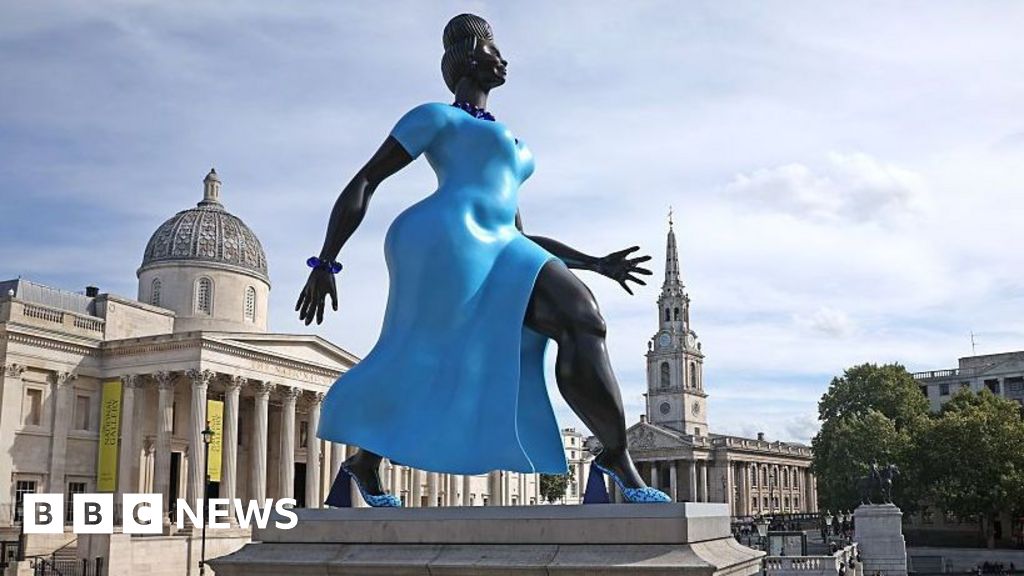
A sculpture inspired by a desire to bring a contemporary "everywoman" to Trafalgar Square has been unveiled on London's Fourth Plinth.
Lady In Blue by New York artist Tschabalala Self, which pays homage to a young, metropolitan woman, is the 16th artwork to feature on the plinth since 1998.
The bronze and blue figure replaces Mil Veces un Instante (A Thousand Times in an Instant) by Teresa Margolles.
The statue has been patinated with a pigment refined from Lapis Lazuli, a semi-precious stone that has been used by artists for millennia.
Self said she had set out to put an ordinary contemporary Londoner on a site more usually associated with statues of monarchs and military commanders.
"My work Lady In Blue will bring to Trafalgar Square a woman that many can relate to," the artist said.
"She is not an idol to venerate or a historic figurehead to commemorate.
"She is a woman walking forward into our collective future with ambition and purpose. She is a Londoner, who represents the city's spirit."
Self was named as the winning artist in March 2024, alongside Andra Ursuta, whose work is due to go up on the plinth in 2028.
Both were selected by the Fourth Plinth Commissioning Group, an independent panel chaired by the writer and curator Ekow Eshun.
She said: "Lady In Blue transforms the everyday into the monumental.
"Tschabalala Self takes the familiar figure of a woman moving through the city and gives her an extraordinary presence at the heart of London."
Justine Simons, the deputy mayor for culture and the creative industries, described the work as a striking addition to a historic part of the city.
Born in New York in 1990, Self works across painting, printmaking and sculpture, often using sewn and printed materials to build up depictions of the human figure.
She held her first institutional exhibition in London and later showed her first major painting series in the city.
The Fourth Plinth was left empty for more than 150 years after money ran out for an equestrian statue of William IV.
The commissioning programme was started by the RSA in 1998 and the first work, Mark Wallinger's Ecce Homo, went up the following year. A new sculpture has been installed roughly every two years since.
Listen to the best of BBC Radio London on Sounds and follow BBC London on Facebook , X and Instagram . Send your story ideas to hello.bbclondon@bbc.co.uk
Date for next artwork to stand atop Fourth Plinth
Winning Fourth Plinth sculptures announced
Trans and non-binary faces unveiled on Fourth Plinth
Topics in this story
Gathered from external sources. Rights to this text belong to whoever originally published it.