Bristol venues strike back against AI generated artwork
Café Kino is the latest venue to ban the use of AI artwork over ethical and sustainability concerns.
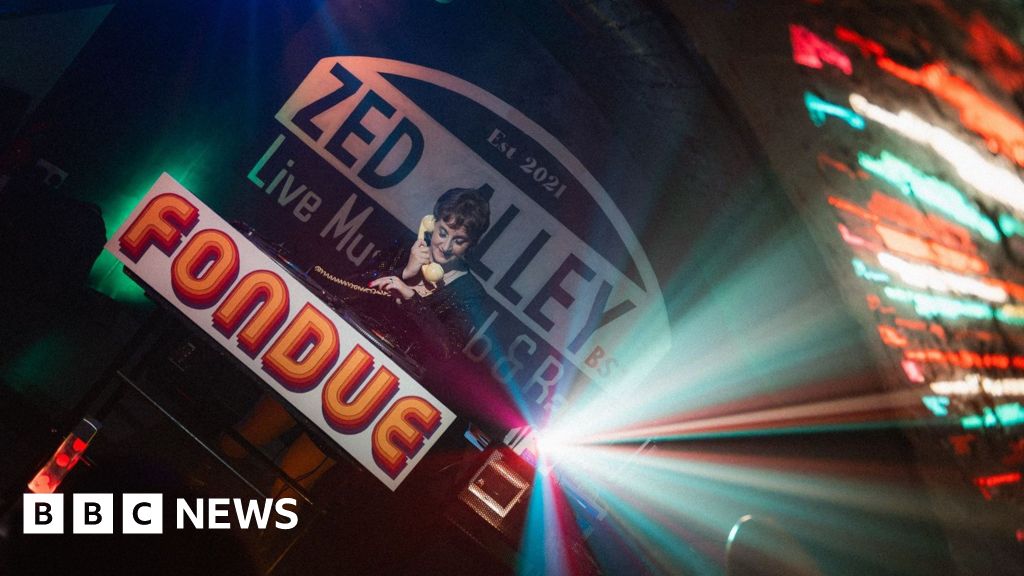
Communities in the West of England are taking a stance against the use of AI-generated artwork.
Café Kino, based in Stokes Croft, Bristol, has become the latest venue to ban AI-generated posters, while the University of Bristol Students' Union has banned AI artwork at its Freshers Week poster sale.
Bristol-based live music venue Zed Alley also banned AI artwork on its social media channels last month, citing ethical concerns and a lack of originality.
"It fundamentally is terrible for the environment, and it takes the work out of the hands of graphic designers," said Chris Illingworth, who manages the venue's social media platforms.
Illingworth said the venue had received an "overwhelmingly positive" response from customers.
As well as ethical concerns, Zed Alley decided to ban AI-generated posters because of their poor performance on social media.
"I think it's partly that it's missing a human touch and by and large, they look very samey," said Illingworth.
Earlier this week, a mural based on AI-generated artwork was removed from the Jolly Colliers pub in Bedminster after members of the community described it as "disrespectful".
A spokesperson for Punch Pubs & Co, which owns the pub, previously said the mural was a "temporary solution" and that they would work with artists to replace it soon.
Bristol artist Jenny Harrison described the situation as "equal parts funny and tragic", due to the mural's location around the corner from Upfest, Europe's largest street art festival.
Harrison said she had noticed a rise in AI-generated posters.
"It's one of those things where I understand that often budget is a big issue for venues, but again, I think it's such a shame when creatives don't support other creatives."
Generative AI learns from vast quantities of material from the internet, which can be used to generate new content.
This visual material can include images and videos, meaning that an artist's published work can be used to train AI models.
"It makes me feel quite uncomfortable," said Harrison.
"When it comes to AI replacing human creativity, that makes me really worried because creativity is such a purely human trait."
Zase, a Bristol-based graffiti artist, said he did not mind people using AI generated artwork.
"I'm not bothered about what somebody else is doing," he said.
"AI threatens loads of many jobs, graphic designers, office jobs, it is what it is."
'Hefty school fines' and 'new bellringers sought'
Internet access suspended at dozens of schools
Redundant workers set up blue glass firm to keep heritage 'alive'
Ruby Saunders, a 21-year-old mathematics student at the University of Bristol, said she is often put off by companies using AI artwork.
"It makes me think that they only value money, like profit over the people," she said.
"Because if they got in an actual artist, it means they care about the artist having a living."
After purchasing a poster at the Students' Union's annual poster sale, which she later realised had been designed using AI, Saunders led a motion to ban AI-generated artwork at the event.
"I felt quite upset that I put my money into something that didn't turn out to be what I thought it was," said Saunders, who is against AI artwork due to ethical and environmental concerns.
"It's just using stolen art, and artists aren't getting credited, so they're not getting the money that they should be.
"As well as that, a lot of people accuse artists of [using] AI when it's actually their own work.
"They have to put in a lot more time and effort to show, 'actually, this isn't AI art'."
Saunders said AI's environmental impact was also a major factor.
"Especially with the recent drought, there's a lot of water usage in AI in general, because they need a lot of water for coolant systems," she said.
"A lot of energy is made using crude oil and non-renewable sources. And as well as that, it produces greenhouse gases. It warms up the whole world."
A Bristol SU spokesperson said: "We are very happy to see our students using our democratic mechanism to bring change to the SU and to the University.
"This motion to ban AI, Stolen and Unethical Art at SU Poster Sale was brought forward and passed at Student Council in term 1 of the 2025/26 academic year.
"We did not run a poster sale this Welcome Week."
Follow BBC Bristol on Facebook , X and Instagram . Send your story ideas to us on email or via WhatsApp on 0800 313 4630 .
Community condemn AI mural as 'insult' to artists
'AI slop' art trail cost £11,688, figures reveal
Gruffalo Granny illustrator says rise of AI images 'worrying'
Topics in this story
Gathered from external sources. Rights to this text belong to whoever originally published it.