I loved capybaras before they were viral - I'm so glad they're having a moment
Filmmaker Sharon Walia explores the craze for capybaras in her latest documentary.
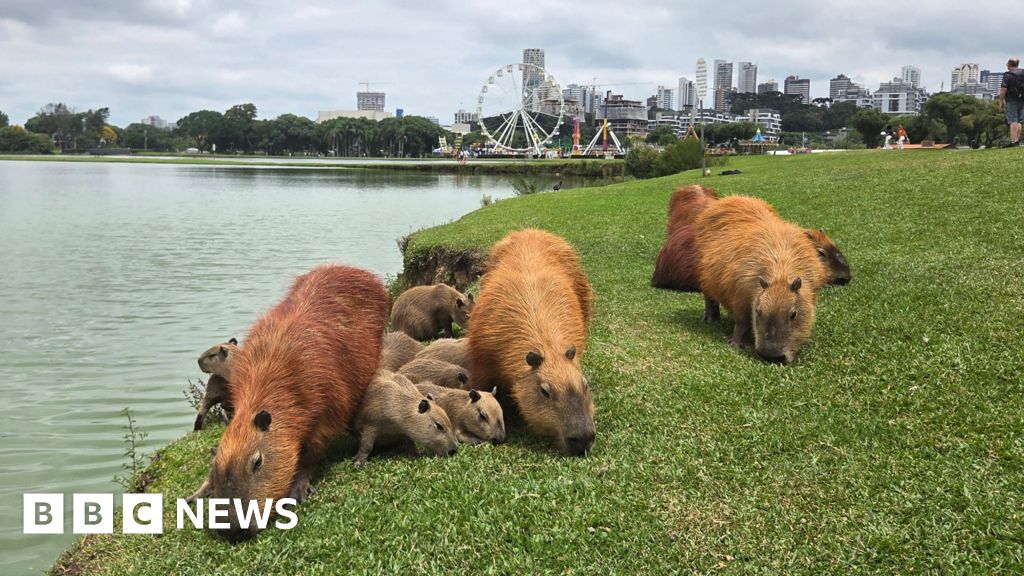
They look like giant guinea pigs, they eat their own poop, and the Vatican once declared that they were fish.
Capybaras - the world's largest living rodents - are unusual animals to say the least, and in recent years - helped by some high-profile capers - the capybara craze has gripped people across the world.
Now, a filmmaker has made a documentary all about them.
"I loved capybaras before they were viral, I've loved them for many, many years, but I'm so glad they're having a moment," says Sharon Walia, who explores the popularity of the huge herbivores in The Route to Cappyness.
"There's merch, there's kids with the school bags, there was the Oscar-winning film Flow which featured a capybara, and they're popping up everywhere on memes," Walia says.
"I don't even think this is a moment, I think this will last because it's been going on for years now and I just think people really, really love them."
The documentary is very different to Walia's first, which was, in her own words, "very distressing" to make.
"I was filming people literally drowning," Walia says of The Movement, which followed firefighter Brendan Woodhouse as he rescued refugees at sea.
She had the idea for the film while working as a journalist for Notts TV, a former local television channel in Nottingham, when she interviewed Woodhouse for a news story.
"He had resuscitated a baby off the Greek coast, it was a refugee family," she says.
"I said I would love to come and film when he was going back out on this mission.
"So I kind of just left my job and picked up a camera and I basically took a huge risk."
The risk paid off, as Walia managed to get her film distributed in cinemas and it was also picked up by Amazon.
By then, Walia knew she preferred making documentaries to filming news reports.
"I always felt with news it was too short," she says.
"I could never get the full story and go into depth like I wanted to. You end up having to cut it because your editor said it was too long. Longform was what I really wanted to do."
So she re-invested some of the money she made into her second film, The Keepers of the Pigs, billed as "the first ever documentary about guinea pigs".
"I wanted to do something very different to the refugee crisis," Walia says.
"I mean, I've always had guinea pigs and then I felt like no-one has ever really uncovered the history of the guinea pig.
"There was a local rescue in Wollaton [in Nottingham]. I went and filmed with them, and that ended up taking me to Peru to find out the history, because that's where they come from."
This film was picked up by Netflix, and again, shown in various cinemas and on Amazon Prime.
Her third documentary is therefore a natural follow-on.
"Capybaras are the world's largest rodent, and people call them 'guinea bigs' because they are like giant guinea pigs," Walia says.
"I love rodents. I think rodents get a bad rep generally, especially rats. I think people sometimes think rodents are dirty, smelly pests, and I would like to change that."
Capybaras are native to South America, and Walia's film begins in Brazil, where they roam free in the wild.
Walia met a man who has befriended 300 capybaras, before travelling to Florida and meeting a woman who shares her home with two of the giant rodents.
Walia also travelled to Japan, where capybaras are a symbol of peace and serenity.
She also filmed capybaras much closer to home, at Wheelgate Park in Nottinghamshire, and met a capybara which escaped from a zoo in Telford .
"It took me to four continents, filming this film, so it's been a bit of an adventure," she says.
The film will premiere at Broadway Cinema in Nottingham on Saturday, followed by further screenings across the UK.
It is also being released in the US, with the premiere being at AMC Cinema at the Walt Disney World resort in Orlando.
"It's such a big achievement for the film, it kind of shows how much people do love the capybara," Walia says.
So why does she think they have become so popular?
"I think we're seeking something to connect us more, and capybaras symbolise kindness, co-existence, they get along with pretty much everyone, sometimes you see them hitching a ride with an alligator in the wild, they're so social," she says.
"So really with this film, I did set out to make a wildlife film and also focus on the viral aspect, but I ended up making a film about wellbeing, connection and slowing down."
Listen to BBC Radio Nottingham on Sounds and follow BBC Nottingham on Facebook , on X , or on Instagram . Send your story ideas to eastmidsnews@bbc.co.uk or via WhatsApp on 0808 100 2210.
Escaped capybara 'probably living her best life'
Guinea pig rescue centre inspires documentary
Topics in this story
Gathered from external sources. Rights to this text belong to whoever originally published it.