In the 1980s, an Australian man left law school to run his family farm after his father died; when drought and bushfires devastated his 670-hectare property, he began selling fallen firewood door-to-door; now his business sells 1 million bags a year
Rest of World News: Peter Chauncy was supposed to become a lawyerHe enrolled in law school, but then his father got sick. Young Chauncy took his textbooks and came home t.
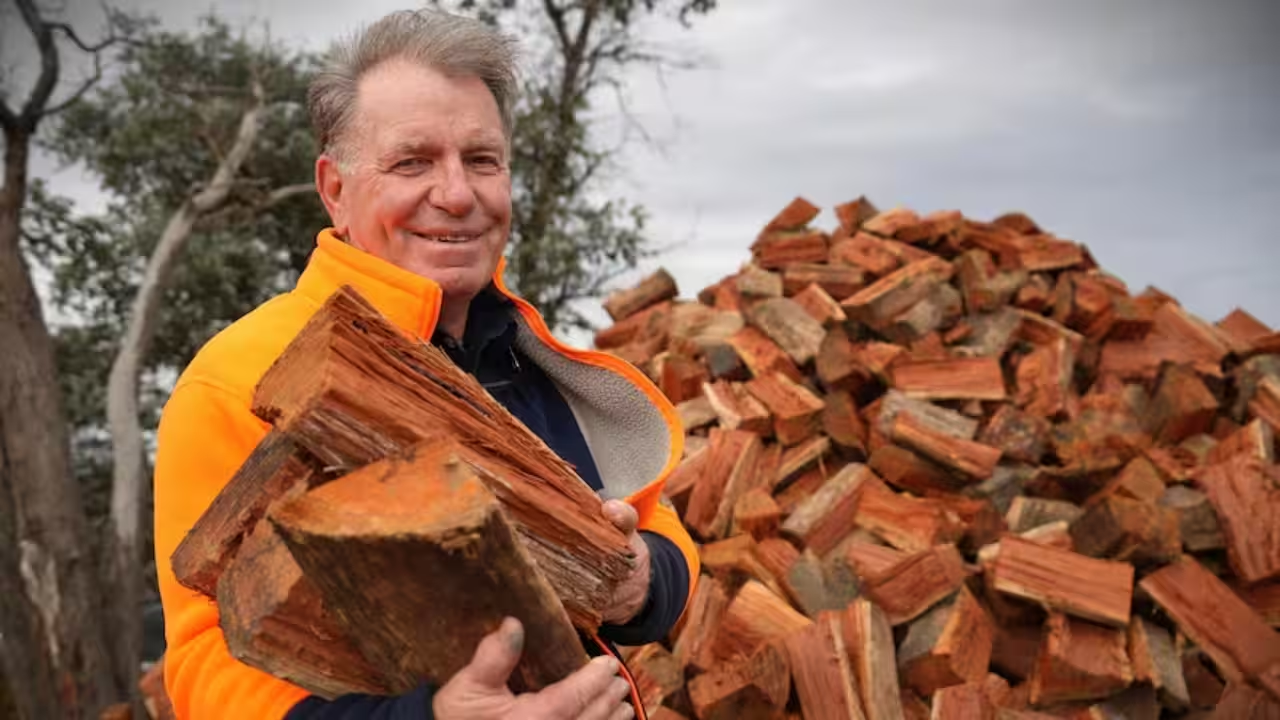
Peter Chauncy was supposed to become a lawyerHe enrolled in law school, but then his father got sick. Young Chauncy took his textbooks and came home to help on the family sheep and cattle farm in Canyonleigh, NSW. His father didn’t survive, so the farm became his responsibility. When he thought the worst days were behind him, nature turned against him. A bushfire tore through the 670-hectare property. They struggled to rebuild. But the tragedy was far from over. Then came the drought, a four-year hammer blow that flattened eastern Australia in the 1980s. The financial crisis loomed over the family. A growing family needed feeding, and the farm alone couldn’t provide it. Chauncy, who was 30 at the time, wasn’t ready to give up. He started a side hustle: selling firewood door-to-door. Four years later, it had grown into a multi-million-dollar business servicing half of Australia, according to a report by ABC News.One tragedy after anotherChauncy wanted to be a lawyer. He enrolled in law school in Sydney. When he thought he was done with country life, the call came. His father was diagnosed with cancer. The family relied on their sheep and cattle farm at Canyonleigh. With his father falling sick, they had no choice but to ask Chauncy to lend a helping hand. The idea was to help the family and then resume his studies in the city. “I’d come home to help out while he was ill, thinking he would recover, and, of course, he didn’t. Then I decided to stay on,” Chauncy told the broadcaster.But the tragedy had only begun. This was in the 1980s. Then a bushfire swallowed the 670-hectare farm. After that, when the farmland was about to recover, severe drought hit all of eastern Australia. “We went into a four-year drought, which I believe was worse than anything we’ve seen since,” he recalled.By this time, the family had already gone through serious financial difficulties. But Chauncy wasn’t ready to give up. “I was going broke … I wasn’t going to give in.” So, at 30, Chauncy started selling livestock along the Hume Highway. He also sold wood from fallen trees and branches found on his property.From doorknock to dispatchInitially, the firewood business was quite humble. He would go door-to-door and sell this firewood. He drove into Sydney’s wealthier suburbs, knocking on doors and introducing himself to people who might want logs. Soon, the business picked up. “After about three weeks, I had enough business where I didn’t have to knock on a door,” Chauncy recalled.When drought ruined his livestock business, firewood kept him going. People always needed heat. The wood came from his land, and with ruthless efficiency, he began turning it into cash. What had been a side hustle evolved into something far larger. Machines replaced his axe. Staff replaced the doorknocking. The business stopped looking like survival and started looking like an empire.“I never said no, which is probably a fault, really, because these days, you name it, we go there,” he told the broadcaster. Chauncy shifted his pitch upwards, trading small homeowners for small business owners, then franchisees, then the big companies. The product also changed. Those branches and fallen timber became precision-cut logs, weighed into 10- and 15-kilogram bags, packed in distinctive yellow packaging.On any given day, 25 trucks could be loading across the country, each hauling 12 tonnes of product. The contracts came from forestry corporations in New South Wales and Queensland. The workforce swelled to include long-time staff who had been cutting wood for 25 years alongside European backpackers passing through on temporary visas.By the 2020s, Chauncy’s yellow bags appeared in 3,000 servo locations across four states. The business was shifting around 1 million bags annually. The doorknock business was bringing in multimillion-dollar revenue. Institutional scale. A man who’d nearly gone broke in the 1980s was now running what looked like an unconventional logistics company.Despite renewable energy expanding and the international fuel crisis, his business is doing well. It is experiencing ‘record-breaking demand’, according to Chauncy.“We had the best April … which is surprising considering we had to put a fuel levy on our products and I would have expected it to have had a fairly big impact on sales,” he said.“Throughout the pandemic, we sold much larger amounts of wood because I think people were at home and everybody seemed to have bought a fire pit.”However, Chauncy says his business would be badly affected if NSW followed Victoria and Western Australia and banned native forest logging.“It’d be a challenge we’d have to face at the time. But at this stage, we certainly have a lot of timber ahead of us from private property,” he said.Over the years, Chauncy has seen it all, and giving up is not something he believes in. So, whatever the challenge is, he will keep moving forward. He also has zero regrets about quitting law school. “Family is everything for me … and that’s what I work for and what I live for,” he said.Catch the latest World News and Live updates. Download the TOI app.
Topics in this story
Gathered from external sources. Rights to this text belong to whoever originally published it.