In 2016, a California contractor and his wife spent three years rebuilding an abandoned Oakland church; then they moved their family into its 3,845-square-foot home
A couple spent three years converting an abandoned Oakland church into a spacious family home, highlighting the trend of adaptive reuse in urban architecture.
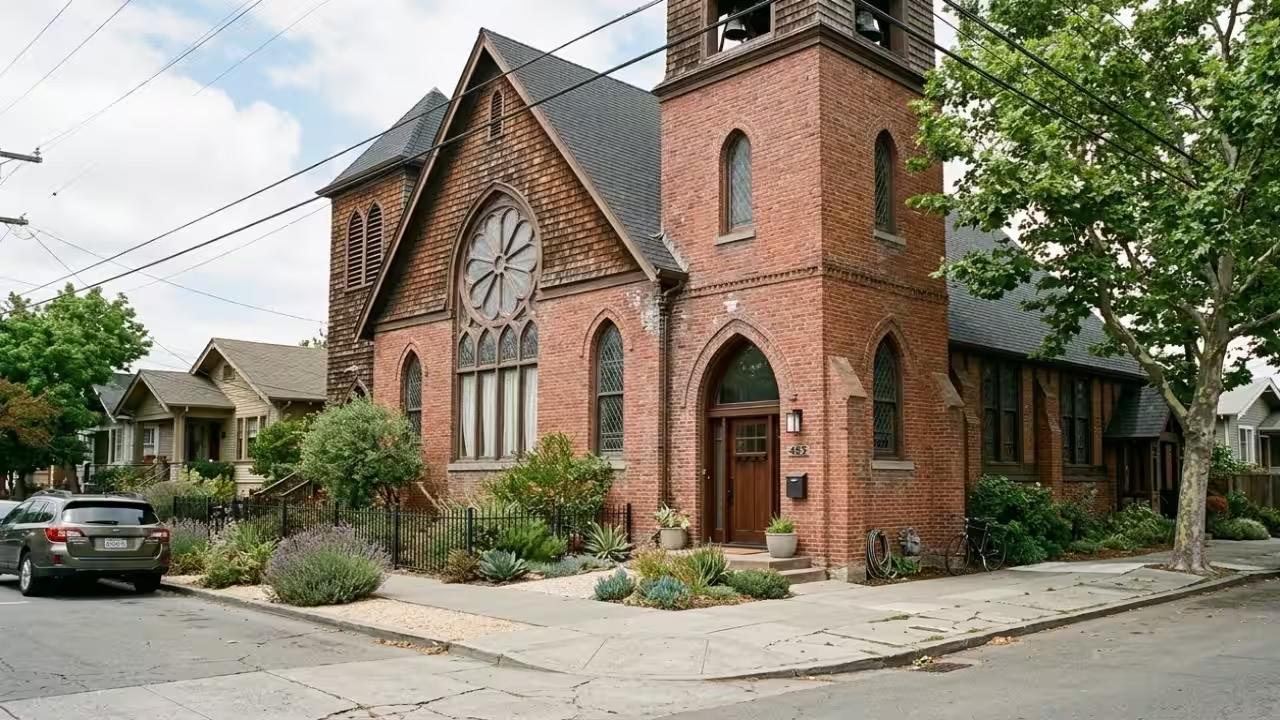
Many of the buildings are left vacant for years while owners and city planners figure out what to do with them, as they are often too big and too specialised for simple commercial use, but also too structurally sound and aesthetically pleasing to be simply demolished.One such structure, now abandoned on 47th Street in Oakland’s Temescal area, was transformed when Jennifer Montague Clark went through its doors for the first time and recognized it as a promise rather than a problem.She and her contractor husband spent three years turning the empty church into a two-storey family home, completing a project that changed about 3,845 square feet of old sanctuary space into more than four bedrooms, three full bathrooms and an upper living area. The conversion of the religious building into a single-family home needed formal approval from local government, and Montague Clark said she worked directly with City of Oakland officials throughout the process because housing was better suited to the narrow residential street than a congregation with no dedicated parking.Reusing rather than replacing a buildingConverting a purpose-constructed religious facility into a private home is part of a larger trend known as adaptive reuse, when an existing building is used for a different purpose rather than tearing it down and creating something new.Projects like this typically follow the general adaptive-reuse principle of retaining a building's original character and materials where possible, even when its use changes entirely. That approach defined a lot of the Oakland project, with the pair maintaining major architectural features of the existing church and reconfiguring the interior arrangement around those characteristics.Montague Clark has said she tried to make the interior of the building, which is naturally vast and open, feel more intimate by incorporating salvaged timber, patterned wallpaper, Moroccan tiles and brass fittings, so that the finished residence is warm, not huge. “It’s more like three houses in one," she says, with the living area up high where the upper reaches of the church formerly were.A unique addition to an existing neighbourhoodTemescal is an older residential section in Oakland, and the city’s own historians have recorded much of its architectural character over decades. For decades, the city's own historians have documented Temescal's architectural character, including through the Oakland Cultural Heritage Survey. The converted church is noticeably larger than the smaller homes typical of the surrounding streets, and it drew attention far beyond the immediate neighbourhood once it went on the market, with prospective buyers describing it as unlike anything else they had seen in the area that year.At the first open house, word of the property spread quickly. One prospective buyer, Zainab Saquib, said she overheard a stranger raving about the house while viewing another property nearby and decided to see it for herself and it lived up to the hype. She was struck by the layout in particular, with a distinctive ground-floor design leading up to the elevated living room. She later said her own real estate agent had called it one of the most interesting houses on the market that year.The value of this project lies not so much in the grandeur of the final house or the novelty of its prior existence as a church, but in the patience required to get there. The willingness of city officials to approve an unconventional use for the property, combined with three years of construction inside a building never meant for daily living, transformed a structure that could easily have been left to decay into a home someone was eager to buy. It now reminds us that an empty church, however unrealistic it may seem at first, is not so much a lost cause as one unfinished.You use AI every day. Now get your AI Quotient. Take the AIQ test.
Topics in this story
Gathered from external sources. Rights to this text belong to whoever originally published it.